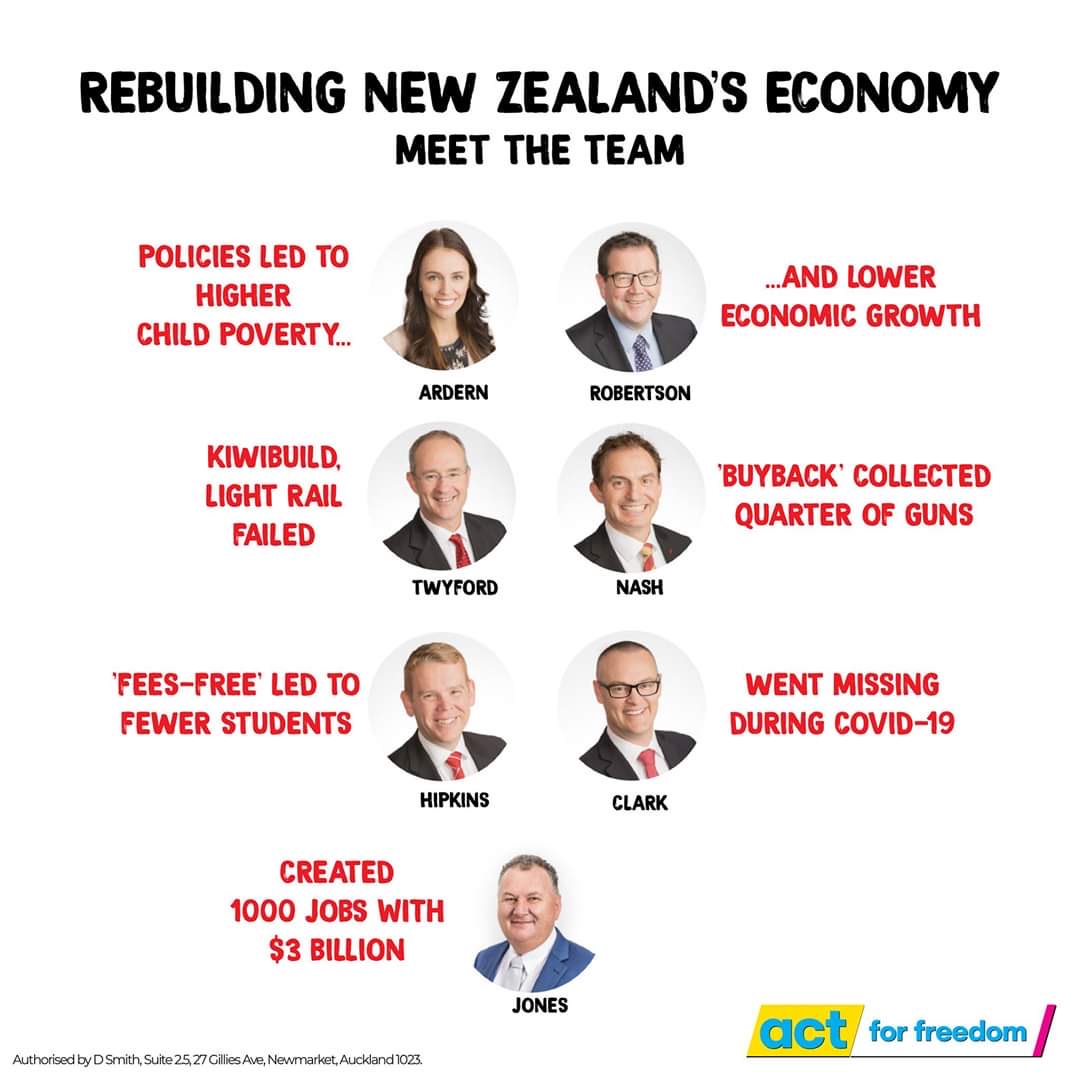
Everyone’s wrong except the PM!

The Herald reports:

Prime Minister Jacinda Ardern appeared to be at odds with more than a few people during her press conference with media this afternoon.

From the New Zealand Medical Association to her own MPs and even the principal of her old high school, Ardern was not too shy to point out her disagreement with a number of parties. …

She also disagreed with comments made by the New Zealand Medical Association, which this morning said the roll-out of the flu vaccine was a “debacle” and “total disaster”.

Kate Baddock, chair of the association, said the issues with the roll-out of flu vaccine meant her practice went without for 10 days while they had 4000 vulnerable people they needed to vaccinate.

Ardern pushed back on these comments this afternoon.

“I disagree with them on that,” she said.

When pressed, she said flu vaccinations started earlier than has otherwise usually the case “for good reason – we wanted to be prepared”.

They started early, but they ran out after one day because they didn’t have the supply line set up.

Defenders of the Government constantly say we should be listening to the medical experts and decry anyone who disagrees with them. SO by their logic, we should be decrying the PM for disagreeing with the NZMA Head.

Ardern also pushed back on comments by Epidemiologist Sir David Skegg, who said if New Zealand had reached the gold standard of contact tracing, the country would be able to come out of alert level 4 now.

“Whilst David Skegg has made that statement, you will have seen others like Shaun Hendy have encouraged New Zealand to stay in level 4 two weeks longer.”

Shaun Hendy is a professor of physics. Sir David Skegg is a specialist epidemiologist and a professor of Preventive and Social Medicine who is globally recognised as a leading expert.

So the PM disparages what he says as an expert epidemiologist, by pointing to the views of a physics academic!

Govt gives $50 million to media

Stuff reports:

Media companies will get help worth $50 million from the Government to help them cope with a huge drop in income during the coronavirus crisis.

Broadcasters will not have to pay transmission fees to state-owned company Kordia to broadcast television channels or FM radio channels for six months, under the first stage of the plan.

The main beneficiaries of that assistance, which will cost just over $21m, will include TVNZ, television channel Three owner MediaWorks, and Maori Television.

Broadcast media will also get the bulk of the benefit from a decision to reduce media companies’ contributions to NZ On Air screen content by $16.5m in the 2020-21 financial year.

The Government will provide $11.1m for “specific targeted assistance to companies as and when needed”.

No doubt the specific targeted assistance will be dependent on how many stories the media company runs that the Government approves of.

We are now going to have basically every media company in New Zealand dependent on the Government’s goodwill. This creates incentives.

NZ 19th for food security

The Economist has published a food security index.

You might think we’d be at the top but are only 19th. Our ratings are:

  • Overall 78.8, 19th
  • Affordability 84.6. 14th
  • Availability 75.5, 14th
  • Quality and Safety 73.5, 13th=
  • Natural Resources and Resilience 73.9, 3rd=

The top 10 are:

  1. Singapore
  2. Ireland
  3. US
  4. Switzerland
  5. Finland
  6. Norway
  7. Sweden
  8. Canada
  9. Netherlands
  10. Austria

The bottom five are:

  • Venezuela
  • Burundi
  • Yemen
  • Congo
  • Chad

Simon O’Connor on the way forward

An excellent analysis by National MP Simon O’Connor:

Like everyone, living in this lock down is a surreal experience. Plans have changed, priorities re-ordered, relationships are being redefined. By order, we are confined to our homes; are restricted in what physical activity we can undertake; have had the media limited; and our businesses closed.

While my work load has increased substantially in the last few weeks as literally hundreds of constituents a day engage with their concerns and queries, it has also provided me some time to reflect on what is happening as a result of this coronavirus/Covid-19 outbreak. To that end, I wanted to write a longer opinion piece discussing some of the decisions that were made here in New Zealand in response to Covid-19, some of the dynamics in play today particularly through media, and then some thoughts on what we need to do in the future.

EARLY DECISIONS

It must be said, up front, that any decision maker(s) works only with the information they have at the time. I say this, as already we are seeing people using current information – or hindsight – to suggest different decisions should have been made. While we must certainly challenge poor decisions so that we learn and improve (as I will), it is not fair to expect any government or health agency to have made decisions based on knowledge that did not exist.

The swift move to a lock down – or level four – was, by and large, good and right. Unlike some countries (for example, the United Kingdom) which announced immediate restrictions with no lead in time, New Zealand had around 48 hours to move between levels three and four. However, even New Zealand’s transition from level three to four lacked some common sense particularly when we consider food, travel, and essential businesses.

That so many cafes, restaurants, food suppliers, and others had to close almost immediately led to enormous food wastage. This was unnecessary. Similarly with travel, and acknowledging government did extend deadlines eventually, there was unnecessary stress placed on people returning to their homes and needing access to the Cook Strait ferries or domestic flights. More time, and again we are only talking 48 hours or so, may well have provided more planning around what was to be deemed essential business and which was not. Instead, we ended up in a muddled situation that has led to much uncertainty, stress, and frustration. It also, arguably, was an early catalyst for a vigilante mentality in some who took it upon themselves to report what they perceived was every breach. Such behaviour damages civil society and relationships between people and, sadly, will not be forgotten once we leave the lock down.

But mistakes were also made, most notably around introducing a quarantine. It took too long, simple as that. There are attempts already to rewrite history and make excuses for why it took so long, but the statistics clearly show that the virus’s sole vector (or avenue) into New Zealand was from overseas. To use a simple metaphor – who defends a castle by calling everyone inside yet leaves the draw bridge down? New Zealand did. To continue the metaphor, government called on everyone to come inside the castle, leave their businesses behind, lock themselves up, and prepare to defend themselves … yet did not pull up the draw bridge and close the border effectively. Nor did we sufficiently test or track those coming into the country. This should have been a priority even if imperfectly introduced. As it stood, little to nothing was done other than requesting forms to be filled out and ‘pinky promises’ made that people would follow the rules. We should learn from this.

WHERE WE STAND TODAY

As figures stand today, New Zealand is doing well from a health perspective and thanks must go to everyone involved from those on the front line to those making the various decisions. However, like everything, it also depends on which figures we choose to look at and who we compare ourselves to. It is particularly to the latter that I want to address this section. Our media in particular have devoted much coverage and sometimes opprobrium to the United States or Italy, and the likes of President Trump or Boris Johnson, yet less comment is made on the likes of Australia or Scott Morrison for example. The former examples certainly make our government response look fantastic, relatively speaking, while the latter begins to raise questions of some of the decisions made on this side of the Tasman.

I think it is fair to say that New Zealand’s overall results are good, but mixed. New Zealand’s death rate is certainly lower than most other countries, which is a blessing. Our testing rates, however, are rather low compared to others. Our hospital system has coped well, but we still appear short of Personal Protective Equipment (PPE) or the equipment is failing to reach the front line in a timely manner.

As I say, if we compare ourselves to the United States or Italy, our death rates, for example, are exceptionally good. Australia, however, has relatively similar numbers to ourselves if we take into account our population difference and yet they have not completely shut down their economy.

I do take on board those saying we must be careful of comparisons. They are correct or rather, we must always make comparison while acknowledging there are nuances and subtleties. However, I must also note that many of these same experts, academics, and commentators remain very happy to compare so as to promote New Zealand’s approach and Prime Minister. If we are going to compare to promote, then it is also correct to compare to critique.

So this section questions and speculates on some of the dynamics in play, particularly what appears to be a deliberate attempt by some to argue for a New Zealand exceptionalism – that is, that the choices made here were exceptional as to the person(s) making them. As readers will anticipate, I do not fully agree with this position. We have done well, but we are not exceptional or being led in a way that is somehow unique.

First, it must be said that no two countries are the same. New Zealand has natural advantages in relation to an outbreak such as Covid-19. We are an island with a low density population; we have a good existing health system; a better demographic spread than many other countries; and a single governmental system as compared to the likes of America or Germany with their confusing federal systems. It is also worth noting that here in the Southern Hemisphere the traditional winter influenza season is not yet upon us.

Secondly, I would question how media have often chosen to report, or contrast, what is happening here as compared to other nations. There seems to be a fascination with what is happening in parts of Europe and in America. Less appears to be said of what is happening in the likes of Australia. I will keep coming back to Australia as our closest neighbour, a critical ally as we progress forward, and as a country that is doing similarly to – and in some cases better than – ourselves.

This fascination often moves towards the macabre which in turn can breed a hysteria which some in media (and across social media) appear to be encouraging. It certainly helps sell the news, but it does not help us as a society approach things calmly and rationally. For example, playing looping videos of supposed mass graves in New York ignores the reality that some of those dying have no loved ones or next of kin present and need burial somewhere. It is without doubt that New York was under-prepared (both at the state and federal government level) and consequently struggling with the numbers of death. However, and again, to hysterically talk of mass graves doesn’t paint the whole picture at best and is deliberately misleading at worst.

Obsessing on the numbers coming out of the likes of Italy or even the United States does nothing if context is not factored in, including aspects I noted earlier. New York State is not an island and, I would suggest, has a confused governance system which makes decision-making slow. None of this takes away from its failures and there must be reporting of what is happening here, yet the way some reports are being constructed appear a rather blatant attempt to weaponise the crisis to promote some leaders and demonise others. There is a distinction between rightful criticism and scapegoating.

There also appears to be a willingness to compare worse case scenarios or predictions with the actual situation and then singularly suggesting the difference is all the work of one person or government. While making comparisons is important, to see media and others so quickly and readily attribute the difference as some sort of messianic action of one person or group is just wrong. If reporting has more to do with promoting certain people than informing the public about the virus, then we have activism over academia, propaganda rather than journalism. We should also be questioning the early modelling – was it accurate? Certainly actions taken by government ‘flattened the curve’ but we must also simultaneously ask whether early modelling was well-considered or instead leant towards the sensational.

We also have the fact that New Zealand’s trajectory is not that much different from other countries; our path is not that exceptional. As I alluded to earlier, Australia’s Covid-19 per capita numbers are similar yet our respective countries have taken different approaches when it comes to the economy. Put simply, Australia has restricted activities whereas New Zealand has effectively quarantined everyone to their homes. Yet, despite the similar approaches and results we have reporting here in New Zealand which lauds Prime Minister Ardern and either ignores or criticises Prime Minister Morrison. We even have memes on social media that suggest, somehow, that a leader’s gender is a material component of success. Put probably too crudely, but many in media and in politics appear more than happy to promote any person who is liberal and ‘progressive’ over leaders who are conservative.

While there has been commendable responses to Covid-19 around the world, from both male and female leaders, the willingness to ignore facts and overlook inconvenient truths in order to promote identity politics should concern all those who believe in democracy and civic society. The leader of Denmark is applauded for her leadership yet almost 300 people have died – 30 times more than New Zealand yet a comparable population, while again, the likes of Australia’s Scott Morrison is ignored as he doesn’t fit the stereotype demanded. Merit of action should be based on decisions made (or not made), the application of reason and science, and of course, the final results. Merit and accolade should never be given simply because of person’s age, gender, belief system, or political leanings. Sadly, we are seeing a commentariat very willing to continue its pursuit of identity politics where the ‘who’ is more important than the ‘what’ and ‘how’.

LANGUAGE IS EVERYTHING

A quick point on the importance of accuracy around language. There is a big difference between dying ‘of Covid-19’ and dying ‘with Covid-19’. Reporting to date appears very loose in language, describing every death as ‘of’ Covid-19. This is just not true with many people having significant underlying conditions which has contributed to their death and who have also had Covid-19. Arguably, continuing to portray every death – here and overseas – as due to Covid-19 leads to poor decision-making and an acceptance by the population of current practices.

MOVING FORWARD

It is all too easy, of course, to reflect simply on the past and the present. What are some suggestions for New Zealand moving forward?

We must begin by enlarging our view to incorporate more than just ‘health’ issues when thinking about Covid-19. The economy is taking a battering. Unlike Australia and some Scandinavian countries, for example, we have effectively closed everything down or facilitated monopolies for those remaining open. We have created a tension between those called ‘essential’ and those who know they are essential. To use Scott Morrison again, his view that every job and worker is essential is correct. It does not matter if you pack a supermarket shelf or mow lawns, your job provides the essential monies you need to look after yourself and family and contribute to society in a way that is meaningful to you.

I think one of the challenges we currently face is that many Kiwis do not yet comprehend the pain that is to come, but not necessarily through a fault of their own. Our current situation is surreal and, for some, even novel. A time off even. They understand there is trouble to come but have not yet seen or experienced it to fully appreciate what is about to happen. It will not be until businesses are allowed to re-open and people find their beloved café, grocer, or hardware store are gone; it won’t be until their own job is lost or someone in their family contracts Covid-19; or when the mortgage cannot be paid or the Visa card paid off. These very real dynamics are, in my prediction, just around the corner and it is a domino effect. As one sector struggles, others will soon follow. We have already seen the substantial cuts in Air New Zealand, the liquidation of Burger King, and the damage in media (with NZME reducing staff and Bauer going under).

But the costs are not simply economic and it would be all too easy to fall into a stereotypical ‘fight’ between personal health and the economy. Other costs are what I would term relational. The lock down has already seen a significant rise in the likes of domestic violence and will likely, as during the GFC, see an increase in suicides. We cannot underestimate the grief and harm for families not able to be with loved ones in their final hours or to attend funerals. In turn, anxiety and other issues relating to mental well-being will increase. Furthermore, social isolation has a particular impact on our elderly, with loneliness having very real social, emotional, and physical implications.

And so, we need to end this lock down as soon as possible. I certainly lean towards sooner rather than later and that any move needs to be both well-signalled with clarity given as to what can and cannot be done. Business needs certainty.

The solution is not more government. There is certainly a role for bail out packages, welfare support, wage subsidies, and so on. These, however, should not be understood as replacements for fully functioning businesses or a proxy for the market. Such supports are temporary and partial at best and rely on businesses actually getting back on their feet … quickly! The risk of continuing a lock down for too long, or even a move to level three with far too many conditions and caveats, is that there will be no businesses to get back on their feet. Similarly, the wage subsidy, while a good and necessary step, will not be that helpful if there are no jobs to go back to.

Other things we must consider:

We need to follow Australia’s lead and have all foreign investment vetted. Now is not the time to have our assets bought out by overseas interests at artificially low cost.We need to work closely with Australia, particularly (but not exclusively) around tourism. This can apply similarly to our Pacific neighbours, however, we must approach this with greater caution and responsibility as any outbreak in those islands would be both devastating and hard to manage.

We need more testing. We test around twelve people in every 1,000. Granted, Australia is testing around fourteen in every 1,000 while Iceland is doing 105 tests per 1,000. We need to do more and not continue to ration. If someone gets sick in a retirement village, we need to be able to test everyone.

We need better surveillance and increase our capacity to contact trace, and to do so fast.

We need to consider the domestic production of some goods and not be completely reliant on one country. Free trade is good, but we also need to ensure we both remain free to trade and that such trade benefits both sides. Ultimately, this is a sovereignty issue and New Zealand must ensure it can continue to operate freely and as it wishes. For example, if we remain dependent on the likes of China for key products, and in the current context the likes of PPE or pharmaceuticals, then we are not as free or sovereign to act as we wish.

In my role as the Chair of Foreign Affairs, Defence, and Trade select committee, I have seen clearly that we also must be very cognisant of the wider political dynamics in play including, but not limited to, China and the United States. There a tussle going on for dominance as well as desire to position well out of the crisis. We need to ask many questions and not be afraid to do so. China’s handling of the situation is rightly questionable as too the supposed current reporting which, as far as I will comment here, is highly suspect. The behaviour of the World Health Organisation (WHO) must be questioned too, including its overtly political approach to Taiwan and the information it sought to provide. The key here is not to involve ourselves in a blame game but rather to ensure we engage with eyes and ears wide open and make our foreign policy decisions accordingly. I am already concerned by those saying we should simply believe what we are told or that to question a government’s decision is xenophobic; no country, including our own, should be afraid of transparency. I also think we need to be aware of rather obvious attempts to play health diplomacy as we have seen with the likes of Russia sending supplies to various countries. Fundamentally, we need to be engaging with our allies more at this time not less. There are those who will use this crisis to create division and I can say with confidence that any such division will not serve the sovereign interests of this country.

Closer to home, we need to get back to a fully operating parliamentary democracy. It is not good for the health of a democratic society to have, effectively, one person making all the decisions, no matter what respect that person has. That media have indulged in attacks on the Leader of the Opposition doing his job should be a particular point of concern – there is a desire, implied or otherwise, to have little accountability or oversight. Similarly, when parliament resumes it should focus near exclusively on everything Covid-19 related. That to date we have seen the government pushing through prisoner voting, residential tenancy changes, abortion, and vaping while the rest of the country focused on Covid-19 is disturbing.

We need to think of how we stimulate and grow the economy. We need to understand that all this money – billions of dollars – currently being spent by government must be paid back by you and me and, importantly, future generations. Ideas that we should contract parts of the economy or tax more are absurd. As Churchill noted on both, respectively: “For a nation to try to tax itself into prosperity is like a man standing in a bucket and trying to lift himself up by the handle” and “the inherent virtue of socialism is the equal sharing of miseries”.

My last thoughts are around terminology and the words we use, notably ‘kindness’. Being kind is the consequence of recognising a problem and acting to address it. As you will expect, different people have different views on what these problems are and how they should be addressed. As Jordan Peterson well articulates, “Kindness is the excuse that social justice warriors use when they want to exercise control over what other people think and say.” It is one thing to say getting someone their groceries is kind, but quite another to say we should freeze all rents for 12 months. There is also the already evident hypocrisy in some who talk of kindness yet demonstrate none when it comes to anyone who opposes them. One need only go online to see the many profiles garlanded with ‘be kind’ images but who go about abusing anyone they disagree with. They are both the biggest talkers of ‘kindness’, yet the least in practice. Kindness is not a foundation for action, it is instead the result of good actions taken for the right reasons. We will be a kind society not because the Prime Minister makes soundbites of the word but because we, as a society, choose to debate what is good and act accordingly.

We also have calls for people to not be political. This is just an excuse to silence people. In these times where government has enormous power, people should absolutely be political. People should question and challenge every decision made. We must remember the enormity of decisions that are literally being made by just a few people. Parliament is suspended; people are locked in their homes; police are stopping people doing what used to be the most simplest of activities; businesses are by in large closed; travel is restricted; certain media have been banned; press conferences are highly choreographed with journalists already protesting their inability to ask questions … the list goes on. If there was a time for people to be political, it is now. So beware anyone saying ‘don’t be political’. What they are saying is that they do not want any critique of their actions.

So much for us all to consider as we move forward. We need to look carefully and as objectively as possible at past decisions, not so much to criticise but to learn from. In the present, we need to understand the dynamics in play that shape the way we think and then choose to act. And, finally, we must anticipate the future and what is in the best interest of all New Zealanders. I am under no illusion that the latter is immensely difficult, but I am also a believer that if we seek what is right – using reason, science, and honesty – we will achieve our goal.

General Debate 23 April 2020

How would NZ look if we were a state of Australia?

I thought it would be interesting to look at how NZ’s Covid-19 stats look compared to the six states of Australia. Here’s how we’d rank if we were a state:

Cases per million people

  1. Queensland 201
  2. Victoria 203
  3. Western Australia 208
  4. South Australia 250
  5. New Zealand 301
  6. New South Wales 367
  7. Tasmania 375

So four states have fewer cases than us and two states have more.

Deaths per million people

  1. Queensland 0.79
  2. Victoria 2.27
  3. South Australia 2.28
  4. Western Australia 2.67
  5. New Zealand 2.86
  6. New South Wales 4.08
  7. Tasmania 14.98

So again NZ would be well down. Worth noting NSW had the cruise ship skewing its numbers.

7 months to get an OIA response from PMs Office

In August 2019 I asked the Prime Minister the following:

Under the Official Information Act I seek the following information – the number of meetings between yourself and either the Director-General of the Security Intelligence Service or the Director-General of the Government Communications Security Bureau between 1 January 2018 and 30 June 2019. This should exclude meetings of the Parliamentary Intelligence and Security Committee.

I’d like the information broken down by month, and by Director-General.

Please note I am not seeking any information about the content of the meetings, or their duration – purely how often they have occurred.

The reason for the request was a tip off that there had been several missed meetings prior to March 2019. So the purpose of the OIA request was to find out if this was correct. As it happens, it doesn’t appear to be. And I wouldn’t even be blogging on the request, except for the fact the PM’s Office initially denied the request on the most spurious of grounds.

In September the PM’s Chief of Staff responded saying they are withholding the information because releasing it could prejudice the security or defence of New Zealand.

This was so outraegous, I did something I have never ever done before. I complained to the Ombudsman. I’ve been using the OIA for 20 years or so and have never before complained, but this refusal was so obviously illegal.

I very deliberately did a very specific request that should have been impossible to decline – merely the number of meetings each month. Not what was discussed, or how long they lasted or what dates they were on. I framed it in such a way it should have been impossible to decline it, yet they did.

In my complaint to the Ombudsman I wrote:

I do not believe this is a reasonable refusal as it is inconceivable simply saying how often the PM has met with the DGs can endanger NZ’s security or defence. I was careful to say I was not requesting any details of content or duration or reason.

There is a public interest in how often Ministers meet with their CEs. This information is routinely released for other Ministers (release of diaries is now proactive). It can show how focused a Minister is on a particular portfolio. To suggest that one can’t even reveal how often the PM has met with the two Director-Generals just because of their agency’s role seems farcical.

I note the SIS itself has been happy to publish how often it has met the Leader of the Opposition (https://fyi.org.nz/request/1814/response/6554/attach/html/2/img%20820144534%200001.pdf.html) and even the duration of these meetings. Also the GCSB provided this information also (https://fyi.org.nz/request/2021/response/6998/attach/3/2014%2010%2014%20OIA%20Request%20Alex%20Harris%20Response.pdf)

My view is that the information I asked for should be provided, unless the Office of the Prime Minister can specifically and credibly explain who releasing it would undermine the security or defence of New Zealand or its international relations.

So the security agencies themselves had released far more detailed info on meetings than the PMs Office was willing to, which shows there decision was in obvious bad faith.

In October the Chief Ombudsman advised me he will investigate my complaint and has written to the Prime Minister. I later discovered that previous PMs had released information more detailed that what I had requested so I was confident of a favourable outcome.

In February 2020 the Chief Ombudsman advised the PM’s Office had responded to him and he is seeking further info from them.

Then in March the Chief Ombudsman advised me the PM’s Office had decided to release the information after his intervention. The information was finally provided here. As I said earlier, the data didn’t match what my tip off said (however it does say a meeting cancelled at the last minute may not have been removed from the diaries so not conclusive) so I wouldn’t have done a blog post on this if they had released the data within 20 days as required by law.

But instead it took seven months and the intervention of the Chief Ombudsman to release the information, despite similar information having been released in the past.

So once again we see the claim to be the most open and transparent government to be rather lacking.

My thanks to the Chief Ombudsman and his staff for their work on this. I felt bad taking up some of their time, but I felt the original refusal was so obviously wrong that it couldn’t stand.

Zero income is beyond pretty bad

Newshub reports:

Labour MP Deborah Russell is facing backlash over remarks described by commentators as “offensive” after she suggested small businesses hadn’t prepared financial reserves to cope with a setback like COVID-19. 

Dr Russell, MP for New Lynn, joined the COVID-19 Epidemic Response Committee by videoconference on Tuesday and raised concerns about small and medium businesses with Finance Minister Grant Robertson.

“We are seeing a number of small businesses are really struggling after only a few weeks in a pretty bad situation, which must speak to the strength of those small businesses going into this lockdown,” Dr Russell said.  

“It worries me that perhaps people went into small business without really understanding how you might build up a business or capitalise in the first place so that you have the ongoing strength to survive a setback.”

Robertson shot her down, saying “I’m not sure I totally agree with that prognosis.”

Dr Russell’s remarks have been described as “utterly tone-deaf” by left-leaning political commentator Chris Trotter, “gobsmacking” by right-leaning commentator Trish Sherson, and “offensive” by host of The AM Show Duncan Garner.

Deborah’s not the first, and won’t be the last, MP to say something potentially valid, in a rather bad way. So I don’t want to turn this into a bashing for her, as I’m sure she regrets her choice of words.

But I do think it is worth analysing two parts of what she said, because there may be others out there who share a misconception.

“really struggling after only a few weeks in a pretty bad situation”

You can’t call a total shutdown with zero income a pretty bad situation. It is an externally imposed disaster (for valid public health reasons).

A pretty bad situation for a small business might be income down 10%. That can be the difference between profitable and break even.

A 20% drop in income is huge. Then you’re talking staff layoffs, or reduced salary for the owners etc.

A pretty bad situation can be roadworks outside your store for a month leading to less custom. Or a new cycleway removes carparks for your customers.

But being closed down for somewhere between five and eight weeks is a disaster. That can drain your cash reserves within weeks.

people went into small business without really understanding how you might build up a business or capitalise in the first place so that you have the ongoing strength to survive a setback.”

I think also shows a lack of understanding of small businesses. Large businesses build up capital. The corner dairy generally doesn’t. The plumber doesn’t. they often start with very little capital and a bank loan.

And again a government mandated shutdown of the economy is not a “setback”. It is a once in a 100 years event.

Soper says bureaucracy wins over business

Barry Soper writes:

It was a victory for bureaucracy over business.

Jacinda Ardern said as much when announcing the lockdown would be extended until midnight next Monday. It was an action, she said, recommended by the Director-General of Health Ashley Bloomfield.

The Prime Minister then went on to show this Government isn’t business savvy. Not one of the people on the Covid Response Cabinet Committee has ever run a business – and it shows.

This is true. The members are:

  • Jacinda Ardern – last worked in private sector at her school fish and chip shop
  • Winston Peters – been in politics since 1978
  • Kelvin Davis – was a state funded school teacher
  • Grant Robertson – student politician and political staffer
  • Chris Hopkins – student political and political staffer
  • Carmel Sepuloni – no private sector experience
  • David Clark – ran a university hostel
  • James Shaw – was employed as a consultant, so closest they have

Few MPs have ever run a business where they have had their own money at risk – have had to put in capital etc.

Should NZ do cash payouts?

Stuff reports:

New Zealanders should each be given a payment of $1500 to stimulate the economy, Kiwibank chief economist Jarrod Kerr says.

“Everything we have talked about to date is about keeping businesses up and running,” Kerr said. “Assisting individuals who have been directly impacted… that’s what we should have been doing. But there comes a time when we move to level two and then to level one and at that point we need to move from saving the economy to stimulating it.”

He said New Zealand would re-enter a new world after the lockdown. One way to put a “Firestarter” under the economy was to direct more money back into New Zealanders’ hands.

That could be done with tax breaks – getting rid of GST for a period or reducing its rate – or by giving cash to people.

Kerr said he was living in Australia in 2009 when the Government sent A$900 bonus cheques to Australians to help save the economy after the Global Financial Crisis. …

United States President Donald Trump has given every adult US$1200 ($2000) and every child US$500.

“I’d say a good $1500 per adult and $500 per child would cover a few months of bills for struggling households,” Kerr said.

That would mean a household of two adults and two children would receive $4000 and a single parent with three kids would get $3000.

“Some families will cover costs. Some will go shopping. Some will save it. It all helps.”

He said New Zealand was in the sort of crisis that no one had seen before. “Normally a crisis takes a lot longer to develop. We are seeing businesses shut down immediately. This is incredibly fast. We need to be incredibly quick to provide relief.”

This is definitely worth considering.

Spending $9 billion in five years times on some trains will do nothing to help the economy when it most needs it – now. If you want to soften the recession, you need to do something that has immediate impact.

So how much would it cost?

Say 1.2 million kids times $500 is $600 million.

Say 3.6 million adults times $1,500 is $5.4 billion.

So all up $6 billion.

General Debate 22 April 2020

Tick tock, tick tock

Stuff reports:

The Serious Fraud Office has released a timeline of its investigation into the NZ First Foundation, showing it will be completed before the September election. 

The outcome of the investigation will determine whether or not the SFO will formally lay charges in relation to the Foundation. …

SFO investigations are known for being comprehensive and lengthy and there was some doubt that an investigation would be completed by election day, September 19.

But an SFO spokesperson told Stuff it had planned to complete the investigation before September and that it’s timeframe had not been altered by the Coronavirus lockdown. 

“The SFO’s pre-lockdown timetable for the investigation in relation to the New Zealand First Foundation would see us completing the investigation before the September election date,” the spokesperson said.

“At this stage, we are progressing the investigation under the current lockdown restrictions and are still on track to complete it within that timeframe” they said. 

Excellent news.

It is my view that there is no doubt laws have been broken (the Electoral Commission’s view also). The only real issue is who broke them, and which laws.

UPDATE: Tick, tock, tick, tock, tick, tock. Barry Soper reports:

The offices of Winston Peters confidante and trustee of the New Zealand First Foundation Brian Henry were the subject of an early morning raid by the Serious Fraud Office in February, before the Covid-19 lockdown.

Investigators took documents relating to the Foundation, which was said by the Electoral Commission to be in breach of electoral law in that it didn’t declare donations that ended up being used for party expenses.

The SFO mean business.

The most expensive campaign ever

FEC filings show Michael Bloomberg spent $1.22 billion on his unsuccessful campaign to win the Democratic nomination.

This is great proof that the influence of money in politics is vastly over-rated. It can help around the margins, but it is no silver bullet.

He received 2.45 million votes in the primaries so each primary vote cost him $499. Staggering.

But the real contest is to win 1,991 delegates to cinch the nomination. He won just 55 so each delegate cost him $22.2 million!

Of course he is worth $55 billion so in one sense he only spent 2% of his fortune. It would be like someone worth $1 million spending $20,000!

Guest Post: Is virus elimination the worst policy decision ever?

A guest post by Barry Brill:

New Zealand is embarked on a world-leading effort to “totally eradicate the virus”, while other countries have settled for containment or suppression or “flattening the curve”.

It is sobering that no other country has yet chosen to follow our lead. While the Prime Minister’s brave endeavour has attracted much international admiration, it may well prove to be the worst policy decision made by any Government in our history.

Eradication requires mind-boggling expenditure of both Government and private sector funds. It will precipitate a devastating economic recession and dole queues not seen since the Great Depression. It requires our borders to remain closed to the world indefinitely and thereby mandates the decimation of our tourism industry.

On a net basis, eradication will cost the lives of many New Zealanders:

 “When economies contract, life expectancy declines, due to, among other things, a rise in poverty, violent crime and suicide. During the global financial crisis of 2007– 09, the suicide rate in the United States increased by 4.8% according to the Center for Disease Control and in Europe by 6.5% according to the World Health Organisation. Philip Thomas, professor of risk management at Bristol University, has calculated that if the UK’s GDP falls by more than 6.4% per person as a result of the lockdown, more years of life will be lost than saved, using [the Imperial College] estimates.”

This quote is from the UK, where Covid deaths are running at 237 per million – a world away from Southern Hemisphere countries where average deaths to date are less than 5 per million. In the Eastern Hemisphere (New Zealand, Australia, Indonesia, Singapore, Taiwan, Japan) the average is only 2 per million. 

What is a QALY?

Most Government expenditure is directed to enlarging the quantity or quality of its citizens’ lives.

Although demand for healthcare may be almost infinite, no Government can spend all its resources in one sector. There are also strong and reasonable demands for welfare, policing, education, defence, housing, transport, justice, etc.

So how can all the necessary trade-offs be planned and allocated on a rational basis, rather than by impulse or by powerful people choosing ‘favourites’?

When a choice must be made between spending marginal dollars on either  (say) a life-saving traffic barrier or an additional Pharmac medicine, that decision-making process must be both objective and consistent. Similar choices arise in allocating limited healthcare funding as between physical health and mental health.  

Throughout most of the world, the solution to these dilemmas is to construct an artifice called a quality-adjusted life-year (QALY) and to assign it a dollar value. This orthodox framework has guided the allocations in Government Budgets for many years.

For New Zealand, the best available QALY proxy is one year’s official estimate of national disposable income per capita – which was $52,500 for the 2019 calendar year. So, if a pending coronavirus epidemic would cost us (say) 100,000 QALYs, it would be defensible for the Government to spend up to $5.25 billion to stop that from happening.

If a Government was not prepared to spend that much on quarantines, it could be criticised for undervaluing human life. And if it spent more than that figure it would be just as bad – because we would be losing even more lives (ie quality-adjusted lives) in other areas than were being saved by the universal quarantine (Lockdown).

Unlimited spend

But has our Government been observing these important disciplines in the Corvid epidemic? Has its unprecedented splurge been proportionate or reckless?  Is it pursuing an expensive cure that will prove worse than the disease?

These are crucial questions that are being asked throughout the developed world. They are especially crucial in this country where the Government has debilitated the economy more than in any other country in the world. But they have not so far occupied much of the attention of the legacy media (or the Epidemic Response Committee) in New Zealand. 

It has been left to a think tank, the New Zealand Initiative, to enquire whether the Lockdown has been a provable over-reaction. Veteran economist Bryce Wilkinson inputs Covid morbidity and mortality data to the 2017 spreadsheet model constructed by five of New Zealand’s leading epidemiologists. His research note is brief and well worth reading in full.

As might be expected, the model’s assumptions have many caveats – and Dr Wilkinson clearly has reservations about the model itself. His purpose is “to begin an exploration of trade-offs, not to provide an authoritative valuation”. The key finding from his modelling:

“spending 6.1% of annual GDP might be justified if it saved the 33,600 Covid-19 deaths epidemiologists advised the Ministry of Health could result were the pandemic left “substantially uncontrolled.” Under the lower projection of 12,600 deaths, spending more than 3.7% of annual GDP could be excessive, even if success was assured.

So, even if the Government was quite sure it could prevent as many as 12,600 deaths from an uncontrolled epidemic, it would not be able to justify spending $11.47 billion (3.7% of $310 billion) to achieve that.

This finding is a bit of a shock. The Government’s wage subsidy alone might exceed $12 billion  and that is just one of a string of expensive initiatives that have been announced. And there are more to come. Clearly, the Government has already way overspent on its efforts to save 12,600 lives.

Impressing the world

In March, the Minister of Health was advised by the model’s authors that 6 modelled scenarios showed an uncontrolled Covid could claim between 7 and 14,400 lives.

The Government did not recognise that the most vulnerable lives (over 70s) have few QALYs left. It did not check the absurd assumptions behind the figures. It apparently preferred the worst case scenario over the most likely scenario – which was close to the 12,600 lives considered by Dr Wilkinson.

Whether the modelling was right or wrong, that formal advice provided Ministers with a clear benchmark of about $12 millionas the upper bound of the range of spending that could be justified. But then the Cabinet took a political decision to zoom right through that benchmark and spend far more.  Suddenly, money was no object. Nor was the Bill of Rights.

How did this happen? If the level and duration of coerced restrictions was not based on a careful balancing of QALYs, then what was its basis? Was it perhaps to extend the crisis out towards the September election?  We simply don’t know.

There was clearly a certain glamour in New Zealand “going where no country had gone before” and being the very first country to totally eliminate a coronavirus. The Prime Minister is well skilled in the politics of drama and the lure of global affirmation.

Did the recurring opportunity for world leadership have a certain ring to it?  Was it the draw of political theatre and the opportunity to stride the world stage?  Perhaps the Prime Minister glimpsed “her nuclear-free moment” yet again?

You can now donate to Stuff

Stuff announced:

Stuff has a long and trusted history of telling New Zealand stories. Through some of our newspapers, that dates back more than 150 years.

Today, we’re seeking your support to keep us telling Kiwi stories for another 150 years. This reliance on our readers is in our DNA; through a history of paid newspaper subscriptions as well as the time you’ve spent with us, which has attracted our advertisers.

Now, as with many other news organisations here and abroad, you can make a direct digital donation too. Donating supports Stuff’s mission to report your stories without fear or favour, and with fierce independence – it directly contributes to powering newsrooms across New Zealand.

This is a sensible move by Stuff. I think more people may donate voluntarily to a media organisation than will pay a subscription for a paywall. Time will tell.

Stuff has many great journalists whose work I enjoy – Dana Johannsen in sports, Tony Wall in investigations, Rebecca Stevenson in business, Henry Cooke in politics, Tom PS in IT, Andrea Vance, Martin van Beynen, Eugene Bingham etc. (non exclusive list).

Five extra days a lot for small businesses

HDPA writes:

I’m so disappointed on behalf of small and medium-sized businesses.

I can’t even begin to think how hard this must be for them – the prospect of trying to last an extra five days. For some, they could barely last four weeks.

Five more days will tip many over.

From the relative comfort and seclusion of lockdown bubbles, I’m not sure enough people realise how hard this will be for businesses.

It’s insulating to have the Prime Minister and the Finance Minister say it’s just two more working days. It’s not, it’s five – which business that has been shut for four weeks would not work all five available days to catch up?

Many retailers would’ve shipped over the weekend. Same with takeaway outlets, same with construction and manufacturing.

This is what happens when no one senior in Government has any experience working in actual small businesses.

The extra five days is a lot. Five more days of zero income.

I think the key is the Health Ministry. I suspect they haven’t been able to get their acts together this whole time. I suspect we were put into level four because our health ministry didn’t have the contact tracing capacity to track down contacts of infected people fast enough

They didn’t have the testing capacity to know where cases were. I suspect we are staying in lockdown because of exactly that same reason.

Ashely Bloomfield admitted yesterday that their contact tracing ability is not at gold standard and won’t be for another week

They’ve had weeks to get ready. They even had the Ayesha Verrall report telling them to sort it out for at least a week. Their inability to do that is costing us a huge price.

The inability or unwillingness of our leaders’ to look across at Australia and see we can achieve the same results while not crippling business is costing us a huge price.

It’s not going to do a lot for economic credibility of the parties of government at election time, when they tell small, medium and even large businesses that all their decisions took into account the plight of business, as that clearly didn’t happen today.

Just means more jobs lost.

General Debate 21 April 2020

Another do as we say, not as we do

Stuff reports:

A cafe at Police National Headquarters (PNHQ) sold coffee to cops during coronavirus lockdown while restrictions to stop the spread of the disease crippled New Zealand’s hospitality sector. 

The cafe, which is on the top floor of the PNHQ building on Molesworth St, Wellington – a short walk from from the Beehive – was closed on April 9 after the rules around it being open were “clarified” by the Ministry of Business Innovation and Employment (MBIE). …

Police staff have visited non-essential businesses that have opened during lockdown and told them to shut their doors.

So every cafe in NZ was closed, except the one in Police National HQ!

Effing incredible.

Winston lawsuit fails entirely

The High Court has ruled in court case Winston Peters brought against the State Services Commissioner, the MSD Chief Executive and two former National Ministers and he has failed on every ground.

This is no surprise. The lawsuit was founded on speculation, not facts, and the hearings showed up how farcical it was.

Not so farcical is this would have cost taxpayers close to one million dollars to defend. The Government must treat Peters no different to any other failed litigant and seek full costs against him. Taxpayers should not have to fund the absurdity of a Deputy Prime Minister suing the most senior public servant in Government.

Some useful extracts from the court ruling:

A significant amount of evidence during the hearing related to Mr Peters’
completion of the application form for NZS. The payment irregularity arose because Mr Peters’ application was processed and payments of NZS were made to him on the basis he was single at the time he applied for NZS. That was an error as, at the time, he had a partner, Ms Trotman. Mr Peters considered the MSD and its form were responsible for the error. The MSD and the Crown defendants considered Mr Peters was responsible for it. I have come to the view that the error arose through a
combination of circumstances. The ambiguous nature of the form, the MSD officer who processed Mr Peters’ application and Mr Peters himself all bear some responsibility for the error which led to the payment irregularity.

So the court has ruled that Peters is partially responsible for the over-payment.

Mr Peters must also bear some responsibility for the resultant ambiguity in the form as completed and the consequent issues that arose. To the left-hand side of question 26 is the definition of partner. If Mr Peters had read that definition, it would have been clear, given that Ms Trotman was his partner, that he should have completed the primary question in question 26 and answered it by ticking “Yes”.

So Peters was not dishonest, he just couldn’t competently read and complete a form!

On 18 March 2014, the MSD sent a standard letter to Mr Peters which included a request that asked him to check the following details:
Relationship Status: You are single.

Clear as day.

If Mr Peters had paid more attention to the letter, he would have realised there was an issue with the MSD’s records regarding his initial application.

Can’t complete a form and doesn’t read his mail!

In closing, Mr Henry accepted that the Ministers’ evidence they did not leak the information was unchallenged. He conceded on behalf of Mr Peters that, in relation to all causes of action insofar as they related to Ms Bennett and Ms Tolley, the claim for damages could not be pursued, although a declaration was still sought.

So they took a lawsuit seeking $2.25 million in damages, without any evidence at all to back his claims.

With respect to Mr Soper, his evidence that, in his opinion, the information was deliberately leaked as an attempt by Mr Peters’ political opponents to damage his credibility and to do what the Prime Minister wanted, which was “to cut out the middleman”, namely NZ First, is speculative. It is not the opinion of an expert based on established fact.

Opinion based on speculation is not the same as facts.

So once again the Government must seek full costs against Peters. There is no way taxpayers should foot the bill for his legal stupidity.

Alert Level 4 extended for five more days

The PM has announced that Alert Level 4 will continue at the end of the initial four week lockdown, until the end of Monday 27 April. So it has been extended for five further days.

NZ will then be in Alert Level 3 for at least two weeks.

US political segments

Lord Ashcroft has some fascinating US polling where votes are divided into ten segments and you can see for each what the major issues are, what they think of Trump and how they’d vote.

The 10 segments (from left to right), and their approval of Trump for each is:

  1. Cosmopolitan Activists 5% Trump approval
  2. Mainstream Liberals 20%
  3. Blue Collar Democrats 43%
  4. Melting Pot Moderates 53%
  5. Faithful Centre 57%
  6. Low Key Pragmatists 57%
  7. Losing Ground 34%
  8. Left Behind & Angry 64%
  9. Republican Mainstream 92%
  10. Fox News Militants 95%

And the Trump-Biden margin for each is:

  1. Cosmopolitan Activists Biden 84%
  2. Mainstream Liberals Biden 70%
  3. Blue Collar Democrats Biden +19%
  4. Melting Pot Moderates Biden +1%
  5. Faithful Centre Trump +20%
  6. Low Key Pragmatists Trump +16%
  7. Losing Ground Biden +21%
  8. Left Behind & Angry Trump 59%
  9. Republican Mainstream Trump 91%
  10. Fox News Militants Trump 95%

The key will be how much each group turns out.

Self-appointed guardians

Martin van Beynen writes:

I live in a small settlement along the coast of Banks Peninsula. If you are driving, there are only a couple of ways in.

Quite a large proportion of our settlement’s residents are over 70 and, unsurprisingly, many have underlying health issues.

A couple of community-minded residents and I recently decided we needed to do more to protect them from Covid 19. We felt too many people who didn’t look very local were driving into our area and possibly spreading the virus.

We didn’t feel confident the police had the resources to conduct the constant monitoring and surveillance required so this is what we did. We got some cones from somewhere, put on some white overalls and masks and set up road blocks at either end of the settlement. We started stopping every car to ensure the occupants had genuine business in our area and weren’t just coming in for a tiki-tour.

Of course I just made all that up but you can imagine what would happen if we had done exactly that. We would have been rightly marched off by the police, charged with some public nuisance offence and ended up in court.

Yep. You’d have the Police moving you on or arresting you within minutes, hours at the most.

As the Government struggled with deciding how to protect the country from Covid 19, the former Tai Tokerau MP  Hone Harawira, who lives in Kaitaia, was taking the bull by the horns.

On March 25 he told media he was organising checkpoints to be set up at the main entry points to the Far North to keep out tourists and non-locals. Checkpoints would be set up on State Highway 1 and State Highway 12 on the West Coast. …

At a time when the most common headline is “Outrage At..” here really was an outrage but we didn’t hear much from the mainstream commentariat or from Labour ministers. It was left to uncool old timers like former Maori Affairs minister Dover Samuels and former National leader Don Brash to take issue with Harawira’s plans.

Samuels pointed to free movement rights and said it wasn’t the time for “grandstanding by the sheriff of Kaitaia”.    

Brash called the moves appalling and said they breached the principle that all New Zealanders should be treated equally by the law.

Harawira’s first road block at Whakapara on SH1 on March 26 did not start smoothly. Volunteers had chosen an unsuitable place for their checks and when police intervened they moved down the road but were allowed to continue.

So the Police condoned the vigilantes.

Pretty damn good testing

I’ve just been tested for Covid-19 (I was negative) and have to say I was impressed with the process, and the speed of it all.

I’ve had a cough and some tightness when breathing for a few weeks. As I hadn’t had a fever over 38 degrees I didn’t meet the criteria for a test. They relaxed the criteria late last week so that if you have any of the symptoms, rather than all of them, you qualify for a test.

My partner had been coughing also so we thought we’d ring up Healthline for advice. This was after 9 pm on a Friday night. Got through quickly to someone. She said she would get a health professional to ring us back as we needed a clinical assessment. We got a call back around 10 pm. As my partner was asleep then I asked if they could call back after 7.30 am Saturday. They did. I missed the call, but they then called back again at 8.30 am. We both answered some questions and they advised up we should get tested and gave us a phone number for testing at Keneperu Hospital.

Called them around 8.45 am and they took down some details and said we could get tested at 10.40 am. Turned up and only had to wait 5 – 10 minutes. Stayed in the car and they asked some questions and then took the swab, and we were out of there just after 11 am.

And then we got the results the next day, on Sunday afternoon.

There were definite issues around the testing early on, but I have to say they seemed to be operating pretty smoothly now, at least for us. To ring Healthline late on a Friday night and to have test results by Sunday afternoon is really impressive.

General Debate 20 April 2020

Political Party Support and Personality during the Covid-19 Crisis

Damian Scarf from Otago University writes:

I am a researcher from the University of Otago. We are conducting a study on the lockdown and political beliefs. The survey takes 15-minutes and, in addition to political beliefs, we measure alcohol consumption, how it has changed people’s perceptions of young people (given the media talks about them being the group breaking the lockdown rules), belief in science, and views on conspiracy theories. We also have questions looking at peoples fear about getting covid-19 and measures of compliance with the lockdown rules. 

The survey link is pasted below. We really need people from across the political spectrum to complete the survey, if you can help with that it would be great.

The survey is here.