Should have known the rules

The Herald reports:

Prime Minister John Key will not pay his “teapot tapes” settlement with public money, his office said, as Speaker David Carter confirmed today to do so would be against Parliamentary rules.

Mr Key said yesterday that it was “pragmatic” to pay a small settlement to freelance cameraman Bradley Ambrose out of his National Leader’s Office budget.

However, his office said today that after taking advice from Parliamentary Service, this would no longer take place.

A good outcome, as even if it was permissible, it was a bad look.

However it is not good that they announced the parliamentary budget would be used, without realising they could not. Staff should have checked in advance, and if so this would have never been an issue.

Young on Little

The Herald reports:

If Andrew Little’s aim this week was to annoy his most important coalition partner, unsettle the markets and horrify his ethnic support base, he had a good week.

I think it was a great week!

He must have realised it wasn’t going so well when Winston Peters described him as indulging in dog-whistle politics – and it wasn’t an insult.

Little’s clumsy foray into immigration with comments on an apparent over-supply of ethnic chefs looked like race baiting.

His refusal to rule out legislating for interest rates was more extraordinary.

It has the potential to do longer-term damage to the party’s credibility and that of finance spokesman Grant Robertson as alternative stewards of the economy.

I don’t think even Jeremy Corbyn thinks the Government should legislate to set interest rates.

The most charitable comparison I’ve heard about Little’s failure to rule out legislating for interest rates is that his approach to putting pressure on the banks was akin to how unionists behave in meetings with employers.

Bluster and threats? Yes that would explain a lot.

Why Sanders and Trump are wrong on trade

Former deputy United States trade representative Miriam Sapiro writes in the NYT:

Here are some facts lost in the heat of primary season. Excluding oil, the United States actually has a trade surplus in manufactured goods (you read that right) with the 20 countries with which it has trade agreements (although that does not include China). Over all, the United States enjoys an annual trade surplus in services, driven by financial services and intellectual-property licensing, of more than $200 billion.

Trade agreements support these trends by prying open foreign markets for American goods and services. Without greater access, the United States will have a difficult time creating more jobs: Nearly all of the world’s population lives outside its borders.

The Department of Commerce estimates that every increase of $1 billion in exports sustains nearly 6,000 jobs, and that export-related jobs pay on average 18 percent more than jobs focused on the domestic market. We’d be foolish to start a trade war by imposing tariffs on products from China, Mexico or other countries, which would increase prices and invite retaliation that would hurt American exports.

Tariffs damage both countries. They damage exporters, they damage consumers and they also damage the overall economy by protecting selected industries and not having investment flow to the areas where a country has the best competitive advantage.

To understand how dismantling trade barriers helps the country, we also need to take a broader view of the American economy, and not focus solely on disruptions and lost jobs in particular sectors.

There are many things economists disagree on. But there is a near universal (over 85%) view that reducing trade barriers helps the economy of all countries. The political problem is that the sectors that lose jobs are specific and known and can be blamed on the loss of protection, while the job gains are more widespread and not associated with the removal of barriers.

For example, while the North American Free Trade Agreement is routinely criticized as sending American jobs abroad, data from the Peterson Institute shows that in the seven years after the pact’s passage, nearly 17 million jobs were added in this country and unemployment fell to 4.0 percent, from 6.9 percent.

The rhetoric against NAFTA is false.

Explosions at Brussels Airport

The Daily Mail reports:

Two explosions have been heard at Brussels Airport, it was claimed this morning. 

Witnesses said they ‘felt the shockwaves’ of the blast while shopping in the duty free section of the airport.

Several people injured and hundreds are trapped inside the terminal after an explosion at the American Airlines desk.

This would be before the security checks, so difficult to stop or detect. Hopefully the death and injury toll is minimal (except for the perpetrators). Must be terrifying for those there.

UPDATE: Sadly not minimal. At least 34 dead and 130 injured in three explosions. 14 dead at the airport and 20 dead at a metro station.

eu

Robot pizza delivery

The Herald reports:

Domino’s says it’s working with the Government on a plan to permit robot pizza delivery to hungry New Zealanders.

The government and Domino’s Pizza are working to explore and test driverless pizza delivery options with a four-wheeled unit named DRU (Domino’s Robotic Unit).

Minister of Transport Simon Bridges said the use of the robot is an exciting opportunity for New Zealand, which is one of the first countries in the world being considered for testing autonomous pizza delivery.

“DRU is an early prototype, but the fact that New Zealand is being considered as a test site shows we have the right settings to attract innovation.”

New technology and encouraging innovation is a government priority, Bridges said.

“Over the last 12 months I’ve been actively and aggressively promoting New Zealand as a test bed for new transport technology trials. Our enabling laws and regulation means we have the ideal environment to trial all forms of technology,” he said.

Sounds great to me.

Screening Room sounds good

Stuff reports:

James Cameron and producer Jon Landau have announced they are against a new movie streaming service Screening Room.

Supported by Peter Jackson and Steven Spielberg, the service would allow people to watch movies at home the same day they are released at the cinema.

Landau told Variety that he and Cameron, both best known for Titanic and Avatar, believe that the initial release of films should take place only in theatres.

“We know that this proposal is at the early stage and we have an obligation to speak out publicly against it,” Landau said, adding, “Both Jim and I remain committed to the sanctity of the in-theater experience,”.

The days when studios can unilaterally decide how and when people see movies are gone.

Once upon a time yes they could decide theatres only for six months, then allow it to be rented in video stories, then allow sales, then allow it on Pay TV and finally allow it on free to air TV.

But people will no longer wait years, months or even weeks to see it the way they want to see it. They are happy to pay for it, but want to decide where and when.

So allowing people to watch movies at home of the day of release is a great idea. It should cost more than watching it a month or two later – but people will pay for getting to see it on release day.

As more and more people have home theatres, this will be an attractive service.

It is understood Screening Room, founded by Napster and Facebook’s Sean Parker, would charge about US$50 (about NZ$74) per new release, and viewers would have 48-hours to watch the film at home. A high percentage of the payment would go to studios and theatres, as much as $20 per film

$75 for half a dozen to watch it at home – sounds good.

Early supporters of the Screening Room have also included Martin Scorsese, JJ Abrams, and Ron Howard.

Great.

Phillip Reweti Bear

Whale Oil blogs:

Paula Bennett has been attacked on social media and the other day she highlighted one instance which the media have jumped all over.

Fair enough. But this case is so much worse than what John Lehmann ever said.

Meet Phillip Reweti Bear. He’s a protestor, meat worker, and thinks that “scabs” should die.

He also has a message for Paula Bennett.

And what has he said on Facebook:

bear1

And if that is not bad enough:

bear2

And this is not some nobody. He’s a union activist who seems very cosy with Labour.

bear3

The photo above is from Facebook. Whale has others of him posing with Labour MPs.

I hope all my principled friends in Labour condemn him for his statements.

Good to see opt out ending

The Herald reports:

Jetstar has agreed to drop the use of pre-selected ‘opt-out’ services when selling airline tickets online after the Commerce Commission concluded there were grounds to prosecute the Qantas Airways subsidiary under the Fair Trading Act.

The airline had held out as other companies fell into line with the regulator last year, including rival Air New Zealand, House of Travel, Dash Tickets, Ticket Direct and Naked Bus. Consumer NZ had also campaigned to end the practice. The use of pre-ticked boxes in online booking forms added extras that some travellers may not have wanted, such as insurance.

Good to see this ending. People are quite capable of ticking the extras they want. By pre-selecting them, airlines have been relying on people not noticing they are ticked (quite easy to do) and making money by people buying services they don’t actually want. That is profit making through deception, not through offering an actual service that is valued and people want to pay for.

So good to see this practice stopping.

Guest Post: SUGAR TAXES IN NEW ZEALAND INEVITABLE

A guest post by Carrick Graham:

Last week the British chancellor George Osborne surprise announcement of a sugar tax rippled around the world. Pro sugar tax activists where ecstatic and immediately called for New Zealand’s Health Minister Jonathan Coleman to follow suit.

Those opposed to sugar taxes (this author included) provided commentary showing that the evidence for a sugar tax doesn’t stack up.

Predictably, accusations started flying saying these sorts of comments were typical of ‘Big Food’ trying to protect its profits, whereas the health lobby were only concerned about the health of children who are becoming more obese.

Thankfully, the political reaction by Jonathan Coleman was a text-book political play. With two sides of the argument essentially diametrically opposed – but wanting the same outcome of reduced obesity rates, the health minister saw no need for a knee-jerk reaction on the issue. But his comments left the door open on the issue of a sugar tax.

For those wondering where this debate will go, here is a view of how the sugar tax issue will likely be played out in New Zealand over the next 5 years.

The Government will watch how its 22 initiatives to combat obesity, including targeted interventions for those who are obese and increased support for those at risk of becoming obese, play out in the real-world.

That buys it some time, allows it to say it is doing something, while leaving room to maneuverer on the issue, particularly as it waits for the results of a couple of major studies due late 2017.

Public health researchers, particularly those who favour a sugar tax, will continue to dream up with innovative research topics that demonstrate ‘the effects of education on changing people’s diets’ doesn’t work. Predictably, a key outcome of this research will be the comment in the closing remarks that ‘more research is needed’.

The irony is that the majority of the sugar tax campaigners are from organisations which stand to benefit from collected funds seems lost on many.

Another year will roll by and another $30-$40 million will be added to the $317.5 million already spent over the past 10 years by the Government to address obesity issues.

Industry will continue to be vilified by politicians, called amongst other things ‘noxious industries’ and face grilling after grilling at Parliamentary Select Committees hearings and in the media on obesity issues.

The Green Party health spokesperson Kevin Hague will continue his messaging that ‘all the evidence shows that sugar is damaging the health of New Zealand children and is driving our obesity epidemic’ and will continue to refuse to look at the latest sales data from Mexico showing, without any doubt, the tax on fizzy drinks has made almost no change to sales volumes in the two years since a sugar tax was implemented in January 2014. Engagement with the Greens is pointless.

The Labour Party position on a sugar tax will fluctuate like the tides, with health spokesperson Annette King saying in November 2015 ‘they would not rule out a tax on fizzy drinks’, while four months later saying ‘the party would not tax soft drinks as that would not address the problem of sugar levels in processed foods’. Their position is likely to shift back to favouring a sugar tax, but they will give industry a chance to make product changes.

Manufacturers, will continue to make product reformulations that meet consumer demands, as consumers’ become increasingly conscious that high sugary drinks can be bad for your health. Companies will however, maintain a broad portfolio of products for all consumers – regardless of sugar content.

Manufacturers will also continue to stay true to one of the fundamental tenant of nutrition that energy balance – the balance of calories consumed through eating and drinking compared to calories burned through physical activity, actually works and more importantly because it is true.

Leading public health advocates for a sugar tax, including the University of Auckland’s Professor Boyd Swinburn and Cliona Ni Mhurchu while no doubt feeling deflated at the current ‘rejection of a sugar tax’ will win in the end as they, and others, pump out research after research as evidence justifying a tax.

The conditioning of the public against soft drink manufacturers and the need to have a sugar tax will inevitably wear down any political will to state the blindingly obvious that no sugar tax will stop people consuming a can of Coca-Cola if that’s what they want.

The tide has turned and sugar taxes are inevitable in New Zealand.

On a brighter note for the manufacturers hit with this tax, it presents a win-fall for companies as they can slip in a ‘manufacturers increase’ at the same time they pass on the tax to New Zealand consumers. The government will cop the blame for any price increase while the companies can report larger profits to shareholders.

To companies, the tax ultimately is like any other cost to their business – they just pay it and allocate the cost across all their products.

The question whether the sugar tax will help resolve the obesity debate will simply become academic as it’s a box that has already been ticked off.

The question then becomes one of what’s next.

Carrick Graham is Managing Director of Facilitate Communications and has advised clients on how to deal with increasing calls for regulation and restrictions on products within the food supply chain.

Wicked Campers

Been meaning to post on Wicked Campers, and Geddis is prodding me to do so, so here are my thoughts.

  1. I support the self-regulatory model of the Advertising Standards Authority
  2. I think it is regrettable that Wicked Campers refuse to abide by their decisions, as it undermines the self-regulatory model
  3. Their slogans range from the funny to the obnoxious
  4. There is generally no law against being obnoxious or offensive, and nor should there be
  5. There is a difference between obnoxious in private conversation and on the side of a van, driving around NZ
  6. For example, a van painted “Shoot all Jews” would be in breach of the law
  7. I don’t think the slogans used meet the threshold of illegal. They are offensive, but not illegal

Turning specifically to the actions proposed by several Ministers:

Bennett has a hit list of solutions. She’s spoken to Barry: “Maggie Barry is looking at whether they can be banned from DoC camping grounds because they are so offensive.”

Camping grounds are places with lots of kids. I don’t have a problem with camping ground owners (including DOC) deciding what signage is acceptable on their property.

There’s also been conversations with Justice Minister Amy Adams about getting some bite into the Advertising Standards Authority “so they can act against the company”.

No, no, no. Don’t throw out the model we have, due to one company.

There’s community and tourism industry rejection. “I encourage any private company that are giving services to this company to give serious thought as to whether they are a family friendly company they want to be associated with.

“Maybe if people who are travelling in their vans literally can’t go to certain places and made not welcome, maybe that’s stronger than any legislation we can do.”

Yep – community pressure is good. If people object to the slogans, they can refuse service to vans with them.

As the week wore on, Bennett had also landed another possible solution. The Chief Censor was considering if it had a role, given the company was technically publishing obscene material on its vans.

If so, that’s a $15,000 fine for each offence. And wilful offences could mean jail, says Bennett.

No, no, no. Good intentions can lead to ruin. The threshold for something being obscene under the law is very high. An offensive slogan should come nowhere near that.

Women’s Minister Upston, also associate local government minister, is looking to support councils in finding a solution. Local Government New Zealand is looking to see what legal support can be provided to councils looking to tackle the problem.

Yes, she says, the anti-women theme has struck her. “That’s why, personally and professionally, I just find them absolutely revolting.

“There is a very strong level of disgust with this particular business behaviour. We need to dissuade the customers from supporting a business like that.” This is, in her opinion, “nasty, distasteful and abhorrent”.

I would never drive a van like that. I’m all for community pressure to come to bear on campers who do hire these vans. But that is different from Ministers criminalizing offensive slogans. That is several steps too far.

Reddy confirmed as Governor-General designate

John Key has announced:

PM welcomes Dame Patsy Reddy as the next Governor-General Prime Minister John Key has today welcomed the announcement that the Queen has approved the appointment of Dame Patsy Reddy as the next Governor-General of New Zealand.

Dame Patsy will be appointed for a five year term starting on September 14, 2016.  She succeeds Sir Jerry Mateparae who will complete his term on August 31, 2016.

“I am delighted Dame Patsy accepted the role,” says Mr Key. “She is a passionate New Zealander, a well-respected businesswoman and a staunch supporter of our creative sector.

“She is thoughtful, articulate and has a brilliant legal mind.  I am sure New Zealanders will be proud to have her as our Governor-General.”

After a successful business career, Dame Patsy has worked in the public sector in recent years where she has made a significant contribution to New Zealand in a range of areas, including as Chief Crown Negotiator for Treaty settlements, the Chair of the New Zealand Film Commission and Deputy Chair of the New Zealand Transport Agency.

She most recently worked with Sir Michael Cullen on the review of New Zealand’s Intelligence and Security agencies.

Dame Patsy will be New Zealand’s 21st Governor-General. She is the third woman to hold the position alongside Dame Catherine Tizard and Dame Silvia Cartwright.

“New Zealand is well regarded for gender equality, having been the first country to give women the vote. Dame Patsy’s appointment sends a strong message about New Zealand valuing women in leadership roles.”

Mr Key says it has been a privilege to work alongside Sir Jerry Mateparae.

“I would like to thank Sir Jerry for his dedication and service in his role as Governor-General and wish him and Lady Janine all the very best for the future,” says Mr Key.

Looks a good choice with a strong background in the law, business and the arts.

I do think however that the decision on our effective head of state should be made by Parliament as a whole, not just by the PM. Ideally the PM would nominate the Governor-General to Parliament who would endorse the choice by super-majority, to recommend to the Queen.

Reddy will be NZ’s 21st Governor-General. Her bio is below:

Dame Patsy was born in Matamata and lived her early years in Te Akau and then Minginui, where her parents, Neil and Kay Reddy, were school teachers. The family moved to Hamilton when she was six and she completed her schooling at Hillcrest Primary School, Peachgrove Intermediate and Hamilton Girls High School.
Dame Patsy went to Victoria University of Wellington where she studied for a law degree. She graduated with an LLB in 1976 and an LLM (First Class Honours) in 1979. She joined the Law Faculty as a Junior Lecturer and subsequently as a Lecturer.

In 1982 she joined the law firm Watts and Patterson (now Minter Ellison Rudd Watts), and became the first female partner in 1983, specialising in tax, corporate and film law. In 1987 she joined Brierley Investments Ltd as Group Legal Counsel and subsequently became Group Manager for Special Projects. During her 11 years at Brierley Investments she was involved in numerous mergers and acquisitions, including the privatisation and subsequent flotation of Air New Zealand, and the construction, establishment and flotation of Sky City Entertainment Ltd. She represented Brierley Investments on the Boards of both of these companies following their listing and continued to serve on the board of Sky City Entertainment as Deputy Chair until 2008. In 1999 she and two colleagues co-founded Active Equities Limited, a private investment company.

Dame Patsy has had extensive experience in governance and consulting roles, both in the private and public sector. In addition to Air New Zealand and Sky City Entertainment she has served as a non-executive director of Telecom Corporation, Southern Petroleum and New Zealand Post. Her current governance roles include Chair of the New Zealand Film Commission, Deputy Chair of New Zealand Transport Agency, Chair of Education Payroll Ltd and independent director of Payments NZ Ltd. She has also served as a member of the NZ Markets Disciplinary Tribunal and as a member of the Risk and Assurance Committee for the Department of Prime Minister and Cabinet. Major consulting roles have included as an Independent Reviewer (with Sir Michael Cullen) of Intelligence and Security in New Zealand, Independent Facilitator of the Joint Working Group on Pay Equity, Senior Reviewer for Performance Improvement Framework Reviews of government agencies, and as a Chief Crown Negotiator of Treaty Settlements for Tauranga Moana and Te Toko Toru.

Dame Patsy has also had significant involvement in governance of creative and charitable organisations, including as Trustee of the New Zealand International Festival of the Arts, the Victoria University Foundation, the Victoria University Art Collection Trust, the Spark Art Trust, the Wellington Jazz Festival Trust, the Symphony Orchestra Foundation, and Sky City Community Trust. She was a founding Trustee and advisory board member for New Zealand Global Women and has chaired the Board of the New Zealand Film Archive.

In 2014 she became a Dame Companion of the New Zealand Order of Merit (DNZM) for services to the arts and business.

Dame Patsy is married to Sir David Gascoigne and they divide their time between Wellington and the Wairarapa. Her interests include the arts in all forms – but especially film, the visual arts and opera – gardening, cooking and her miniature poodle, Coco.

Two for one emissions to end

The Herald reports:

Big industrial emitters of greenhouse gases will lose their right under the emissions trading scheme to offset only half of their emissions, Climate Change Minister Paula Bennett told an international energy conference in Wellington.

It was a matter of “when not if” the so-called “two-for-one” concession would be removed, she said, leaving open the impression that the current $25 a tonne upper limit “cap” on carbon prices may also be removed or placed at a higher level.

“It was always a temporary measure,” said Bennett of the concession. “It is abundantly clear that if the ETS is going to work, carbon must cost more than it does right now.”

As Bennett says, the two for one was always temporary. What will be key is how long the transition is.

Trialling regulation a good idea

Stuff reports:

Ride-sharing service Uber launches in Christchurch on Thursday and will be free for the first two weeks.

Didn’t realise it wasn’t there already.

I use it for both my work and when travelling on business for a company I’m on the board of. The office manager there commented how great it is as they automatically get e-mailed a receipt showing the cost of the trip, a map showing the exact journey, and the date and time – allowing them to work out what activity the travel was related to.

In Christchurch, Uber will make it easier for drivers to get approved through a registration that costs $20 and takes six days to obtain. They usually require a “P” endorsement – a passenger endorsement ticket from the NZ Transport Agency (NZTA) that costs $2000 and takes three months to get.

Drivers will still be screened for a criminal record by the Ministry of Justice and for their driving history by the NZTA.

Associate Transport Minister Craig Foss said he replied to a letter from Uber, requesting a three-month ridesharing trial with the different registration model, on March 1.

“I indicated Uber’s request needed to be considered as part of the Small Passenger Services review. The review’s public consultation process is now complete and I expect to announce Cabinet’s final decisions in the near future.”

Uber is launching in Christchurch anyway. The two-week free period will let the Government see the new system in action, Peppitt said.

“The challenge is understanding what you’re dealing with and writing sensible safety-based regulations around that.

“Providing a working model for the Government to be able to look at and provide regulations around is a key part of what we are hoping to do here.”

That’s a good idea – trialling it.

Last month, New Zealand Taxi Federation chief executive Roger Heale said: “Uber are asking for a trial where existing safety checks and balances be removed so part-time drivers can set up shop without regard to many of the legal requirements that currently exist.”

The question is are the requirements necessary and do they add any value? Why require drivers to pass navigation tests in the age of GPS?

The industry should be looking at reducing regulation (except Police checks) on all competitors, rather than forcing the current model designed for n


Watkins on Angry Andy

Tracy Watkins writes:

National has a nickname for Labour leader Andrew Little. Angry Andy. They taunt him with it in Parliament.

They reckon it’s Little’s achilles heel, that he can come across to the punters as perpetually angry. No wonder Labour was happy the day Little’s cat Buddy photo-bombed him. No man with a cat called Buddy .can be angry all the time, right?

But maybe the Nats’ “angry Andy”meme is just a cunning case of reverse psychology. Because angry politics seems to be working just fine for America’s Donald Trump, and its angry septuagenarian Bernie Sanders.

That’s because most Americans are unhappy with the direction of their country. For more than a decade only around 30% of Americans say their country is heading in the right direction. By contrast, in NZ, around 60% of NZers say they think the country is heading in the right direction.

So why isn’t angry working for Little? Labour is stuck in the poll doldrums and looking increasingly adrift as a frustrated Little clutches at a grab bag of soundbites and tries to give them a unifying theme.

They have no discipline and strategy. After years of bagging dairy farmers, they seize on low milk prices and demand the Government force banks to write off loans to diary farmers. They need to choose three issues and focus on them relentlessly. However almost every day they chase the issue of the week.

Because it’s all looking increasingly desperate and on the hoof. In the same week that Little opined against importing ethnic chefs, he and his finance spokesman laid out the case for bailing out battling dairy farmers, not a group that’s traditionally sparked sympathy for being trapped on the wrong side of the inequality divide.

Square pegs and nothing but round holes for as far as the eye can see.

Desperate is a good word for it.

It’s not just the punters who are confused. Little’s MPs are less and less inclined to hide their bafflement at what’s coming out of the third floor leader’s office or – more to the point – what’s coming out of the leader’s mouth.

This is a dangerous time for Little. The success of his leadership so far has been in unifying a fractious and divided caucus. But the traditional fault lines are starting to reassert themselves.

This is significant. Little had no internal criticism for the first 15 months, but his MPs are getting sick of the lack of direction.

Likewise the unease over targeting Asian house purchasers. Labour used to have a stranglehold on the ethnic vote. No more. National Party rallies – once the the domain of the blue rinse set and farmers – are now glitzy affairs where Asian faces clearly outnumber the blue-rinse brigade.

They like a party that doesn’t target people on their surnames.

If Little’s foray into the immigration debate had been a populist attempt to muscle in on traditional NZ First territory it might have been excused as part of a broader – if cynical – plan.

But Little’s desperate attempts to hose down the ethnic chefs debacle make a nonsense even of that idea.

The Labour base went into meltdown. Twitter exploded, the activists were in a fury and Little was left defending himself with the usual figleaf that his quotes were taken out of context.

Having to do a secret blog post to your own members is never a good look.

Unlike the US, meanwhile, we are blessed with a political system that works.

Which is not to say middle New Zealand is not capable of getting angry again.

But Little won’t find that anger by floundering around looking for opportunist itches to scratch.

It’s desperate politics. Again they need to choose three issues and stick with them for not one day, one week or even one month, but three years.

Quote of the week

“The proprietor of stock is necessarily a citizen of the world, and is not necessarily attached to any particular country. He would be apt to abandon the country in which he was exposed to a vexatious inquisition, in order to be assessed to a burdensome tax, and would remove his stock to some other country where he could either carry on his business, or enjoy his fortune more at his ease.”

– Adam Smith

The quote of the week is brought to you by the New Zealand Taxpayers’ Union. To support the Union’s campaign for lower taxes and less government waste, click here.

GG won’t be a politician or the Chief Justice

Stuff has a short-list of what they say are front-runners to be the next Governor-General. It is a silly short-list with only one out of five being likely. They claim the front-runners are:

Starting off with our more serious picks, Dame Jenny Shipley ticks all the right boxes. She’s a former prime minister which would be a point of difference to previous appointments. 

And in the same vein, Jim Bolger would be a contender, being the country’s two-term leader in the 90s.

Fresh off her spy agency review, we have Dame Patsy Reddy: a lawyer, chief Crown negotiator for Treaty settlements, and state review expert.

Former deputy Prime Minister Sir Don McKinnon was speculated to be in the running last time, could this be his chance?

And because there seems to be a historical legal appetite, Chief Justice Sian Elias may be able to put away her wooden gavel.

Stuff seems to be going on name recognition, rather than any idea of the role of Governor-General.

Former Prime Ministers are very bad choices to be the non partisan effective Head of State.  It will not be Shipley or Bolger. Plus Bolger is 81 years old.

McKinnon would be an excellent choice for Governor-General based on his work as Commonwealth Secretary-General etc. However he was a National Party Deputy PM, and it is a bad look to appoint a former politician.

The thought that Sian Elias would give up the incredibly powerful job of Chief Justice to be Governor-General is fanciful.

Dame Patsy Reddy is indeed possible – the only one on the list that makes sense.

UPDATE: John Key has explicitly said it won’t be a former politician.

UPDATE 2: The Herald says it will be Dame Patsy Reddy.

Ambrose lawsuit settled

The Herald reports:

John Key has defended using taxpayer money to “pragmatically” settle defamation action relating to the “teapot tape”.

A meeting yesterday between the Prime Minister and a cameraman he had long maintained deliberately recorded the tape led to defamation action being dropped.

Mr Key’s office yesterday released an agreed statement with freelance cameraman Bradley Ambrose, which said Mr Key now accepts the cafe recording was not deliberate, and acknowledged his previous comments on the matter as harmful.

No one but Mr Ambrose can know if it was deliberate. The “accident” story seems pretty far fetched to me, but I guess you can’t prove intent, so no real surprise it was settled with an acknowledgement that the recording was not deliberate.

Even accepting it was accidental, I still regard it as outrageous that media published a secret recording. The ethical thing to do would have been for the Herald on Sunday to delete the recording.

The Prime Minister will also make a “small payment” towards Mr Ambrose’s costs, which will be met from the Parliamentary leaders’ budget – something Labour and NZ First have criticised.

Some previous legal costs relating to the case had already been met by the leaders’ budget. Mr Key’s office would not reveal that amount.

At his regular post-Cabinet press conference, Mr Key was repeatedly asked whether it was correct to use taxpayer money to settle the defamation action.

If the Speaker rules the fund should not be used, the National Party would pay, Mr Key said.

“The rules have been pretty clear for a long period of time, and plenty of politicians have used the leaders’ fund, or if it as a minister or prime minister, Crown Law. So there is nothing new here.”

It may be legally correct to pay the small sum from the parliamentary budget, but I think it is a mistake to do so. It isn’t a good look.

The parliamentary budget is a fixed amount, so you can argue if not spent on this, it would be spent on something else. But at the end of the day, the optics are not good on it.

UPDATE: The tape was not officially published by the media but anonymously leaked online. I regard this as the same thing. Only staff at the Herald and Amrose had a copy of the recording, so either directly or indirectly they must have been responsible for leaking it and having it published online. TV3 also had a copy (presumably from Ambrose), and may have been responsible.

The appeal of Trump

Like most of the world, I’ve been wrong at almost every stage about Trump in terms of public support. He has broken all the rules and is on track to win a clear plurality of Republican delegates, maybe even a majority.

He has attacked pretty much every senior figure in the Republican Party, is campaigning against free trade, and says appalling things, yet his support continues, and even grows.

Why?

This post is an attempt to answer that question. There is no one answer, but multiple factors. First, and maybe the most important.

  1. Americans are very unhappy with the direction of their country

When I say Americans, I don’t just mean Republicans and I don’t mean angry (that is a subset). Americans have been unhappy with the direction of America for around 12 years, and in fact for most of the last 35 years.
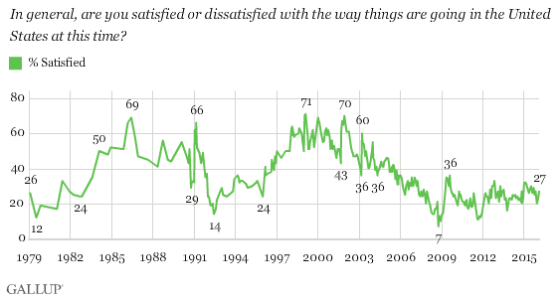
Gallup direction

This shows the percentage of Americans who say they are happy with the way things are going in the US. If it is over 50% then most Americans are happy. At present it is just over one quarter.

Under Carter satisfaction dropped to 12%.  In Reagan’s first term it improved to 20s, then 30s and in 1984 it hit 50%. Reagan was re-elected and in his second term it got to a high of 69%. Under Bush 41 it was in the 40s and 50s. It his 66% after the first Gulf War but dropped to 14% by mid 1992 as the economic recession hit.

Clinton’s first term saw it in the 20s and 30s only but in 1996 got up to 45%. Clinton was re-elected and it kept increasing to a high of 71% in Feb 1999. Remained in the 60s for the rest of his term.

Bush 43 was in the 50s and high 40s until 9/11. Just after that rose to 70%. 2002 to 2004 saw it in the 50s and 40s.

Around 2005 it went back into the 30s and 40s. Then in 2007 it went into the 20s and in 2008 hit a lot of 7%.

Obama’s election saw it hit a high 36% in August 2009 and then a low of 11% in 2011. Obama’s reelection saw it go up to just 33% and at the end of last year was just 20%.

The last time satisfaction hit 40% was in 2005 and 50% in 2004.

country direction

This malaise is not shared in other countries. This graph compares the net (positive less negative) direction in the US and New Zealand.

NZ has never had negative net approval since 2008 and the US has never had positive net approval since 2004.

So for well over a decade Americans think their country is heading in the wrong direction. In that time there has been a Republican and a Democratic President, a Republican and a Democratic Senate, and a Republican and a Democratic House.

So Americans are disillusioned with the country, politicians and the parties. Up to three quarters of Americans think their country is heading in the wrong direction, and they are looking for a way to change that.

This explains some of the appeal of Trump (and Sanders).

2. Make America Great Again

Trump’s slogan of Make American Great Again is very appealing to many Americans. They want to be proud of their country. They think the US is an exceptional country. They feel let down. Trump is no Reagan but he is tapping into the same vein.

Key even tapped into this somewhat in 2008. He never did an Angry Andy and said NZ is an awful place due to the Government.  Key said NZ is a great country but can be even better. Trump’s tactics are different (he blames stupid politicians) but he is appealing to people’s pride in the country (even if unhappy with the direction).

Politicians on the left struggle with this. How does Obama make people think America is a great country, when he hand wrings about Guantanamo Bay, racism and the like. This isn’t saying Obama is wrong, just that getting the tone right is a challenge.

3, A backlash against political correctness

Trump’s statements banning all Muslims from migrating to, or even visiting, the United States are deplorable. But they have struck a chord, Why? Because people feel they can’t even discuss the problems of Islam and extreme Islam.

When there is a terrorist attack, the President can’t even call it Islamic terrorism. They laughable “Islam is a religion of peace” line is trotted out in all the media. People feel they can’t have an honest and open debate about the serious problems within Islam (such as over 30% of Muslims worldwide support executing people for apostasy).

So when Trump comes out and says “Ban all Muslims”, people feel that it liberates them to at least be able to say what they think. You saw this in a different way with Brash’s Orewa speech. Brash’s speech was nothing like what Trump has said, but it struck a chord as the political elite had ruled such conversations off topic for so long.

So at one extreme you have Obama unwilling to even use the term “Islamic terrorism” and at the other Trump saying “Ban Muslims from crossing the border’. It is one extreme that creates the other. This is not to say anyone but Trump is to blame for what Trump says – he is. But the reason he has found such support, has been the politically correct climate where politicians and others have to measure every word they say.

4. Blaming someone for all the problems

Winston is the master at this. For decades he has done well in saying that everything would be like it used to be (he thinks the 70s were a golden age). if it were not for some group to blame. That group for Winston has ranged from Asian immigrants to Big businesses.

Trump has made it simpler. He blames stupid politicians. Everyone but him is stupid, and all will be well if he is President. He will negotiate better deals, scare all the enemies, and get Mexico to pay for a wall – because he is super smart and everyone else is dumb.

Politicians are a good target for blaming everything on. Their approval rating (generically) is normally below 20%.

5. Non-politicians appeal

Tied to the above, there is a long history of non-politicians appealing. In NZ both Brash and Key did very well because they were not seen as career politicians, but people who have succeeded outside of politics.

6. People don’t expect Trump to do exactly what he says

Many of us have gone wrong thinking that people won’t support Trump because his so called policies are impossible to achieve and implement. Take these three:

  1. Build a wall with Mexcio and get them to pay for it – of course they won’t
  2. Ban Muslims from travelling to the US – every court in America would strike it down as unconstitutional even if it passed Congress
  3. Impose huge tariffs on imports(against WTO rules)
  4. I will target and kill families of terrorists – US military would refuse to do

But Americans may be smarter than we give them credit. I suspect few of his supporters expect him to do exactly what he says. But what they like is what he is effectively saying, which is:

  1. I will be much much tougher on illegal immigration
  2. I will battle radical Islam
  3. I will get better deals for the US from other countries
  4. I will be hard arse in batting terrorism

So they are responding to his direction rather than his specific policies.

7. Trump doesn’t have to worry about relationships

Trump is the insulter in chief. It gets him great air time, and his supporters love it. He can do it, because he is not a politician. He is not even that interested in whether the Republican Party does well. He just wants to be President. Other candidates have political careers and need to work with others. They have to be restrained in what they say.

8. There is no effective Republican establishment leadership

Us parties are very different to NZ parties. The US parties are more brands than unified parties. This is why Trump and Sanders can come in and be viable. Unless you hold the Oval Office, then your party has no clear leadership. The RNC Chair is not very powerful.

So when people say the establishment is failing to stop Trump, that is partly because there is no single establishment figure who can bring everyone together and say “This is what we are doing”

9. Trump never backs down

Trump has said more false things than any other candidate in recent history. But he never ever admits he was wrong. While this is off putting to some voters, he has shown that you can brazen things out. This may probe to set a very bad incentive for future candidates.

10. Free media

Trump doesn’t need to spend money for publicity. One tweet from him generates 200 stories. This has helped him dominate the media.

No surprise when Police are not able to pursue

Stuff reports:

More than 1000 people who taunt police with car chases are getting away with it – and teens involved are boasting about their antics online.

New figures obtained under the Official Information Act reveal 1206 pursuits in 2015 ended with the fleeing driver escaping before police could identify them – an increase of 39 per cent in four years.

Police were unable to pinpoint what was behind the rise but the total number of chases has jumped 25 per cent to 2998 between 2014 and 2015.

The more the IPCA restricts the situations in which Police can pursue someone fleeing, the more people will flee. They know that the faster they go, the more likely the Police have to give up.

Now I accept there are situations where the Police should not pursue. But you need to look at having very string incentives for people not to flee, otherwise they will.

Those incentives could be automatic loss of licence and loss of vehicle. They could be automatic jail time.

But if you have strong incentives to flee, and weak incentives not to flee – then more and more will flee.

OIA league tables a good idea

TVNZ reports:

New ranking tables to name and shame government departments about noncompliance with Official Information Act requests are likely by the middle of the year, the Ombudsman’s Office says.

Chief Ombudsman Peter Boshier has told TV3’s The Nation he plans to shake up enforcement of the act, which allows New Zealanders to request information from most government departments.

He said league tables to rank departments for their OIA responses were on the cards for July 1.

“We pretty much know who are the good compliers and who are not, and probably it would be good for the public to know that as well,” he said.

This is an excellent idea and should have been done years ago. No Right Turn has been compiling his own in the absence of official ones.

The data I suggest they collate and publish for each agency:

  1. Number of OIA requests made
  2. Number granted, partially granted and declines
  3. How many responses were sent before 20 days
  4. Median time for a response
  5. Number of extensions
  6. How many requesters appealed to the Ombudsman?
  7. What proportion of those appealed to Ombudsman were upheld, partially upheld or reversed?
  8. How many requests were made by the five most frequent requesters

Tenure of Opposition Leaders

Danyl McL blogs:

There’s a lot of criticism around about Labour leader Andrew Little, after what’s been a pretty awful week and a pretty lousy couple of months. And there are, presumably, whispers in the party about maybe replacing him, maybe bringing back David Shearer? Or Bringing Jacinda Ardern forward? Because there always are, although Little will be harder to get rid of than the other leaders because of his support in the union movement and that movement’s kingmaker role within the modern Labour party.

But maybe being Opposition leader – widely observed as being ‘the worst job in politics’ – is just a really hard job and it typically takes a long time to get good at it and build up credibility with the public? Here’s a bar chart of how long our recentish opposition leaders were in the job until they were elected or deposed. The dataset is small so definitive conclusions are tricky, and we transferred from FPP to MMP during this period. But maybe Key’s quick rise was atypical and the best way to change the government is to pick a leader – like Clark or Bolger – and let them build up their competence and credibility over time?

Danyl has Shipley and English missing from his graph so I’ve done one with them, and going back to WWII.

oppldr

The tenure has been shorter under MMP. Since Helen Clark, so opposition leader has done more than 40 months.

Matthew Hooton noted in the comments:

What you describe here is being called “The Kirk Model” by Little’s supporters. They point out that Kirk lost to Holyoake in 1966 and 1969 but then, after National replaced Holyoake with Marshall, became PM in 1972. Similarly, they say, Little may lose to Key in 2017 and perhaps 2020 but should be given an opportunity to try again, perhaps against Key’s successor, in 2023.

The funny thing with Little is he did really well in his first nine months or so on the job. But since the TPP debacle, it has been all downhill.

Labour’s $38 billion bribe!

The Herald reports:

All adult New Zealanders could be given a Government handout of at least $200 a week under a new policy being considered by the Labour Party.

The co-leader of a global network promoting a “universal basic income”, British professor Guy Standing, will be a keynote speaker at a Labour conference on “the future of work” in Auckland next week.

He said yesterday that a system “where every legal resident of New Zealand should be entitled to a modest monthly basic income” would reduce inequality and give some security to people who increasingly have to earn a living from insecure casual and short-term work.

And Labour finance spokesman Grant Robertson said Labour was considering a local version of a scheme developed by economist Gareth Morgan, who proposed paying every adult a basic income of $11,000 a year ($211 a week).

“I’ve spoken to the Morgan Foundation about it. They are continuing to work on the idea,” Mr Robertson said.

“We are looking at how do we ensure income security, and one of the things we are looking at is whether or not a universal basic income could form part of that policy. It’s very early days.”

A discussion paper on the idea, due to be published by Labour today, suggests paying an $11,000 universal income to everyone aged 18 or over to replace all existing welfare benefits except for “supplementary transfers for disadvantaged groups”.

So what would this cost?

We have 3.49 million people aged 18 or older.

$11,000 per person is $38.4 billion!!

This is fantasy land stuff. Not even Jeremy Corbyn would float this.

Even if you used this to replace Vote Social Development (Benefits) which is $19.5 billion, that leaves an $19 billion gap.

This would be slightly more generous than Dr Morgan’s proposal, which suggested a lower rate of $8500 for those aged 18 to 20, and the paper acknowledges that “there may need to be some changes to taxation policy to mobilise revenue”.

“The top tax rate could be increased or further revenue might be gathered from other forms of taxation,” it says.

You think!

This would require everyone earning over $48,000 a year to pay 82% income tax.

This isn’t so much the future of work, but how to get everyone working to leave New Zealand.

A lower corporate tax rate is how you stop profit shifting

The Herald reports:

A major Herald investigation has found the 20 multinational companies most aggressive in shifting profits out of New Zealand overall paid virtually no income tax, despite recording nearly $10 billion in annual sales to Kiwi consumers.

The analysis of financial information of more than 100 multinational corporations and their New Zealand subsidiaries showed that, had the New Zealand branches of these 20 firms reported profits at the same healthy rate as their parents, their combined income tax bill would have been nearly $490 million.

This is not new. Basically firms sell products to their NZ subsidiaries at a rate which means little profit is made by the NZ subsidiary and lots by the global parent.

This is often justified. If it is the global parent who has paid for all the research and development on a product, and all the NZ subsidiary does is sell it, then you would expect this.

In other cases, it will be less justified.

As why multinational companies engage in profit-shifting, the twenty companies on the Herald list paid effective tax rates of 22 per cent on their non-New Zealand income, considerably lower than our 28 percent corporate rate.

You can not pass a law dictating at what cost a company can see products to a subsidiary. But you can reduce the company tax rate so there is no incentive for companies to have their parent companies pay almost all of the tax where they get a lower rate.

If the OECD can come up with a treaty or agreement to reduce the ability to unfairly profit-shift, that is a good thing. But short of that, there is little individual governments can do.

Every time James Shaw or Grant Robertson demands the Government do something, the response should be “What?”. Challenge Grant or James to tell us what is the law change they would propose that would stop this? Neither of them can. At best they mutter about an inquiry.