Covid for Christmas. It was a line that Labour ministers Grant Robertson and Chris Hipkins effectively deployed with glee last week when National released its Covid policy.
National, they said, with its policy to open the borders at an 85 per cent vaccination rate, would be virtually giving Kiwis the virus for Christmas.
It was a clever line from two men who have spent almost their entire adult and professional lives trying to destroy the National Party. They just couldn’t help themselves.
Both Ministers followed near identical paths of student presidents to ministerial staff to MP to Minister, having never had a job in the private sector.
Yet it is now something that both men – Hipkins in particular, as Covid-19 response minister – could well live to regret. There will most likely be Covid for Christmas, but it won’t have been via an open border or the National Party.
I’d say it is going to bite them big time, and deservedly so. National’s policy was a serious constructive document, and the response from Hipkins and Robertson was nasty politics at it lowest.
The biggest issue, and where the Government has clearly dropped the ball, is ICU capacity. After the first lockdown last year, it should have moved quickly to create a special visa class to get ICU specialists into the country. It did not.
This is an astonishing failure, given that the clear capacity constraint in the system – testing, contact tracing, isolation, hospital care – was always going to lie in providing and staffing ICU facilities.
Not only did they not bring in a special visa for ICU specialists, they have been actively turning them away. It is beyond madness.
A road rager who pursued a young family for 10 minutes before shooting at the family’s car has had his jail sentence thrown out.
Dekota Chase Simpson will instead serve a sentence of home detention after a jail sentence imposed at Manukau District Court was quashed.
On May 10 last year, Simpson and his brother were driving along South Auckland’s Roscommon Rd in Wiri.
A newly-published High Court decision showed Simpson was driving and his brother was in the front passenger seat.
An adult couple were in another car with two children, aged 12 and 13.
“They pulled out of a service station and on to a connecting road when Mr Simpson’s car sped up close behind them.” Justice Ian Gault said in the new High Court judgment.
“Annoyed at Mr Simpson’s driving, the adult male victim showed his middle finger to them and yelled ‘f*** you’ as Mr Simpson pulled into a service station on Roscommon Rd,” the judge added.
In response, Simpson pointed his hands at the victims and made gun gestures. His brother got a shotgun from the back seat and assembled it.
The couple with children drove away and got on the Southwestern Motorway (SH20), heading north.
Simpson and his brother changed seats and Simpson retrieved a guitar bag with another shotgun and ammunition.
Justice Gault said Simpson and his brother caught up to the victims about 10 minutes later, yelling as Simpson waved around the shotgun.
“He then leaned out of the front passenger window of the car with the shotgun all the way out of the window and pointed it at the adult victims.”
He fired a shot, striking the front bumper of the victims’ car. …
He said 19 months’ imprisonment was manifestly excessive.
“A sentence of home detention also better reflects parity between Mr Simpson and his brother.”
The jail term was quashed and replaced with a sentence of seven months’ home detention.
19 months manifestly excessive for firing a shotgun unprovoked at a family of four, including two kids.
According to media outlets, Te Pāti Māori (the Māori Party) would like all NZ place names to be restored to their original Māori name by 2026 and ‘Aotearoa’ to officially replace ‘New Zealand’. According to co-leader Rawiri Waititi, this is because “It’s well past time that te reo Māori was restored to its rightful place as the first and official language of this country” and “Tangata whenua are sick to death of our ancestral names being mangled, bastardised, and ignored. It’s the 21st century, this must change.” Let me start out by nailing a few of my colours, so to speak, to the mast:
The resurgence of te reo Maori in recent years is a positive development;
Basic courtesy demands that we try to pronounce te reo Maori words as they are pronounced in te reo Maori – e.g. Oamaru should not be pronounced Om-a-ru;
New Zealand maps, road signs, etc should identify locations by their te reo Maori name and non-te reo Maori names (if any); and
They can change NZ’s name to Landy McLandplace for all I care. But for all that, I will not be investing any time in learning to speak te reo Maori. Why? It’s quite simple really: because I have not the faintest interest in doing so. My time on this earth may end in 50 years or it may end tomorrow. Whatever my expiry date, human life is finite and I intend to spend as much of mine as possible doing things that I actually care about doing. Currently, I find that I like going bodyboarding and hunting and engaging in practical problem solving in my garage. I like reading and writing and music. I like playing with my dog. I like spending time with my wife and children, and with our wider family and friends. Conversely, I do not find myself feeling that I should get into aqua jogging or learn to pole vault. I don’t find within myself a desire to tinker with motorbikes or to become an amateur taxidermist. I don’t enjoy karaoke and I’ve never felt compelled to dress myself in a onesie. Nor do I wish to learn te reo Maori. What can I say? Perhaps I’m just quirky. As intimated earlier, I think it’s great that many New Zealanders are finding enjoyment or satisfaction or meaning (or whatever) through their discovery or re-discovery of te reo Maori. More power to them, I say! But, as it happens, I simply have no interest in taking a magical mystery tour on the te reo Maori Express. I have not found myself in need of te reo Maori during my 40+ years thus far, and I see no reason to suggest that I will need it during the time that I have left. I’m pretty sure that my kids aren’t going to need it either… And that’s okay. And maybe I’m wrong. That will be okay too. I have never been deprived of my native language, so I can only imagine how important te reo Maori must be to many Maori. Nobody should be deprived of their native tongue, and it is a national tragedy that for so long Maori were deprived of theirs. Perhaps this wrong can be made right. But I am not Maori and te reo Maori is not my language. And if, in the minds of the Initiated that reduces me to the status of an ignorant pakeha, palagi, honky or some other name, then so be it – having the approval of the Approved matters little to me. For I know who I am, and though sadly I know relatively little of my ancestors, I do know that like Maori, they came to New Zealand from far across the sea. I know that like Maori, they hacked out for themselves and their children, a new life in a rugged and often unforgiving land – sometimes by fair means and sometimes by foul. And I know that like Maori, the efforts of my ancestors have borne some fruit that is sweet……and some that is bitter. For such is the way of all people and the way of all things. So I, for one, will not spend my life as a hostage either to the perceived sins of the past, the fluctuating resentments of the present, or the certain uncertainty of the future. My land is Otago and my home is Dunedin; and while it may be Otepoti to Maori, to me it will always be Dunedin. Furthermore, it will be a meteorologically stable day in Dunedin (as opposed to a cold day in Hell…) before anyone from anywhere compels me to call it anything else. In any language. Kia kaha.
A Mongrel Mob leader accused of helping a Covid-positive sex worker obtain documentation to travel to Northland has lashed out at the allegations and threatened legal action.
In an interview with Te Ao Māori News this afternoon, Hawke’s Bay Mongrel Mob leader Harry Tam says the claims levelled by former Deputy Prime Minister Winston Peters are not true.
“If Winston said it, he needs to prove it… If he’s not going to apologise, we will need to look at legal action,” Tam said.
Peters appeared on TV3’s Newshub on Saturday morning levelling the allegations which had been circulating on social media and encrypted messaging app ‘WhatsApp’ on Friday night.
Winston claimed to have impeccable sources, but basically his source appears to be a Facebook post that had circulated widely.
I have received it almost a dozen times, and was sceptical of the part that claimed Harry Tam was with the Northland case and arranged her travel. It was just far too convenient – the guy who had just been in the news. So I decided not to publish it, but Winston blurts it out on live TV as holy writ.
It is a shame Winston did, because it has allowed the Government to escape scrutiny over the rest of the issue. They have denied the aspects about Harry Tam, but are not denying all of it:
Speaking to media on Saturday afternoon, Prime Minister Jacinda Ardern said there was “no evidence” to support some of the claims around the Northland case and that the government was being transparent in their disclosures.
Note the carefully phrased use of “some of the claims”. If the Government was transparent it would share with the public what they know.
A long and interesting article at History Reclaimed pushing back on the notion that the US and Canada are countries stolen from the indigenous populations by colonisers. Some relevance to NZ.
Trans women retain physique, stamina and strength advantages when competing in female sport, even when they reduce their testosterone levels, new guidelines for transgender participation in national and grassroots sport published by the UK sports councils will say on Thursday.
The long-awaited report argues there is no magic solution which balances the inclusion of trans women in female sport while guaranteeing competitive fairness and safety.
It will be different in different sports. Rugby could well make a different decision to say bowls.
The guidelines state that because males and females do not often play competitive sports against each other, many people do not appreciate the differences, particularly in team sports.
“However, an understanding of the gap between the two sexes can be recognised by results of practice matches between national senior women’s football teams against underage boys’ teams in recent years,” it says. “The national teams from Australia, USA and Brazil were beaten comprehensively (7-0, 5-2, 6-0 respectively) by club teams of 14- and 15-year-old boys.”
That’s staggering.
In reviewing the latest science, the guidelines say adult male athletes have on average a 10-12% performance advantage over female competitors in swimming and running events, and that increases to a 20% advantage in jumping events, and 35% greater performance in strength-based sports such as weightlifting for similar-sized athletes.
The best male weightlifter in the world can lift 223 kgs in a snatch. The best female weightlifter can lift 155 kgs.
Sports are also given three potential paths they might consider. They are prioritising transgender inclusion; protecting the female category by having open and “female-only” categories; establishing new formats by adapting rules to include non-contact versions of team sports so that everyone can play.
So each sport can choose which path is most appropriate for them.
I put together this graph showing daily community covid cases and significant changes to alert levels. Red means a tightening and green a loosening.
So after the first infection, we went to Level 4. Cases peaked around 80 and then as they fell to 60 areas outside Auckland went to Level 2 and then to Level 2 as they were around 10.
Auckland cases stayed between 10 and 25 for a couple of weeks and the Government relaxed Auckland to Level 3. For the first week cases stayed around 20 but have been steadily increasing. Despite that, they did a further relaxation for Auckland this week.
It looks like going from L4 to L3 in Auckland did lead to an increase in cases and we will find out soon if the firtehr relaxing continues that trend.
We have confirmed the appointment of Sir Graeme Harrison to the National Party Board of Directors.
Many of you will be familiar with Sir Graeme’s achievements. He brings an impressive and extensive range of personal, commercial, and community experience to the Board of the National Party, and we are excited to welcome him to the team.
Born and educated in Canterbury, Sir Graeme is best known as the founder of ANZCO Foods. He served as its Managing Director for 20 years, and Chairman for 14 years, leading the company to grow into one of New Zealand’s largest meat product exporters, with annual sales of around $1.5 billion and more than 3,000 employees.Sir Graeme is a passionate advocate for rural New Zealand and our primary industries sector, and his strong leadership over the last 30 years has been inspirational to so many Kiwis.
In 2010, Sir Graeme was winner of the Federated Farmers Agribusiness Person of the Year, and in 2011 was made a Knight Companion of the New Zealand Order of Merit for services to business.
Sir Graeme has also enjoyed a long history with Lincoln University as an adjunct professor, member of its Council, and in 2012 was conferred an honorary Doctor of Commerce degree. In 2015, he was also awarded the Order of the Rising Sun by The Emperor of Japan in recognition of his contribution to strengthening economic ties between New Zealand and Japan.
That is an impressive appointment. This is the benefit of now allowing the Board to co-opt members. Sir Graeme will bring a record of extremely astute judgement to the board.
The annual Herald Mood of the Boardroom has occurred and as usual I summarise the scores CEOs give to key politicians. While CEOs are not representative of all NZers it is interesting to see how their scores have changed from last year and which MPs are seen as better and worse performing. Scores are on a 1 to 5 scale so 3 is middle.
David Seymour 4.36 (+0.33)
Grant Robertson 3.68 (-0.50)
Kiri Allan 3.15
James Shaw 3.06
Jacinda Ardern 3.03 (-0.88)
Chris Hipkins 2.96
Andrew Bayly 2.86
Andrew Little 2.85
Ayesha Verrall 2.81
Nanaia Mahuta 2.76
Damien O’Connor 2.58
David Parker 2.57
Peeni Henare 2.51
Aupito William Sio 2.40
Megan Woods 2.38
Stuart Nash 2.34
Meka Whaitiri 2.33
Jan Tinetti 2.22
Willie Jackson 2.20
Priyanca Radhakrishnan
David Clark 2.17
Kris Faafoi 2.17 (-1.41 from 2019)
Michael Wood 2.15
Marama Davidson 2.14
Carmel Sepuloni 2.09
Judith Collins 2.06 (-1.46)
Poto Williams 1.98
Phil Twyford 1.79
Kelvin Davis 1.73
Phil Twyford will be glad he has Kelvin there to make him look good.
They also rate Ardern in a number of different areas:
Representing NZ overseas 4.0
Leverages personal brand 3.9
Stands up to US 3.42
Political performance 3.30
Stands up to China 3.28
Covid response 3.01
Climate change response 2.84
Security and intelligence 2.45
Transformative change 2.08
Build confidence with business 1,97
So Ardern gets high marks for international stuff, average for Covid and below average for the transformative change she promised.
The government has introduced legislation which will allow the Minister of Health and the Director General to take over private companies doing COVID testing (further description is here). The likely target of this change is Rako, which has sought a commercial negotiation with the government for the last year. The amendment, which is before the Select Committee, will give the government the option of taking Rako’s property and unilaterally determine compensation.
This is potentially the most spiteful and malicious action by the Government.
Rako has spent around a year trying to convince the Government of the merits of saliva testing. After months of delay they finally agreed we should use it. But then they did a tender and gave the tender to a company that didn’t have a validated test. I suspect they did this, because Rako had so embarrassed them by not keeping quiet, but going public over how the Government should have been using saliva testing. The bottom line is a year later and the Government has yet to roll it out in a meaningful way.
So having made huge blunders in terms of not agreeing to it, and a flawed tender process, the Government is now sneaking a law change through Parliament under urgency that would allow them to simply confiscate the labs off Rako and unilaterally determine what the compensation will be. This is third world stuff.
Burgess also looks at the regulatory impact statement on the proposed law change and notes:
Focus on costs. Officials seem to operating with a cost model that threatening to take a company’s IP is costless, and costs crystalise only when property is actually taken.
I wonder what Rako’s investors and employees think about that view? In fact, I wonder what every owner of intellectual property in every sector thinks about the Ministry’s view.
Because the cost of taking companies’ property is not the administrative overhead, as officials suggest in the RIS.
The cost is all the investment in innovation that will not happen in the future.
Those costs are large, big enough to be measured in percentages of GDP. So it is laughable that officials could list administrative costs as the only real downside of their proposal.
Do officials at the Ministry of Health understand how investment in specific assets works? Do they understand that investment in intellectual property, and in all sunk assets, depends on the credibility of the government’s promise not to take the property once it is created? Do officials recognise that even threatening such opportunism in one sector could have wider ramifications about security of property elsewhere? That prospective investors in wind turbines or EV charging infrastructure won’t notice the government putting in place machinery to take the property of medical companies?
Could officials and the government be any more short-sighted?
Basically the Ministry of Health doesn’t think confiscating private labs has any costs to society or the economy except administrative ones.
Wow. Former Green Minister Julie-Anne Genter just freezes and then walks out of an interview about criticisms of a bill she actually introduced. Just totally unprepared it seems.
Imagine having 15 Maori MPs in caucus, seven in the ministry and five in Cabinet and Maori groups have to go to court just so they can help with the vaccination of Maori! https://t.co/gqMbsIBowk
Labour has the largest number of Maori MPs ever in caucus and cabinet, yet none of them appear to have any actual influence on the Government. They can’t even convince the Ministers with the power to allow Maori community health groups do outreach to unvaccinated Maori.
Not only does the 110-page leaked report claim Biden did in fact win, but Trump actually received 261 fewer votes than the official figures initially suggested, and Biden scooped 99 more, according to Business Insider.
This was a so called recount by a Trump loving company that had no experience in elections, but even they couldn’t find any proof of fraud – in fact all they found was Trump lost by 360 more votes than the officiaL count!
Jackie Foster is the mother of Jamie Foster who was convicted of sexual violations and indecent assault in April 2020 however his mother claims the justice system failed her son which resulted in a miscarriage of justice.
She believes the issues in the system go beyond just her son’s case and she is fighting not only for her son, but for all other males who may face the same system in the future. She believes everyone deserves a fair chance.
While I am aware that Foster was convicted and his appeal turned down last November and leave to appeal at the Supreme Court was denied, I have read Jackie’s story with ongoing interest.
I think it is important for everyday people to be able to raise public issues around the justice system which they think is unfair. So I’m blogging Jackie’s story below. So people can read her side of the story after I believe most have read the mainstream media stories published over the past year including a recently deleted story on mainstream media she states was full of errors.
In doing so, I am not taking a position on the convictions. I just strongly believe that people should be able to make the case in public against a conviction, as have seen with the David Bain, Peter Ellis, Mark Lundy etc
Fair Pay Agreements that sound soft and kind, until we realise that they are nothing but a return to compulsory unionism and the nationwide awards system that stifled New Zealand’s innovation, drive, and success before 1991. The only place they seemed not to operate was in the owner-occupied businesses known as family farms. No wonder farming led innovation and the adoption of new technology.
Three Waters; which is accompanied by what should be declared false advertising – $4 million of taxpayers money spent on advertisements seemingly trying to convince Kiwis that our drinking water isn’t safe. For the record, it’s a crock. And $710 million spent by Government from the Covid-19 Recovery Fund, essentially bribing local councils to fall into line. …
Putting that aside, what is really behind Three Waters is a wish to take the assets of local government, and put the governance into four groups half appointed by councils and half by iwi.
It has little to do with water quality and a lot to do with control.
You might ask, “what of He Puapua?” Well, that’s the roadmap that the Ardern Government seems to be sticking to. Clearly, it is the only plan that they seem to have. KiwiBuild, the plan to build 100,000 houses in 10 years, was a $2 billion flop.
It’s not a total flop. After four years they have finally made 1% of their total!!
Thankfully, National has a Covid plan. We’re asking the Government to adopt it. The lot of it. Not just a bit. Do it now.
Then we start rebuilding the economy. That means rebuilding trust. Trust that the Government won’t take more. Trust that the Government won’t make it harder to build a home, to have a home, to take a punt on being in business.
That also means, embracing new technology. That means taking New Zealand to the top in the world’s education ratings. That means getting our kids to understand that maths and science are fun. That coding is awesome. That it is the way to open their opportunities. That technology is the way forward. That increased productivity doesn’t mean working more hours for less, but working fewer hours for more output and income.
That means, embracing success. That means ridding ourselves of the notion that turning up is enough. That means deciding to be the best we can. Every, single one of us. That must be us.
That’s what we can do. That’s what this country needs.
And, in the meantime, can the Government please stop telling everyone to “be kind”, until it decides to be competent.
Everytime I see an NZTA billboard demanding I “be kind”, it has the opposite effect on me.
Hawke’s Bay-based Mongrel Mob life member Harry Tam was granted an essential workers exemption to travel into locked down Auckland.
That’s nice for Harry.
Newstalk ZB can reveal Tam was given the green light to travel into the city, to encourage gang-linked unvaccinated individuals to get the jab.
It comes after it was this morning revealed that Waikato’s Mongrel Mob chapter president Sonny Fatupaito was given the same exemption.
This is the mob president who claims they have gone straight but whose No 2 has been charged with meth dealing?
It comes after Covid-19 Minister Chris Hipkins this afternoon finally confirmed there were quite a large number of gang members in this outbreak.
This has been widely speculated on, but the Government won’t front with numbers. They are happy to tell us the exact number of people linked to a Pacific Island church, but not the numbers linked to gangs. Why not? Do they know that NZers would be shocked how many are gang related?
Now if Fatupaito and Tam are honestly travelling into Auckland just to promote vaccinations to gang members, that can be justified. But are we just taking them at their word, that is what they are doing? Are we measuring effectiveness? Are they actually getting gang members vaccinated? It’s one thing to claim they are doing something, but surely the Government is actually verifying it?
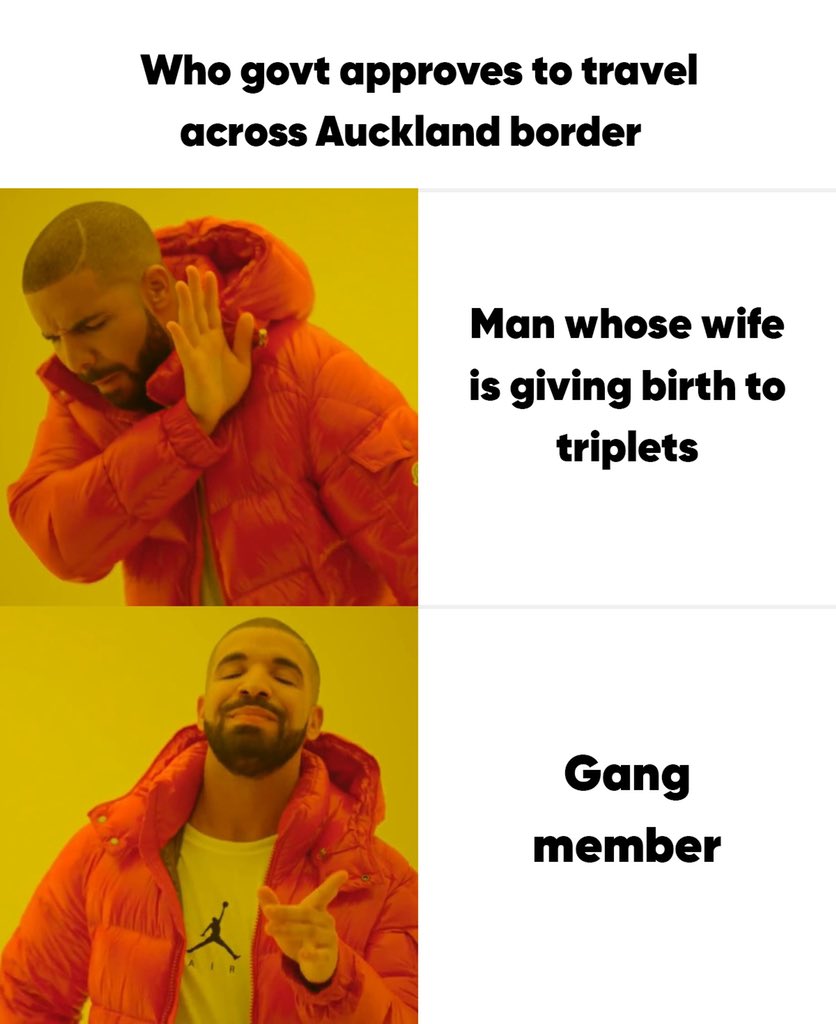
So in theory you can make the case for them to able to cross the border, but what will annoy many people is that the Government is so inflexible for other New Zealanders, such as the man whose wife is giving birth to triplets. I guess he wasn’t able to tell the Government “Jacinda trusts me, don’t you”!
n official report of UoA’s first drug checking event states it was a success, and resulted in tangible harm reduction outcomes.
During re-orientation week, Know Your Stuff (KYS) ran a pilot for a free, confidential, drug checking service in Albert Park, supported by UoA’s Student Wellbeing Team and the New Zealand Drug Foundation (NZDF). This event was possible due to legislation passed last year, allowing drug and substance checking services to operate legally in New Zealand, with the aim of minimising drug and substance harm.
The clinic ran for three hours on July 19 at full capacity, with a total of 35 drug samples tested at the event. The most common drugs seen were MDMA, ketamine, and amphetamines. According to testers, the majority of people who visited the clinic were inexperienced drug users.
Drug checking is a proven effective drug harm reduction strategy. According to KYS, drug checking reduces the risk of death from drug use by ensuring people know what substance they have, and the risks associated with it so they can make an informed choice. An official report of the event revealed only 57% of the samples tested were consistent with what the client had presumed them to be.
After further ESR testing of one sample presumed to be a fake Xanex, it was determined that the drug checking service most likely saved a person’s life. “If the full pill had been ingested, it would have resulted in death within a couple of hours for the consumer.”
I’m all for drug testing. It reduces harms and saves lives.
I have had the privilege of attending three NFL games and two Division 1 College matches. I love the game but it has been an acquired taste. With little local sport the NFL season is an opportunity. It may be the world’s greatest game!? Here is a guide for kiwis.
Choose a good team. The current team to watch is the Tampa Bay Buccaneers. They have three of the NFL greats – Brady, Gronkowski and Sherman and won last year’s superbowl.
Understand that these athletes make Sonny William Williams look like a local club midget. Gronkowski is 6’5, 130kgs and runs 40yards before Sonny gets out of the blocks. He throws defenders around like rag dolls and catches bullets from Brady with one hand (not real bullets – I am not talking Chicago here).
He looks a lot like me at my best:
3. It is good if those who can cook in the house make nibbles for the duration of the match and possibly even dress-up (use your imagination). This is one of the key plot themes of the great movie Silver Linings Playbook.
4. Before the game it is important to go down and catch a few fish. Like I did on Monday at the Russell wharf.! No … I really did. Yes – that Snapper is 52cm. (I caught great squid last night but I am never one to brag).
5. The game starts and just before that the very great Tom Brady (now 203 years old) runs the length of the field and fist pumps and brings the whole opposition crowd to their feet. Brady is the GOAT of world sports! Fact! He now plays for the Bucs. Great Patriots coach Bill Belichick scowls but that is how he normally looks – win, lose, or getting castrated.
6. Brady is not only a great QB but is also a testimony for the inference that if you win 7 superbowls you get to have a very good looking wife.
For any men on KB – I know she is not as good looking as our wives but she does have more money and speaks a funky language.
7. Prepare well. The game is going to last three hours. Do not start drinking in the first two quarters – there is a long way to go. Tea, Miso soup, or iced coffee is best even for the first three quarters. After that – you are allowed a beer (Jacinda said that earlier this week – not even joking). Beware of extra time!
8. To the game itself: It is the USA equivalent of a great Cricket One Day International but with more brains and grunt. It is chess on legs. The intellect required to be a good quarter-back is the equal of the collective IQ of NASA. Even the cubby guys (and I mean CHUBBY – 6’8″ and 300 pounds) on the front line need to know what is going on – while consuming huge quantities of food just to keep breathing (sometimes they need pure oxygen – again – not even joking).
9. As stated above. The game lasts a while and kiwis tend to complain about the breaks (forgetting what happens at the end of every cricket over). I generally make use of the time to read a full novel in the breaks –War and Peace by Tolstoy on Monday … can you believe that Prince some-one-or-other?
10. Often the game is decided by a tiny margin. Today it was a field goal attempt that glanced off the posts as it was o.ooo1 degree out. The kicker was immediately fired and may even have been shot. They often are never heard from again and rumour has it that they play the odd game in a place called Canadia.
11. At the end of the game – as a fan – if you have chosen to follow the Tampa Bay Bucs you will feel vindicated. My financial suggestion would be to re-mortgage your house and place a bet on the TAB of the Bucs winning Super-Bowl 2022 (please note – not legal advice).
12. The USA is not politically correct. When I went to a game in Boston my son and I got lost in the crowd on the way in – true story. They had two chants – 1. “Brady is better” (he was playing for them back then) and “Manning has a vagina”. Please note that we did not join in the second chant. One 6’8” fan did grab me and throw me around a bit and ask me who I thought would win. Bay of Plenty meant nothing to him and I am lucky to be alive – I should have said Wanganui.
You need to get to know this game. The relevance to NZ – apart from Monday entertainment under-lockdown is that it may even be the cure for covid. There were 66,000 people in the crowd just out of Boston and not a mask to be seen. They have this weird thing called FREEDOM.
Hutt City Council chief executive Jo Miller threatened to take legal action against three councillors, accusing them of defamation after they raised concerns about her actions as the manager of the local authority, according to emails and legal correspondence.
The threats, issued through lawyers, contributed to David Bassett’s decision to resign abruptly in June after 14 years on the council, including nine as deputy mayor. The by-election to replace him will be held on September 24.
Local government experts said moves by a chief executive to sue the councillors – who are technically her employer – were unusual.
More than unusual – it suggests an extremely toxic culture. Councillors should not be threatened with defamation for raising concerns about the Council.