Reshuffle options for Ardern

If Whaitiri is sacked, then the PM has two vacancies – one Minister inside Cabinet and one outside Cabinet.

Filling these could be challenging due to Labour’s fixation on demographics. There are basically few female options for them to promote.

Assuming they don’t decide to shrink the size of the ministry (which would be a good thing), here’s what I would do.

The vacancy inside Cabinet should go to an existing Minister outside Cabinet. This means Faafoi, Henare, Jackson or Sio. None are women but all are Maori or PI. I’d say the obvious candidate would be Kris Faafoi. He is popular and moderate and seen to be doing a solid job in his portfolios.

The vacancy outside Cabinet should go to Michael Wood, a current Under-Secretary. Wood has good political smarts, and is clearly capable. If though, they can’t have it go to a man, let’s look at what women they have outside the ministry who are not first termers:

  • Louisa Wall. Showed good political smarts in steering the marriage equality bill through Parliament. But seems to be offside with the leadership as she is the only experienced female MP without a senior role.
  • Poto Williams. Currently Assistant Speaker. If you move her, you then need a new Assistant Speaker
  • Ruth Dyson. Currently Senior Whip. Clearly capable of being a Minister but needed where she is, and probably seem as to much from the past.

So that brings you to the first term female MPs. It would be tough to become a Minister after one year in Parliament but I’d say Deborah Russell would be capable of doing a good job. You could either make her Minister of Revenue and Women’s Affairs outside Cabinet or if you promote Wood, make her an Under-Secretary to replace him.


Taxpayers paying more in interest as Labour dodges their own rules

Stuff reports:

The Government allowed Housing New Zealand to borrow billions to build new state houses despite advice from Treasury that such debt would be expensive and risky.

In May, the Government announced it would be building 6400 new state homes over four years.

The funding for this came principally from $2.9b Housing New Zealand were allowed to borrow independently, instead of through regular Government borrowing. …

In a February briefing, Treasury analysts wrote that borrowing directly through the crown would save $11 million per year. This was based on a plan to borrow $1.75b instead of $2.9b. A later analysis estimated an additional $3m-$6m in annual interest costs for every $1b borrowed by Housing New Zealand.

So it is cheaper to borrow money through the Government, rather than have Housing NZ do it directly. So why wouldn’t you. I mean why cost taxpayers more money by having a higher interest rate?

In essence, overseas credit rating agencies would not see this debt as separate from Crown debt given the agency delivered such a core service, and thus would just factor it into their decisions about New Zealand anyway.

Because of this it risked the credibility of the Government’s Budget Responsibility Rules – as it was essentially a loophole through them.

So basically Labour are unable to keep to their own rules they promised. So they found a loophole, which means taxpayers pay more in interest.

Whaitiri stood down

Stuff reports:

Prime Minister Jacinda Ardern has stood Customs Minister Meka Whaitiri aside while an investigation is carried out into staffing issue in her office.

Stuff has been told relations in Whaitiri’s office are toxic and she is understood to have been through an entire rotation of staff in the short time she has been in the job.

I also understand she went through five EAs in her last term of Parliament. Of course she isn’t the only MP who goes through a lot of staff. That by itself is not a reason to lose your job.

People who are close to the situation told Stuff on Thursday Whaitiri can be unpleasant and difficult to deal with, but it’s understood Ardern’s actions relate to a specific incident involving a single staff member.

NewstalkZB gives more details:

Barry Soper told Mike Yardley that there are allegations, currently unproven, that Whaitiri had physically assaulted a staff member, and that is what is being investigated.

If the allegations are correct, that would certainly be a sackable offence.

Off memory this is the first time a Government has had two Ministers facing action in one week – one demoted and one stood down for now.

Labour won’t release report

The Herald reports:

An internal Labour Party report into allegations of sexual assault at a Young Labour summer camp has not been released because there are matters now before the court, Prime Minister Jacinda Ardern says.

Does that mean they will release it after the court has dealt with the issue?

Also they could release an abridged version which doesn’t includes details of the alleged assaults.

Meanwhile Newsroom reports:

One of the victims from Labour’s youth summer camp scandal has slammed the party for its “absolutely appalling” handling of a review into what went wrong, saying nobody is being held accountable.

A fair criticism. Labour did nothing for weeks until the victims went to a Minister and then the media.

However, one of the victims told Newsroom they were disappointed with how the party had handled the investigation into its failings, including the decision not to release the report publicly.

“Failing to release the report shows a blatant lack of accountability and from my perspective as a victim, is absolutely appalling.”

The report should have been released with the redaction of any information which could have identified people, they said.

Yep. The court case is an excuse.

Compare Labour’s response to Russel McVeagh. Russel McVeagh released their external report in full. Labour have released nothing but a bland assurance about policies and procedures being reviewed.

Former Chief Rabbi calls out Corbyn

The Guardian reports:

The former chief rabbi Jonathan Sacks has called Jeremy Corbyn an antisemite, saying the Labour leader’s comment about Zionists at a 2013 conference was the most offensive statement by a senior UK politician since Enoch Powell’s “rivers of blood” speech.

Labour dismissed the comparison with Powell as “absurd and offensive”.

In an interview with the New Statesman, Sacks, who was the UK’s chief rabbi from 1991 to 2013, said Corbyn had “given support to racists, terrorists and dealers of hate who want to kill Jews and remove Israel from the map”.

Will Peters sell the TAB to the Aussies?

Newsroom reports:

Giant Australian gambling companies are poised to take over the TAB’s role in New Zealand if a report into the racing industry is adopted by the Government.

The report, commissioned by Racing Minister Winston Peters, and kept secret from racing industry leaders, is due to be released tonight at a public meeting in Hamilton.

Sources familiar with the contents of the report says it recommends that race betting in New Zealand be outsourced to an Australian company, effectively meaning the end of the TAB.

I’m not a fan of the TAB monopoly. But rather than hand the monopoly over to an Australian company, why not abolish the monopoly?

Allow any registered company to do sports betting, under a common framework where a percentage of takings is paid to the sport in question (except I guess politics :-))

Sources have told Newsroom that the big gambling companies in Australia have proposed giving the industry an up-front cash payment and more money, said to be $100 million over 25 years, if they get the licence to control betting on NZ races. 

Will be interesting if the opponent of all things foreign turns out to support selling the racing monopoly to the Aussies.

Guest Post: Lady Justice

A guest post by Rodney Hide:

We are all familiar with Lady Justice: her sword is her authority, her scales her weighing of evidence, her blindfold her impartiality to power, wealth and status.

In recent times, judges have slipped her blindfold.

In July High Court Judge Whata took a peek to see Ms Ratauhunga Puriri was Maori and wanting to be a teacher.  He accordingly overturned her conviction for aggravated assault and theft. The good Judge explained: “The woeful statistics of Maori underachievement on all walks of life, are testament to the difficulties confronting Ms Puriri as she embarks on this important phase of her life”.

There are only two possibilities for Ms Puriri confronting difficulties as a Maori: one would be endogenous which would make Judge Whata racist; the other would be exogenous, which would mean he is claiming the institutions of teaching are racist.

Presumably, Judge Whata is arguing the second.  But in doing so he has made a common but gigantic leap of logic that requires throwing away Justice’s scales as well as peeking under the blindfold.

The fact of Maori underachievement doesn’t prove that Ms Puriri confronts difficulties. The statistical result may well have nothing to do with Maoriness.  Indeed, there are hundreds, no thousands, of successful teachers who disprove Judge Whata’s prejudice.

There are also a great many variables that explain Maori underachievement better and more reasonably than racism. It’s a lazy prejudice to declare race the cause of statistical difference without regard to other more significant factors.  Indeed, the only evidence of discrimination in the case is Judge Whata’s in overturning the Ms Puriri’s conviction because she is Maori.

The Judge’s prejudice is highlighted by the very title of the academic Working Paper he cites in support of his judgement: “Indicators of Inequality for Maori and Pacific People”.  The Report is nothing but a summary of “Indicators”: there is nothing there to suggest Ms Puriri has an uphill battle because she’s Maori. The Report provides no analysis of the cause of inequality with race undoubtedly a confounding variable and the one indicator of direct relevance to teaching (tertiary participation rates) shows no racial divide.

Judge Wahta lifted the blindfold and tossed the scales aside to make inflammatory assertions without a shred of evidence.

He has also deliberately denied teaching authorities, schools, and parents knowledge of her aggravated assault.

It’s an extraordinary conceit on a Judge’s part to assume to know better than teaching institutions (and parents) what information is relevant to teaching and what is not.

For my part, I would want to know the following facts before Ms Puriri was ever to be responsible for my children:

“Ms Puriri went to a two-dollar shop. She stole a $4.50 mobile phone cord and left the store. Outside the store the shop owner tried to stop her. Ms Puriri slapped the owner twice to the head and pushed her to the ground. The shop owner got up and Ms Puriri kicked her multiple times causing the shop owner to fall to the ground.”

Ms Puriri is an adult.  She stole from a shop. When confronted,  she attacked a middle-aged woman multiple times including kicking her to the ground.  She’s proved herself dishonest and violent. I would not want her teaching my children. Not before she accepts full responsibility for what she’s done, demonstrates genuine contrition, and proves she has her life under control and on a decent path.

That to me is what Justice demands  And that is precisely what she escaped.

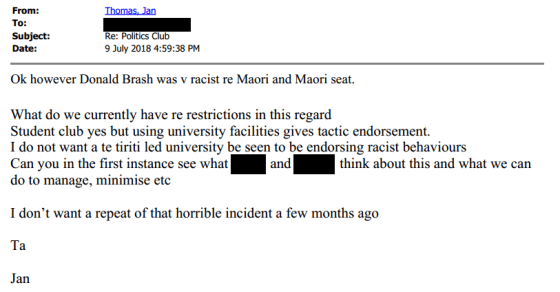
It’s also upside down that Don Brash gets de-platformed and accused of hate speech for wanting public policy and the law to be blind to race while our judiciary happily use their esteemed platform to make decisions precisely based on race.

Review: Bob Dylan in Christchurch last night, by John Stringer

A smiling and happy Dylan took a sold out Horncastle Arena of adoring New Zealand fans in Christchurch on a tour of re-arranged songs from across his six decades of albums.

At 77 –dressed in a silver grey tuxedo jacket, bus conductor pants and a black Western shirt with silver buttons and a bolo tie, and that trademark mussy Dylan mop top, but no hat this time – Dylan still has it.

Singing without any backing vocals, just his five-piece live Band, the man from Duluth, Minnesota, sent us through a rollicking three sets of re-arranged songs without a break over two solid hours.

He sang a set from the early days, the middle of the concert was more recent songs, and ended up with some 60s classics.

Kicking off with Things Have Changed from Wonder Boys (for which he won his Academy Award which was on stage) and It Ain’t Me Babe and Highway 61 Revisited, Dylan took us to a strong new version of Summer Days with some high energy southern fiddle.

He variously stood askance or sat down playing vigorous or melodic reflective baby grand piano and there was plenty of trademark harmonica. At two points Dylan left the baby grand piano to huge applause and sang centre stage. There was obvious fun with those gangly Dylan stage moves and the hand on the hip.

Bob Dylan plays Christchurch for the fourth time, 28 Aug 2018, Horncastle Arena.
Bob Dylan plays Christchurch for the fourth time, 28 Aug 2018, Horncastle Arena. PHOTO: JOHN & LAURIE STRINGER. 

Non-use of hand-held devices, recording or photos and video was strictly enforced. People were encouraged to just enjoy the performance for once instead of distracting everyone with little illuminated screens in their faces. We were 20 metres away and caught every Dylan grimace and nuance. He was really enjoying himself in Christchurch. It was fun watching The Band watching Dylan like a hawk, to see where he was going next and what chords to follow in. Classic Dylan!

Backed by huge red velvet curtains which Dylan brought with him, The Band wore black fedoras and matching tuxedo jackets with silver glitter lapels. Dylan had a matching silver yoke on his Western shirt. The stage was full of retro nostalgia (also brought in) such as: a suspended set of seven vintage trashcan-style movie-set spot lights, a ring of eight caged retro industrial lights on stands glowing orange in some songs and to the right of the piano, his academy award and that neo-classical bust of Athena with a bob that he takes everywhere.

Dylan gave us: Tangled Up in Blue, Roman Kings, Like A Rolling Stone, Honest With Me, Make You Feel My Love, Love Sick, Thunder on the Mountain, Don’t Think Twice, It’s Alright, among others. Some were unrecognisable new renditions. I didn’t recognise Desolation Row until it was over.

Perhaps the highlight of the evening was a new version of 1979’s Gotta Serve Somebody from Slow Train Coming, but with funny new lyrics: “You mi-ght be a My-stic…” something about a “fine-toothed comb” and “hallucinating, you mighta seen a ghost” to “you might not even know, the day of your birth!” which was received with standing applause and Dylan beaming.

He encored at 9:50pm after 110 minutes with a nice Blowin’ In the Wind backed by some lovely fiddle, and finished up with a feisty Ballad of a Thin Man (“Do Ya, Mr Jones?”) from 1965. The audience loved it and Dylan seemed pleased, smiling and grinning throughout.

​Here’s the Setlist, 20 songs in all:

Things Have Changed
It Ain’t Me Babe
Highway 61 Revisited
Simple Twist Of Fate
Summer Days
When I Paint My Masterpiece
Honest With Me
Tryin’ To Get To Heaven
Make You Feel My Love
Pay In Blood
Tangled Up In Blue
Early Roman Kings
Desolation Row
Love Sick
Don’t Think Twice, It’s All Right
Thunder On The Mountain
Soon After Midnight
Gotta Serve Somebody
Blowin’ In The Wind [encore]
Ballad Of A Thin Man [encore]

Backlash against Handley

The Spinoff reports:

Much of New Zealand’s tech community has reacted with derision to a report entrepreneur Derek Handley is all-but-certain to soon be announced as New Zealand’s first chief technology officer. The critiques, which erupted on Twitter and have been followed with interviews and emails to The Spinoff, are notable for the diversity of their tech experience. Those who have spoken out include people with engineering, investing and UX/design backgrounds, as well as fellow tech founders.

It’s almost a who’s who of the tech world.

The storm was best captured by Nat Dudley: “Literally everyone I know in tech, an industry known for arguing over the stupidest shit like which almost-identical JavaScript framework they’re going to use, is united in the idea that Handley would be a terrible pick for NZ CTO.”

So will the Government proceed with Handley in the face of such opposition?

The general sentiment among those The Spinoff spoke to was that if the role is worthwhile, then Handley is not right for it – and that if Handley is right for the job then the job has no purpose.

Ouch.

How have the Brexit predictions gone

Asa Bennett writes in The Telegraph:

Philip Hammond relied on analysis drawn up by Treasury officials in warning of “large fiscal consequences” for Britain of leaving the EU without a deal. Their analysis, he said, indicated that Britain would take a 7.7 per cent hit to GDP over the next 15 years if it were to leave under such circumstances.

The Chancellor’s sombre assessment brought a stinging response from Eurosceptics, with Jacob Rees-Mogg lamenting: “As a dog returneth to its vomit, so a fool returneth to its folly. The Treasury is desperate to stop Brexit. Everything [it] does has to be read in this light.”

Despite his faith in what officials are saying, Mr Hammond has previously said that “forecasts are there to be broken”. But a look at what the Treasury previously forecast about Brexit, which Eurosceptics saw as “Project Fear”, suggests he should not forget that.

So let’s look at the Brexit predictions:

Fear: Recession by Christmas 2016

The Treasury envisaged that merely voting to leave the EU would cause an immediate “shock”, that would see the economy “fall into recession with four quarters of negative growth”.

“Does Britain really want this DIY recession?” said George Osborne, the chancellor at the time. “Because that’s what the evidence shows we’ll get if we vote to leave the EU.”

Reality: The United Kingdom has not had a single quarter of negative growth after the referendum, with no recession materialising.

So no recession.

Fear: Tens of billions in extra borrowing

The Treasury expected that ministers would have to borrow tens of billions of pounds further amid the economic shock after a Leave vote. It estimated the bill after a year would be around £24 billion, or as high as £39 billion.

Reality: The battle against the budget deficit is almost over, with the latest official figures showing government borrowing has fallen to its lowest level in 16 years. Last month was the biggest surplus for any July since 2000 as receipts outstripped spending by £2 billion.

Books are finally back in surplus.

Fear: Lower productivity

The Treasury used what it called “many cautious assumptions” to warn of “lower future productivity” after a vote to leave.

Reality: Official figures confirm that output per hour worked is higher than where it was at the time of the referendum, with the last update from the Office for National Statistics revealing that it had grown by 0.9 per cent compared with the three months before. This marked its first rise since late 2016 and the biggest increase since the second quarter of 2011.

Productivity up.

Fear: House prices falling by nearly a fifth

Mr Osborne was blunt during the referendum about what would happen to property prices in the two years after the referendum: “The country and the people in the country are going to be poorer. That affects the value of people’s homes and the Treasury analysis shows that there would be a hit to the value of people’s homes by at least 10 per cent and up to 18 per cent.”

Reality: The average UK house price has risen over the last two years, the Office for National Statistics has confirmed, with it now at £228,384. That represents a rise of around 7 per cent.

No housing market crash.

Fear: At least half a million more people out of work

The Treasury thought “unemployment would increase by around 500,000” after a Brexit vote. This was a conservative estimate, as officials thought the number could be as high as 820,000. The unemployment rate would increase by as much as 2.4 per cent.

Reality: The number of people out of work has fallen markedly since the referendum, from around 1.63 million to 1.36 million. Such a low level has not been seen in over 40 years. The unemployment rate fell over the same period from 4.9 to 4 per cent.

This is probably the biggest fear reversal. A 40 year low for unemployment.

Small businesses unimpressed

Stuff reports:

Small businesses have little faith in the Government’s new Business Advisory Council as it tries to win the confidence of business.

Bryn Thompson of  Metalcraft Engineering runs a metal fabrication company employing 24 staff in Christchurch.

He said the new business council would do “zero” for business confidence.

What businesses want is some certainty over the policy and legal environment they will have to operate under. Another working group isn’t what they need.

A Whangarei booking keeping business owner Di Crawford-Errington said the business council announcement did little to bolster her confidence.

“In my industry compliance costs have been going through the roof, with new regulations around money laundering. It feels like we’re bombarded by extra regulation and that can really knock your confidence down,” Crawford-Errington said.

Every new regulation is an extra cost on business.

So about that no safe level of alcohol

David Spieghalter from the Winton Centre writes:

A recent paper published by the Lancet demonstrating the global impact of alcohol consumption was a huge exercise from the Gates Foundation-funded Institute for Health Metrics and Evaluation (IHME) in Seattle. They built a large and complex statistical model from a vast range of data sources, and conclude that while moderate alcohol consumption may be preventive for some conditions such as ischaemic heart disease and diabetes, when combined with increasing risk of cancers and other outcomes there is a steadily increasing harm from alcohol consumption, as shown in Figure 5 from the paper reproduced below. This leads them to argue that there is ‘no safe level’ of alcohol.

Which contrasts with the bulk of scientific evidence to date that moderate drinkers have better health outcomes than non drinkers.

But in spite of the Lancet’s own guidelines for meta-analyses saying

“For risk changes or effect sizes, give absolute values rather than relative changes”

the paper did not report any absolute risks, meaning that readers couldn’t tell how dangerous drinking alcohol really was for them. 

Almost everything we do has some risk or danger – working, skiing, drinking, chocolate etc. The important thing is how big is the risk. Smoking is a huge risk, chocolate less so.

Specifically, comparing no drinks with one drink a day the risk of developing one of the 23 alcohol-related health problems was 0.5% higher — meaning 914 in 100,000 15–95 year olds would develop a condition in one year if they did not drink, but 918 people in 100,000 who drank one alcoholic drink a day would develop an alcohol-related health problem in a year. 

So the increase in risk is four people in every 100,000 will develop an alcohol related health problem if they have a drink a day.

I’d have a drink to those odds.

Let’s consider one drink a day (10g, 1.25 UK units) compared to none, for which the authors estimated an extra 4 (918–914) in 100,000 people would experience a (serious) alcohol-related condition.

That means, to experience one extra problem, 25,000 people need to drink 10g alcohol a day for a year, that’s 3,650g a year each.

To put this in perspective, a standard 70cl bottle of gin contains 224 g of alcohol, so 3,650g a year is equivalent to around 16 bottles of gin per person. That’s a total of 400,000 bottles of gin among 25,000 people, being associated with one extra health problem. Which indicates a rather low level of harm in these occasional drinkers.

A nice fact check.

Next look at 2 drinks a day, that’s 20g, or 2.5 units, slightly above the current UK guidelines of 14 units a week for both men and women.

In this case, compared to non-drinkers an extra 63 (977–914) in 100,000 people experience a health problem each year. That means, to experience one extra problem, 1,600 people need to drink 20g alcohol a day for a year, in which case we would expect 16 instead of 15 problems between them. That’s 7.3 kg a year each, equivalent to around 32 bottles of gin per person. So a total of 50,000 bottles of gin among these 1,600 people is associated with one extra health problem. Which still indicates a very low level of harm in drinkers drinking just more than the UK guidelines.

This analysis supports the current UK guidelines as being low-risk, but perhaps would better be described as ‘very low-risk’.

So the current guidelines are pretty good.

The paper argues that their conclusions should lead public health bodies “to consider recommendations for abstention”.

But claiming there is no ‘safe’ level does not seem an argument for abstention. There is no safe level of driving, but government do not recommend that people avoid driving.

Come to think of it, there is no safe level of living, but nobody would recommend abstention.

Presumably people who choose to drink alcohol moderately get some pleasure from it, and any risk needs to be traded off against this enjoyment.

Exactly.

Full vs edited versions

A reader has compared Sunday TV’s full interview with Stephan Molyneux and Lauren Southern with what they edited to screen. In bold is what screened.

SM Stephan Molyneux

LS Lauren Southern

Video of full interview is here https://youtu.be/DzZyKsLj4ao

Interviewer   Stephan the science around the claims that race is linked to IQ is something that you have promoted

SM  No no this is not accurate

Interviewer   Explain?

SM  This is not something  I have promoted. This is not my research. I have had a wide variety of experts on the show who have talked about the fact that IQ ‘s do differentiate between the races. So it is not my perspective or my belief or something I have promoted. This is a bit of like don’t shoot the messenger. It is very well understood.

Interviewer  You have provided a platform by talking to those people

SM  Yes of course becauseI think that facts are very important when it comes to talking about things like ethnicity. And so this is very well understood, very well studied and is one of the most certain things in the field of phycology and the field of neurology and neuro biology. This is one of the most certain things in the field

And it t is tragic to me that the really essential information that helps clarify and inform our discussion about races, it is not the be all and end all and you never judge individuals by aggregate characteristics, but we need to talk about this because otherwise the only explanation to different outcomes of races is to blame white racism and that’s racist because there are lots of other explanations that can help more deeply inform our discussion about these issues.

Interviewer Isn’t it the case that it is undisputed, it is disputed that race is connected to IQ. I mean the person that came up with IQ testing accepted that environmental factors played a huge role

SM I have never denied environmental factors. The latest research I have, and I had the editor of the magazine called Intelligence on the show and he said at about the age of 18 years IQ is about 80% genetic. There are environmental factors and I have promoted this throughout my show, peaceful parenting, breast feeding, don’t yell at your kids, reason with your children, give them great language skills, education can be very important. Whether or not that is going to fundamentally change your IQ remains a pretty dicey question but it helps people use in essence what they have to their best advantage.

Interviewer  Have you had people on your show to dispute the science

SM  Yes absolutely  in fact one of them is a NZer. Dr James Flynn, I had him on for an hour and he talks about some of this stuff and Dr Eric Turkheimer  came in, he talked about the environmental issues, so yes I have tried to have a very robust debate on the show regarding this. I hope, you know my hope is that it is as much environmental as possible because otherwise we have much more limited a tool set to work with but these are questions we need to talk about.

Interviewer Lauren where do you stand on that?

Lauren Southern gave her views generally in support of Stephan and concludes saying

LS I am not an expert on this so I have not delved in to this but the fact that there is such a big suppression of this conversation is very very scary

Interviewer It isn’t suppressed though because it is on the internet

LS Its absolutely suppressed

SM If there wasn’t an internet there would be far less discussion and if you look at the controversy in 94  that came out with ….  Murray’s The Bell Curve. He was viciously attacked. The information has been repeatedly attacked. Anybody who talks about this gets the inevitable label of racist

Interviewer  maybe that’s because the majority of science doesn’t support it

SM  The majority of science does not support what?

Interviewer What you are talking about that race is connected to IQ

 LS Do you have evidence for this?

SM The majority of science does support it.

Interviewer  Well I am just suggesting why maybe it subconscious……

SM  Well lets just say…., I don’t believe what you say is correct, I have cast my net pretty wide getting people on and on this there is fairly unanimous agreement, but let’s say you are absolutely correct that there is this big controversy then we should have a very robust debate about it and not suppress the  information 

You get a very different impression from the full transcript.

Chelsea Manning in NZ

Stuff reports:

National is calling on the Government to bar ex-US army intelligence analyst Chelsea Manning from visiting the country next month.

Former Immigration Minister Michael Woodhouse said the “convicted felon” should not be allowed to earn money talking about her crimes, and it would “not enhance” New Zealand’s relationship with the US. …

Woodhouse said if an application from Manning had landed on his desk while he was Immigration Minister, he would have denied it, and called on the Government to do the same.

“This is a convicted felon, sentenced to 35 years in jail, coming in here for money,” Woodhouse said.

“She is wanting to be hailed as a hero for stealing military secrets and state secrets. She was convicted of very serious crimes. …

Green Party foreign affairs spokeswoman Golriz Ghahraman said Manning should definitely be let into New Zealand.

“She got her criminal convictions for acts that were in fact in the public interest. She doesn’t pose a risk for New Zealand in relation to anything that dates back to those convictions…It’s not like she was a drug or sex offender,” Ghahraman said.

I’m actually agreeing with Ghahraman on this one.

I dislike what Manning did and think it was right she went to jail. But she is now free, and if people in NZ want to hear what she has to say then they should be able to.

But what about the next term?

Stuff reports:

Prime Minister Jacinda Ardern has sought to ease concerns about a new type of collective bargaining, saying there will be “no more than one or two” fair pay agreements in the current electoral term.

If anyone thinks this is a concession, they’re falling for spin.

The working group is to report back by December 2018.

There would then be consultation on their report, taking you through to say March 2019. Then draft a law which takes you to say June 2019.

A law takes around nine months to get through Parliament which takes you to March 2020 – just a few months before the next election.

So when the PM says there will be only one or two in the current electoral term, this is not a concession or reassurance. It is merely recognition that there won’t be time for more.

But then how many in the second term? Will any industry be exempt? Of course not.

Rental changes

The Government is consulting on changes to residential tenancies, specifically these six changes:

substituting the ability for landlords to terminate tenancies for any reason with specific and justifiable criteria for ending a tenancy

This change means that property owners may effectively lose control of their property. Once you have a tenant in, you may never be able to get rid of them without going to the Tenancy Tribunal and spending heaps on lawyers fees.

setting the amount of notice a landlord needs to give to terminate a tenancy to 90 days under all circumstances

90 days seems reasonable to me. But tenants only have to give 21 days. Is this fair?

limiting rent increases to once a year

That is worthwhile. There is no reason in times of low inflation for rents to be increasing more often.

better equipping tenants and landlords to reach agreement about pets and minor alterations to the home

Seems to be about mainly saying landlords must give a reason why a pet is not allowed.

Why did Mallard even talk to Ardern about the inquiry?

The Herald reports:

RNZ revealed at 6 am on Friday that the text had been sent the week before, Bridges had a standup at about 9.30 am and revealed he had referred the text to the police, Ardern made her comments about the National Party at about 10 am, Mallard spoke to Simon Bridges at 11.30 am, Mallard spoke to the Prime Minister at 11.45 am, and he issued his statement cancelling the inquiry about 12.45 pm.

Why did Trevor Mallard even talk to the Prime Minister about the inquiry? It has nothing to do with her. It is an inquiry into the leaking of parliamentary information against the leader of the opposition.

Brownlee did not believe there would resistance among the caucus to National conducting its own investigation about the leak with a forensic specialist.

“Most MPs are pretty incensed that the Speaker has gone out and effectively pointed the finger at our caucus and made a couple of pretty serious accusations – one of extreme disloyalty and another of a problematic mental illness.”

Unless the Speaker knows for sure who the leaker is, why has he concluded it is someone within National?

Handley tipped for CTO job

Stuff reports:

It is now an “open secret” that entrepreneur Derek Handley was about to be announced as the country’s first chief technology officer last week.

After his secret meeting with the Minister which was hidden from staff and officials, and not even disclosed to written parliamentary questions.

It may be unfair to Handley, but appointing him after that will be a very very bad look for the Government.

As CTO, Handley would have a potentially highly influential role in charting a digital future for the country which could touch on a wide range of government initiatives.

Creating the role – which comes with a salary of up to $400,000 and a $100,000 travel budget – was the flagship of Labour’s ICT policy before the election.

But it is one that is still vaguely defined and there are different views as to what the job should be or whether it should even exist.

$400,000 for a vaguely defined job, that you get after a secret meeting with the Minister.

Wellington bus anger

Stuff reports:

Bureaucrats faced the wrath of some Wellington bus users at a meeting to discuss the city’s new, and problematic, bus network.

About 300 people were at the public meeting of the city’s southern and eastern suburbs on Sunday afternoon, at which officials were jeered at and abused by frustrated bus users. 

The new bus system has caused an outcry from those using it since it was implemented in July; driver shortages, a lack of route knowledge, no-show ‘ghost buses, overcrowding, IT malfunctions, and poorly planned timetables have seen the overhaul labelled a disaster.

The bus system before the “upgrade” was actually pretty good. Wellington has always been a public transport friendly city (as it is so compact). The WRC has managed to take a good system and turn it into a disaster.

GWRC chairman Chris Laidlaw and public transport general manager Wayne Hastie faced heckling from the crowd as they tried to state their case. Perhaps one of the biggest jeers of the afternoon came when Hastie suggested the service had improved overall during the past week.

But Laidlaw took the brunt of criticism. He was jeered at, shut down and abused as he addressed a number of issues.

Good on him for facing up, but elections next year could be pretty ugly for incumbents.

Former IT boss and Miramar bus user Joe Stewart told the officals the new network was a disaster and slammed GWRC’s excuses over malfunctions with its new computer system.

“If you’re putting in a new computer system there’s this great concept called testing,” Stewart said to loud applause. 

Not a new concept either.

That is not near a school

Stuff reports:

The Department of Corrections has set up a paedophile village – outside the wire and a short walk from multiple schools – at Rimutaka Prison.

While the move has shocked a nearby parent who only found out after it was a done deal, a prison expert says Corrections is dealing with the tricky situation of housing child-sex offenders in the most-realistic way. 

Mike Williams, head of penal reform organisation the Howard League, said prisoners had to be released eventually under supervision and nobody wanted them to move into their community so housing them on prison land was a solid compromise.

Sounds pretty sensible to me. A sort of halfway house.

So is it really “near schools and childcare centres” as the headline claims?

The prison grounds are 1.5 kilometres from Hutt International Boys’ School, 1.8km from St Brendan’s School, and Silverstream School is 2.8km away.

That is not near a school. I suspect there is no location in urban New Zealand that is not within 1.5 kms of a school. We have 2,500 schools in NZ.

As an example, there are 64 schools in Wellington City. Let’s assume they are equally spaced out. If each school has a circle around it with a 1.5 km radius then each schools takes up 7 square kms. 64 schools would take up 448 square kms.

The urban area of Wellington City is 442 square kms.

Being within 1.5 km of a school is not close to a school. That is fear mongering. Being 100 metres from a school is close. Being 1.5 km from a school just means you live in a city.

Local mother Gina Roberts on Thursday received an email from her daughter’s school and was immediately concerned as there were four schools or early childcare centres within 4km of the site. 

If you say nothing can be within 4 km of a school or early chilldhood centre you are saying nothing can be within 50 square kms of a school or early child centre.

There are 8,000 schools and ECEs in NZ. So the exclusion zone for them would need to be 400,000 square kms. The total area of NZ is 268,000 square kms.

So this really is hysterical nonsense.

Where’s the proof Kelvin?

The Herald reports:

Minister of Corrections Kelvin Davis has spoken in favour of prisoners having the right to vote, saying it is an important part of reducing reoffending.

Interesting that Labour is campaigning to give Clayton Weatherston the vote.

If there was evidence that allowing prisoners to vote reduces reoffending, I’d be interested to see it.

Is there any such evidence?

What happened to the reoffending rate of prisoners sentenced to less than three years jail after they lost the vote around 2011? Does Kelvin have data showing that their reoffending rate has increased since then.