An excellent initiative from the Greens

Metiria Turei announced:

The Green Party has announced a policy to bring more clarity into the political system today, in Co-leader Metiria Turei’s State of the Nation Speech.

Green Party Co-leader Metiria Turei proposed the formation of the Policy Costings Unit (PCU), which would operate independently to cost the policy of political parties.

“New Zealanders deserve more transparency from their politicians so that they can better engage in the political system,” said Mrs Turei.

“That’s why the Green Party is proposing the establishment of the PCU, to provide independent costings for the policies proposed by political parties.

“The PCU would be an independent unit within the Treasury and available to all parliamentary parties. It would help cut through the noise of political party promises and deliver New Zealanders unbiased information.

This is an excellent idea, and something I have long advocated.

Politicians often release uncosted policies that would require massive take hikes to fund.

It is because of this, that the Taxpayers Union spent a lot of money hiring a top economist to cost the policies of major parties at the last election. We called it a bribe-o-meter. We found that that in 2014 the cost of policies proposed was:

  • National $1.4 billion
  • Labour $5.81 billion
  • Greens $6.54 billion
  • NZ First – impossible o calculate

Since the election I have kept a running total of demands for more spending by politicians, media and lobby groups. Since the 2015 Budget there has been an extra $11.7 billion in new annual spending demanded. This would require a top tax rate pf 87%!

So an agency to cost parties policies is an excellent idea. It would allow parties to get expert advice on the cost of a proposed policy and the public to them understand how much their taxes will have to increase by, to fund those policies.

My only quibble is that I would have the agency attached to one of the parliamentary agencies, so it is like the Congressional Budget Office in the US. Having it in the Treasury may open the Treasury up to (even more) partisan attacks if a party doesn’t like the costing.

I’m staggered National has rejected this proposal. They should be supporting it strongly. It would be a welcome step towards greater fiscal transparency and a better informed voting public.

EU says most asylum seekers are not genuine refugees

The Telegraph reports:

Six in 10 migrants arriving in Europe are economic migrants with no right to asylum, one of the EU’s most senior officials has disclosed.

Frans Timmermans, the first vice president of the European Commission, said that the majority of those coming to the EU are not fleeing war or persecution.

Many are Tunisians or Moroccans who were joining the migrant trail through Turkey, he said, and they must be deported if the public is to consent to aiding asylum seekers.

How do you deport 600,000 people a year? Each one can appeal and appeal and the time and costs will be beyond belief.

This is why you need a secure border, and genuine refugees should be encouraged to go through the UNHCR system, rather than just turn up at the border.

The Press on a 4th term for Key

The Press editorial:

So what are the potential threats to Key’s hopes for a fourth term? Unless something goes drastically wrong between now and the second half of next year, it looks unlikely the Labour Party under Andrew Little will be in a position to pull together the next government.

They need to persuade 200,000 more NZers to vote Labour to be in with a chance.

In terms of successors to Key being actively groomed or quietly blossoming within the National Party’s caucus, there will be some definite contenders post-2017. But In terms of challengers who might actively challenge his leadership before that election or after, that is harder to foresee.

Near impossible to imagine.

If Key does lead National to its fourth successive victory, it will then become a question of when he might stand aside. Would it be within a few months of the election or as late as possible? That last strategy runs the risk of locking a leader into the next election campaign and yet another possible term as prime minister. Voters will need to know how far into that fourth term he might stay as leader.

He can’t say in advance because you become lame duck, but my pick would be during the latter half of the 2nd year, so after around 11 years in the job.

Who might be Key’s possible successor? It depends who you listen to, but the personable, fifth-ranked Paula Bennett is a rising star of some charisma. Now minister of climate change issues as well as social housing and state services, she is also associate minister of finance, a sign, some say, that she is being groomed by Key.

Deputy Prime Minister Bill English is a steady pair of hands but would be a case of “been there, done that”. Steven Joyce has vast experience and is in the same mould as a Bill Birch or Michael Cullen, but does not have the populist touch needed. Neither does Gerry Brownlee.

Then there’s Judith Collins – she has her supporters in caucus but may be a bit too divisive. Jonathan Coleman and Simon Bridges are possible leaders of the future, and so is Amy Adams, but she is currently a long shot.

I should point out Bill English has said he will never seek the leadership again.

That Key says he realises he is not indispensable appears an encouraging sign of self-awareness, a trait some other leaders have struggled to master. Short of a major change in fortunes, he could well still be prime minister in two or three years’ time.

Key has actively worked to promote successors, unlike some of his predecessors.

Good reviews for Tickled

Stuff reports:

Former Mediaworks journalist David Farrier should be tickled pink by the response to his debut documentary at the Sundance Film Festival.

Farrier, who recently left the broadcaster and his role on late night show Newsworthy, premiered Tickled at the prestigious Utah-based annual festival on Monday evening NZ Time.

A documentary that explores the world of “competitive endurance tickling” and boasts British comedian Stephen Fry as an associate producer, it has already received some impressive notices from renowned film industry magazines and websites.

Writing for Variety magazine, Dennis Harvey says that “what sounds like a fun look at a particularly outre subculture turns out to be no laughing matter”.  

“David Farrier and Dylan Reeve’s documentary traces the New Zealand duo’s investigation of an online tickling-video empire, behind which there lurks a monster of cyberbullying and litigiousness. An alarming cautionary tale about how easy it is in the Internet age to ruin people’s lives while hiding behind a cloak of anonymity, the pic boasts a humorously titillating entry hook that soon gives way to engrossing conspiracy-thriller-like content.”

Predicting that the movie will sell well internationally, Harvey says “the well-shot and tightly edited pic manages to maintain a sense of humour without belittling its subjects, and glimpses a somewhat gamey underworld without descending into a tabloid-style shocking expose”. …

“At times his [Farrier’s] perky narration, half indignant, half tongue-in-cheek, and the confrontational, hidden-camera style of some of the film’s investigative sequences, remind us of one of those exposes British comedian/journalist John Oliver used to do on The Daily Show before he became too well-known.

“But there’s something else going on in Tickled too, something a little more cinematic. Part of this is a portrait of a lost blue-collar America, a post-Springsteen world where young men from no-hope towns try to scrape some money together by letting themselves be pummelled in Mixed Martial Arts bouts – or being tied down and tickled, on camera. If that sounds a little reminiscent of Foxcatcher, at least in mood, it is.”

Marshall predicts the film will find a cinematic release and revealed that Vendetta Films had already signed up to distribute the film in Australasia. No release date has so far been announced.

I have an interest in this film as I helped crowd fund it. The guy being exposed started threatening all sorts of legal action, so lots of people online contributed to help out.

This review gives a good idea of what it is about.


The benefits of driverless cars

The Herald reports:

The car barrelling down a Japanese freeway with New Zealand’s transport minister on board lacked a driver. Instead of drifting into a side barrier, the state-of-the-art ­Nissan seamlessly changed lanes to overtake other cars.

Simon Bridges was joined by long-serving Ministry of Transport chief executive Martin ­Matthews for the ride in one of Nissan’s ­autonomous vehicle prototypes, during a visit to Japan last July.

“There was a person in the driver’s seat but not doing anything, and we were on a motorway and this vehicle was changing lanes and passing ­other vehicles,” Matthews recalled.

“The manufacturer said that ­vehicle will be on showroom floors in five years.”

The hype around driverless ­vehicles and the revolutionary effect they could have has produced sceptics, and much remains unknown, including how the vehicles might operate in normal traffic.

But the Nissan ride impressed our top transport official, and his ­ministry is working out how radically the country’s transport system could change as technologies arrive.
In the US this week, the Obama administration proposed spending nearly $4 billion on driverless car ­development over the next decade.

Car-makers and safety regulators hope self-driving cars could eventually eliminate the 94 per cent of fatal crashes that involve human error. They also believe the technology could reduce greenhouse gas emissions and loosen gridlock.

Just as most planes operate on auto-pilot, one day are cars will also.

If one could order a driverless car to pick you up from where you want, and deliver you to your destination, I’d not need to have a vehicle for myself.

An OECD think-tank has ­modelled what a large move to ride-­sharing would mean for a mid-sized ­European city, Matthews told the ­select committee. It found Lisbon would need only about 30 per cent of ­today’s vehicle fleet.

Great.

“At the moment we tend to think of a binary choice between private ­vehicles and public transport,” he said. “Mobility as a service may well lead to a third choice.”

Public transport is great for some stuff but it is on fixed routes. A transport provider that can pick you up from anywhere and deliver you anywhere, at a much cheaper rate than taxis, will fill a niche.

So what is Labour’s position on the TPP?

Listen to this six minute interview with Andrew Little on Morning Report on the TPPA and then tell me whether Labour supports or opposes the TPPA.

I defy anyone to tell me the answer, because it is impossible. He just keeps using the same cliches and slogans yet can’t state clearly where Labour stands on it.

Meanwhile Todd McClay has released the TPPA National Interest Analysis. The analysis says:

TPP would be New Zealand’s first FTA with five countries, including our fourth and fifth largest trading partners (the US and Japan). TPP countries account for NZ$20 billion (40%) of New Zealand’s global goods exports, NZ$8 billion (47%) of New Zealand’s global services exports, and three quarters of New Zealand’s outwards and inwards investment. …

An estimated NZ$334 million is paid annually in duties on New Zealand exports to the five TPP countries with which we do not have existing FTAs (the US, Japan, Canada, Mexico and Peru).1 While TPP has not delivered the full elimination of tariffs on our exports that New Zealand sought, it would deliver substantial benefits to exporters from the moment the Agreement enters into force, and the full elimination of tariffs on 95.4% of New Zealand exports when fully phased in, saving NZ$272 million in duties in these five new markets.

The savings by sector are:

  • Dairy $96m
  • Meat $84m
  • Horticulture $34m
  • Wine $16m
  • Forestry $11m

And the long term:

Economic modelling commissioned by the New Zealand Government estimates that once fully in effect, TPP would result in New Zealand’s GDP being about 1% larger than if TPP had not existed, adding NZ$2.7 billion to GDP (in 2007 dollars) in 2030.

Also if we do not participate TPP, then our GDP will shrink as more trade will flow between TPP partners, which we’ll be excluded from.

From the first year of entry into force, TPP would be of net benefit to New Zealand8 . This net benefit would grow substantially as the benefits from TPP come on line (e.g. tariffs phased out over longer periods). Total benefits after three years are predicted to be ten times larger than costs, with the gap continuing to widen as the economic benefits of greater export opportunities were made available to New Zealand businesses.

The impact on GDP in the long term is projected as:

  • Reductions in tariffs and quota barriers on goods trade $624m
  • Reductions in non-tariff measures (NTMs) on goods trade $1,460m
  • Improved trade facilitation measures $374m
  • Reductions in barriers on services trade $250m
  • Copyright term extension -$55m
  • Foregone tariff revenue -$20m

Yet Labour are joining protests against the TPP, while still trying to avoid stating a position on it.


US and NZ in Antarctica

The relationship between New Zealand and the United States when it comes to Antarctica is as co-operative and helpful as one can get. While McMurdo and Scott Base are run separately, there is a huge amount of assistance and co-operation between the NZ and US Antarctic teams.

ANT0032

One major area is transport. We flew on a US Hercules. They provide most of the transport to Antarctica for us. But the RNZAF also flies Hercules down, and sometimes US staff will ride on these.

The US provides overall air traffic control and co-ordination and maintains the three landing fields.

ANT0116

New Zealand built and constructed three wind turbines a few years ago, to reduce the use of generators. The wind farm now provides 30% of the total energy to both McMurdo and Scott Base.

ANT0121

McMurdo has the port where once a year an icebreaker will come in, followed by a fuel ship and a cargo ship. It costs around $2.50 a kg to ship gear to Antarctica and $16 a kg to fly it, so the port is a huge cost saving.

ANT0128

You can see McMurdo here. It has around 1,100 people in summer and 90 in winter. Unlike Scott Base which has all major buildings joined up, McMurdo has no linkages. This means that if the weather hits condition one, staff may be stranded in the building they were  in. It also means you constantly need to change clothing to go to another building.

I much prefer the way Scott Base has been constructed.

ANT0142

McMurdo looks a lot like an old mining town. There are huge piles of dirt, fuel tanks and timber yards everywhere.

ANT0143

This is one of the most popular places in McMurdo – the second hand exchange shop. A huge amount of gear here that people donate when leaving for others to use. Some people even get their own gear back a few years later by chance!

ANT0144

And of course they have lots of communications stations.

New Zealand would not be able to achieve a lot of what it does, without the relationship with the United States. Antarctica NZ works with the National Science Foundation’ US Antarctic Programme and the RNZAF works with US Air Force. But the relationship is deeper than institutional.

You often get staff transfer between different bases in Antarctica – some Scott Base staff have worked at McMurdo, the Australian base and the Italian base (they have the best coffee).

An example of the helpful nature of the US team is from one of the science teams I was at Scott Base with. Their GPS unit (cost around $250) wasn’t working, so McMurdo lent them a $30,000 GPS unit they had for their field work.

Cunliffe standing again

The Herald reports:

Labour MP David Cunliffe has had a bruising fall in politics but intends to run for Parliament again in 2017.

Since Labour’s disastrous election result under Mr Cunliffe’s leadership in 2014, he has lost the leadership and was demoted to the backbenches by leader Andrew Little in November, a clear hint he should reconsider his political future.

Yesterday, Mr Cunliffe said it was his intention to stand again despite the torrid 18 months he’d had. “That’s the plan. I’m happy to be the MP for New Lynn and I’ve got work to do there.”

He indicated he was hoping for redemption within caucus. “Politics is a rollercoaster. You know that and I’ve been around long enough to know that.”

Cunliffe’s electorate is very loyal to him so if he wants to stay on, then he’ll win the selection.

I suspect Andrew Little would rather there were fewer ex-leaders hanging about!

Sounds a fun flat

Stuff reports:

A room-for-rent advertisement in Wellington that specified ‘no heterosexuals’ has been criticised by the Human Rights Commission.

The advertisement, which was listed on Trade Me on Thursday, included the line: “We don’t want to live with a couple, a heterosexual person, or someone who is loud at night, or drinks/does drugs/party[s] a lot.” …

It was for a four-bedroom house in the suburb of Newtown, which the existing flatmates described as a “queer, transgender, vegetarian household”.

They described themselves as two “feminist/politically switched on adults” and went to say they also did not want to live with anyone who is “racist, sexist, homophobic, transphobic, fatphobic [sic], hates sex workers, hates migrants or is otherwise a jerk”.

“We want to live with someone who is relaxed, motivated, grown up, reliable, considerate, child friendly, LGBTQIA+ [lesbian, gay, bisexual, transgender, queer, intersex or asexual], pays the board on time with no stress, [is] vegetarian or vegan.”

Sounds like a real fun place to live 🙂

But you know what I support their right to specify who they want to live with. They should be able to set whatever criteria they want.

Another expat student loan story

Stuff writes about Brad:

This is the situation facing 33-year-old Brad, who did not want to reveal his last name due to the distress it may cause himself and his family.

Brad said he left New Zealand for Melbourne in 2007 due to a lack of employment opportunities, after gaining a Bachelor of Arts with Honours in performing arts.

His loan is now at $108,000, with interest accounting for more than half of the debt.

It’s hard to verify this as we don’t know when he finished studying but if in 2007 you owed $62,000 then in 2016 you would owe around $108,000 if you have made no repayments ever. So only one third would be interest.

Brad said he made an arrears payment of $500 each month, an arrangement made with IRD, but can’t afford the $5000 minimum annual repayment. This means his debt keeps building.

$500 a month exceeds the minimum annual payment so he is complying with IRD and does not need to fear arrest. If he pays $6,000 a year then his interest is $5,724 so his debt should not be building.

The Whanganui-born expat said while he earned $60,000 a year, at least 30 per cent of that went towards living costs.

Which means he has 70% left over. 10% is going on his student loan. He could decide to make that 20% and start reducing the balance.

Brad said his loan had caused him “considerable stress”.

“I have been diagnosed with clinical depression and anxiety; the thought of my crushing student loan debt is constantly on my mind, and there are basically no options I have to remedy the situation.”

Pay back more?

Return to NZ and work here, so you get zero interest on the loan?

While he has been in contact with IRD, constant threats to detain borrowers has made Brad too scared to return to New Zealand most of the time. 

“I have returned to New Zealand twice in the last four years and each time I have had to seek anti-anxiety medication from my doctor simply to board my flight, and almost did not return last time, all because of the thought of my loan and being detained at Customs.”

I am sure he is distressed but on the basis of what he is doing (making repayments) he has nothing to worry about.

The borrower said he believed interest should be frozen to help people like him get ahead.

It is – if you live and work in NZ.

“I am supposed to be out here in the world representing New Zealand, promoting it, and instead I feel like I’m being punished for that, and I am deeply resentful of my nationality as a consequence…

No Ambassadors represent NZ. You’re in Australia presumably for reasons of employment of lifestyle. That’s fine, but it means you are not paying tax in NZ or contributing directly to NZ, so you are expected to pay back your student loan.

Quote of the week

“The point to remember is that what the government gives it must first take away.” 

– John S. Coleman

The quote of the week is brought to you by the New Zealand Taxpayers’ Union. To support the Union’s campaign for lower taxes and less government waste, click here.

Labour in Roy Morgan polls

RM Labour

The 1st poll of 2016 saw Labour at 27.5%. This is after we hear what a great year Labour had last year from the media.

The graph above shows Labour in the Roy Morgan poll since they started in 2005.

It is no surprise that they are lower than when they were in Government but they are lower than most of the time they have been in opposition.

In January 2010 they were at 32% and in January 2013 they were at 31.5%. These are at the same stage of the electoral cycle.

So they are polling 4% to 5% worse than they were at the same stage as their 1st and 2nd terms in opposition.

And how were National one year into their third term in opposition?

They were polling 42.5%.

Another claim not verified by media

Stuff reports:

A struggling solo mum in Blenheim is only $34 better off a week since she came off the benefit and got a job.

The 48-year-old said Marlborough’s low wage economy meant it was harder for people to enter the workforce.

The early childhood teacher, who worked 29 hours a week, earned $21.90 an hour, just more than the living wage set at $19.25.

“When you weigh it up, is it worth going to work?

“The Government is trying to get everyone off the benefit but there is no incentive to work.”

She received $580 a week when she was on benefits looking after her three dependent children aged 10, 15 and 17. 

Her new job, which she also juggled with studying for a bachelor in early childhood education, paid $614 a week after her student fees were taken out.

She missed qualifying for a working for family support benefit by one working hour.

This is not correct.

According to the IRD calculator if she is working more than 20 hours a week she should receive $239 a week in family tax credits and $60 a week for in-work tax credits which is $299 a week on top of the $614 from her job.

Either the anonymous person quoted is not mentioning this, or they are unaware of what they should be getting. Regardless she should be around $335 a week better off in her PT job if she is getting the tax credits above.

Jetstar needs more capacity

The Herald reports:

Hundreds of Jetstar customers were stranded in Queenstown overnight after their flight was cancelled.

Earlier today, a disgruntled Sam Collins emailed the New Zealand Herald to say his girlfriend, Rosie Shelton, was among more than 200 “irate” Jetstar passengers still at the airport, more than 24 hours after they were due to fly out of the resort town.

This is why I’ll never fly Jetstar.

It is great to have them providing competition and the cheaper fares on regional routes especially has benefited everyone.

But they have no spare capacity so when something goes wrong with a plane, it is not a 30 minute delay but a 24 hour delay.

Air NZ manages to have enough spare aircraft that they rarely have a domestic delay on more than minutes, or maybe a couple of hours.

If Jetstar wants to get rid of its poor reputation, it needs to invest in more capacity for when things go wrong.

Umm, no

Stacey Kirk writes at Stuff:

The value the Government places in New Zealand’s children will be judged by its appointment of the next Children’s Commissioner. 

Umm, no. Not at all.

The value the Government placed on children will be judged by the effectiveness of its policies that:

  • reduce welfare dependency
  • improve the education system
  • improve the heath system for children
  • boost after tax incomes for families

With no disrespect to the Children’s Commissioner, their impact on the wellbeing of children is minor. That is not to take anything away from the good work they do, but it is a very Wellington centric view that the appointment of an official is what matters to children’s welfare.

2015 hottest year since records began

The NOAA reports:

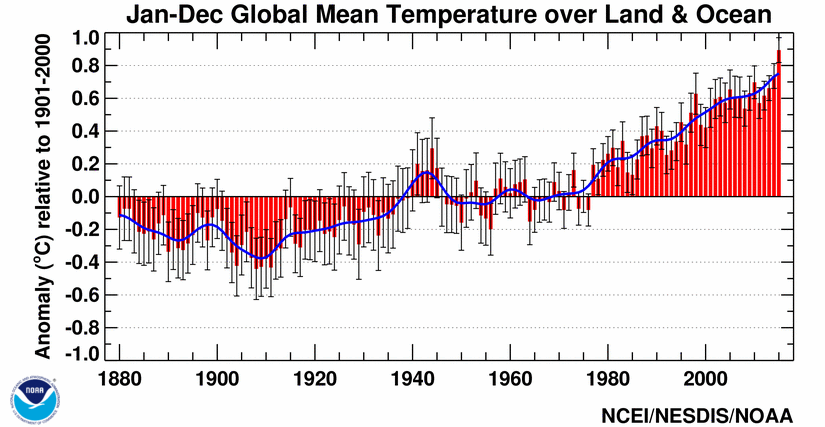
The globally averaged temperature over land and ocean surfaces for 2015 was the highest among all years since record keeping began in 1880. During the final month, the December combined global land and ocean average surface temperature was the highest on record for any month in the 136-year record.

Specifically:

  • During 2015, the average temperature across global land and ocean surfaces was 1.62°F (0.90°C) above the 20th century average.
  • This was the highest among all 136 years in the 1880–2015 record, surpassing the previous record set last year by 0.29°F (0.16°C) and marking the fourth time a global temperature record has been set this century.
  • This is also the largest margin by which the annual global temperature record has been broken.
  • Ten months had record high temperatures for their respective months during the year.
  • The five highest monthly departures from average for any month on record all occurred during 2015.

temperature

However what matters more is not the temperature for one year (as they get affected by many variables).  In the last 40 years or so the average temperature (sea and land) has risen around 0.7 degrees. The graph above shows the average by decade.

How the US electorate see the Republican candidates

538 looks at the favourability ratings of the Republican contenders. They tell quite a story.

First what do Republicans think of them:

  1. Ted Cruz +51%
  2. Ben Carson +47%
  3. Marco Rubio +46%
  4. Mick Huckabee +40%
  5. Carly Fiorina +30%
  6. Donald Trump +27%
  7. Chris Christie +23%
  8. Jeb Bush +13%
  9. John Kasich +7%

So all get positive ratings, but luke warm for Kasich and Bush, moderate for Christie, Trump and Fiorina and strong for Cruz, Carson, Rubio and Huckabee. This shows who may be best at turning out the Republican base.

But most Republicans will vote for the Republican nominee regardless. They key is winning Independents. What do they say?

  1. Ben Carson +5%
  2. Marco Rubio +4%
  3. Carly Fiorina +1%
  4. John Kasisch -1%
  5. Chris Christie -3%
  6. Ted Cruz -3%
  7. Mick Huckabee -6%
  8. Jeb Bush -13%
  9. Donald Trump -27%

So Carson, Rubio and Fiorina has slight favourability with Independents. Most have slight unfavourability and Trump has severe unfavourability. You really want someone from the top six to have a good chance of winning Independents.

Now what about Democrats. They won’t vote for the Republican candidate but the more they dislike them, the more likely they are to actually vote.

  1. John Kasich -4%
  2. Carly Fiorina -20%
  3. Chris Christie -24%
  4. Ben Carson -26%
  5. Marco Rubio -28%
  6. Jeb Bush -30%
  7. Mick Huckabee -34%
  8. Ted Cruz -37%
  9. Donald Trump -70%

Democrats really hate Trump.

And when you combine them all together, what do Americans say:

  1. Ben Carson +0%
  2. Marco Rubio -1%
  3. Ted Cruz -7%
  4. John Kasich -7%
  5. Carly Fiorina -8%
  6. Mick Huckabee -12%
  7. Chris Christie -13%
  8. Rand Paul -16%
  9. Rick Santorum -22%
  10. Jeb Bush -22%
  11. Donald Trump -25%

Trump winning the nomination would make Hillary Clinton the President.

More people die trying to get to Europe

Stuff reports:

At least 43 people, including 17 children, drowned when their boats capsized off two Greek islands near the Turkish coast on Friday (Saturday NZ Time), coastguards said, marking one of the deadliest days for migrants risking the perilous route to Europe from Turkey.

According to survivors’ testimonies, dozens were on board a wooden sailboat which went down off Kalolimnos, a small island in the Aegean Sea close to Turkey’s coast, one coastguard official said.

Twenty six people were rescued and at least 35 migrants drowned in one of the worst incidents in months, the official said. It was not clear why the vessel capsized, but witnesses said strong winds were blowing at the time.

Very sad.

But a reminder of why it is better to incentivise refugees and asylum seekers to go through the UNHCR system and refugee camps, rather than kill themselves taking dangerous journeys by sea in the hope of reaching Europe.

In flight wifi spreading

Stuff reports:

Internet-deprived airline passengers take note: Experts believe Qantas and Virgin Australia will be increasingly pressured to offer in-flight Wi-Fi on international routes now that most of their partners and competitors do so.

“American, Delta, and United now offer Wi-Fi on nearly all flights [from Australia] to the United States, but neither Qantas nor Virgin Australia do,” Jason Rabinowitz, data manager for airline product differentiation platform Routehappy, said. “At some point, passenger demand is going to force them to offer it.”

Rabinowitz’s comments came as Routehappy released its annual Global State of In-Flight Wi-Fi report.

Both airlines I used recently in the US had wifi on board. Veyr reasonable prices also – just $8 for an entire flight.

I look forward to Air NZ providing wifi one day. I understand the Pacific Ocean makes it a bit more challenging for them, but in a few years it will be standard on all longer flights and hopefully the shorter ones also.

Sue Bradford for Children’s Commissioner

Stuff reports:

Poverty activist and former Green Party MP Sue Bradford is in the running to become our next Children’s Commissioner.

No she isn’t. Applying for a job doesn’t mean you are in the running. If I applied to be UN Secretary-General, that doesn’t mean I’m in the running. To be in the running you need a non-zero chance of getting the job.

The Green Party has put Bradford forward as one of its nominees to fill the role when current commissioner Russell Wills’ five-year term ends in June this year.

And the chance of a National led Government appointing Sue Bradford as Children’s Commissioner is about the same as Labour-Green Government appointing Stephen Franks to be Chief Justice.

20 years of Sky City

The Herald reports:

The Sky Tower has overcome early scepticism to become an iconic image of the Super City, more photographed than Rangitoto Island, Auckland Harbour Bridge or One Tree Hill when it still had its lone pine. It is ubiquitous and disparaging labels from its early days, such as The Hypodermic, are seldom heard.

“Can you image the Auckland cityscape without the Sky Tower?” asks Nigel Morrison, SkyCity Entertainment Group’s chief executive. “You wouldn’t be able to identify it. Every photo you see has it in there. It has been embraced.”

It has become iconic, and I recall all the sneering and opposition to it, when first proposed. It now seems to have been with us forever, but in reality is just 20 years old.

SKYCITY IS a city within the city. It operates around the clock, employs 3500 people, and, come 2019 when the convention centre opens, will cover three downtown blocks.

That’s a lot of jobs.

Watching it grow are neighbours, St Matthew-In-The City and the Auckland City Mission.

Odd bedfellows you might think. “We are sandwiched between SkyCity and the City Mission,” says Reverend Helen Jacobi. “You find on one side the poorest of the poor and on the other the richest of the rich. That’s the kind of world we live in.” But, says Jacobi, look past the incongruity of a house of the Lord sitting next to the country’s biggest gambling den and SkyCity is a good neighbour, in fact they are business buddies. The church uses SkyCity’s catering for some of its own events and hosts functions for casino customers who want a different style of venue. “They are a good business partner for us, for a dinner, a cocktail function or a concert or whatever.

“Obviously we would have concerns, not on the morality but the damage to lives that can occur. I don’t think we would have an opinion on gambling per se but we know that people get addicted to gambling and we know that it can damage lives … but we live in the real world and Sky City is more than gambling, it is hotels and convention centre and restaurants. “The church is here for those people as much as it is for our [other] neighbours at the city mission.”

What a sensible approach.

About two-thirds of the company’s revenue comes from gaming, the rest from hotel rooms, hospitality and non-gaming entertainment.

Would be interesting to know the profitability on each.