General Debate 09 December 2023

The Business Committee has agreed the allocation of MPs on each select committee. They are:
So the Government has a majority on all bar Economic Development and Maori Affairs. Of course National has a majority on none of them, so select committees hopefully will be more independent of the Government than previously.
The Herald reports:
At the same time the former Labour Government was laying into the National party for announcing a poorly costed Transport plan on the campaign trail, its own officials were warning that Labour’s transport plan was substantially unfunded and undeliverable.
Treasury was so concerned that it recommended the ministers drop all new projects from one of the most significant parts of the plan.
Nevertheless, the former government proceeded.
If Ministers were company directors, they’d be prosecuted for fraud. They were told their plans were unfunded and impossible to deliver, yet they still proceeded with announcing them.
The combined list of new and old projects would require the Government to find $43 billion in funding over the next decade, officials said.
They also warned that an additional 100,000 workers would need to be found to deliver the new projects – a number roughly equivalent to the number of soldiers New Zealand sent to fight in the First World War. The current workforce is just 180,000 strong.
So that is $43 billion of more debt they hid, and it would require a magical increase in the construction workforce of around 70%!
The first ballot for members’ bills was done on Thursday. 95 MPs were eligible to have a bill in the ballot, but only 65 did so. How did each party do?
So Greens were on the mark, and National were impressively prepared considering how many new MPs they had.
The Auditor-General released:
After the official results of the general election were published on 3 November 2023, the Electoral Commission became aware of issues relating to the counting of votes. Subsequent investigation found that three voting places had misallocated party votes to the wrong parties during data entry, another 15 voting places had similar errors for candidate votes, one electorate had special votes entered incorrectly, five voting places had correctly entered voting data, but for the wrong days, and one electorate had missed counting the votes in a ballot box during the official count.
Although these errors had no effect on the outcome of the results of the election or the result in any individual electorate, the Commission had expected its quality assurance processes to have identified and corrected those errors before the official count was completed. Amended official results were published on 9 November 2023.
It is important that the Commission is able to have confidence that the errors it has identified will not re-occur in future elections. Avoiding these errors in future is also important for the public’s trust in the vote counting process. Therefore, after discussion with the Commission, we have decided to carry out review work about the Electoral Commission’s quality assurance processes for counting votes.
This is an excellent move. We need confidence that final results are indeed final. Data entry errors should not be possible if you have the right systems in place.
Earlier today, I viewed a 47 minute video of footage of the slaughter and execution of people in Israel on the 7th of October. The video was beyond horrific. The killings and torture combined with the joy and glee of the killers and their supporters can only leave you revolted and somewhat traumatised.
So why did I decide to take up an invitation to watch the footage (an invitation turned down my most media)? Because what happened needs to be witnessed and not dismissed or justified!
I recall the Christchurch Mosque massacre vividly because I was alerted at an early stage to the livestream of the terrorist. I watched it for around 60 seconds to verify it was real, and then contacted managers I knew in social media companies to try and get it blocked out removed. I never went back to watch any more of it, as it is sickening to see human lives snuffed out. It is not something anyone normal wants to watch.
But the difference between the two terrorist events, is that the world rightfully united in condemnation of the Christchurch mosque attack. Jacinda Ardern was at her finest as she responded to it, and only a very very small number of people on the extreme fringes tried to justify what happened that day as being justified by a wider political issue.
Sadly the 7 October terror attacks have not been treated the same. Before the killing had even stopped, there were groups and high profile people around the world celebrating or justifying what happened. The (legitimate) debate about Israel’s response had allowed many to consider what happened as just a small or insignificant part of an ongoing conflict.
What was done to civilians on 7 October 2023 was evil. There is no other word for it. The footage (most of it from the terrorist themselves) remains seared onto my eyeballs and soul. I watched it, so I could help ensure it is not forgotten.
Permission has been granted for me to write about what I saw. This will follow after the break. You may not want to read the details, but I think it is important for people to understand what happened that day was not war, but a gleeful slaughter.
Continue reading »Michael Johnston writes:
Mathematics is a lot worse. Our 2022 results for maths are down a whopping 15 points since 2018. That is equivalent to about six months of schooling lost in just four years. Since testing began in 2003, we have fallen by 44 points – equivalent to about one and a half years of schooling.
So our 15 year olds today are at the level 13 year olds were in 2003. That is a huge decline.
It is a similar story in mathematics. The numeracy project, introduced in the early 2000s, emphasised the learning of “strategies” over basic mathematical knowledge. Again, this is counter to evidence showing that basic number facts, like times tables, need to be learned cold to support further learning. But again, the ministry has failed to follow the evidence. Meanwhile, Singapore has adopted a science-informed approach to teaching mathematics and is enjoying spectacular success.
Oh god, strategies over actual knowledge, No wonder we are in trouble.
Some time ago I got some large posters for our dining room with the times tables on them. Very pleased our seven year old can do up to 12 x 12, and our four year old is starting to learn them also.
About 10 years ago, England adopted an evidence-based approach to teaching literacy, and a detailed, knowledge-rich curriculum. Their 2018 Pisa scores in mathematics and reading ticked up relative to 2015. That gives us an indication of what we need to do to halt our educational decline.
So we can follow success, with a willing Government.
Some in the education establishment will resist the changes. That is because they are in the grip of the same educational ideology that has led to our present malaise. But how we teach our young people should be determined by evidence, not by ideology or politics.
Absolutely.
Two great maiden speeches from the MPs chosen to lead off the Address in Reply debate. First was James Meager from Rangitata:
My dad is Ngāi Tahu, a freezing worker most of his life, a little Māori kid who was kicked out of school at 14 and who never told his parents, hiding in bedroom closets and spending afternoons down the river until he was old enough to convince his folks to let him go to work at 15. Until yesterday, he had never stepped foot in the North Island. His father, my grandfather, was a truck driver and a freezing worker, and my nana was a seamstress and a wool carder in Ashburton.
Dad’s a hard worker. He’s a bloody hard worker. You can’t stand on your feet for hours on end on the chain and in the boning room for 40 years without knowing what hard work looks like.
Once upon a time the only MPs from a working class background were in Labour, but today it is very different.
My mum and dad split up when I was in kindergarten, so Mum brought me, my younger brother, and sister up on her own—a single mum in a State house on the benefit with three kids. So I know what it’s like to be poor. I know what it’s like to grow up sharing a bedroom with my brother until I was 18. I know what it’s like to have to walk everywhere because we didn’t have a car until I was nine. I know what it’s like to see a father struggle to pay his bills and borrow money from his kid’s school savings account. I know what it’s like to see a solo mother juggle three kids, part-time work, correspondence school, and all the other worries that a single parent living in South Timaru has.
I know what it’s like to have your very first memory be of the police trying to coax you to come out from under the bed, telling you that everything would be OK. But make no mistake, we had a great life. We never went without. My mum has steel in her bones and grit in her soul. My recollection is that, yes, we were poor, but we were never in poverty. My mum always made sure there was food on the table, clothes on our backs, and books in our school bags. Mum made sure schooling was everything. We always went to school every single day.
The power of good parenting.
Perhaps to some I am a walking contradiction—you know, a part-Māori boy, raised in a State house by a single parent on the benefit, now a proud National Party MP in a deeply rural farming electorate in the middle of the South Island—but there is no contradiction there. Members opposite do not own Māori. Members opposite do not own the poor. Members opposite do not own the workers. No party and no ideology has a right to claim ownership over anything or anyone.
So important. Te Pati Maori think they speak for all Maori, when in fact they got just 3% of the overall vote, which would be less than 25% of the Maori population. The current Cabinet has more Maori MPs in it that I think any other Cabinet.
What unites us is our fundamental belief that it’s the individual family unit that knows what’s best for their family—not the State, not the Government, and not us. It’s not the State that saved my family; it was my mum. She took responsibility for our situation. When we fall on hard times, as we all will at some stage, it’s our neighbours and our community that should rally around in support. Only after that does the State become our safety net, as the neighbour of last resort.
So well stated.
Then we have Katie Nimon from Napier:
I would never call myself a political junkie; politics just happens to be neatly—or not so neatly—intertwined with life. Unfortunately, the more involved a Government becomes in people’s business, and businesses, for that matter, the worse things seem to get. In life, I have seen how different Governments have impacted communities through business. I have seen years where small businesses have become untenable, mum and pop owners sell to corporates, corporates grow, employment relations break down, unions grow, and service diminishes, and at some point along the way, the wind changes and the sun comes out. Instead of playing political whack-a-mole, I strongly believe in Adam Smith’s theory of the invisible hand. The argument for limited Government is a strong one, which is one of the many reasons why I stand here on this side of the House. I don’t claim to have all the answers, but you can’t spend your way out of every problem, nor can you regulate your way out of it. All you get is debt and dependency.
An Mp who endorses Adam Smith in her maiden speech – be still my beating heart!
My political values have come from growing up in a family where work was life, not just a job, and seeing the real-life impact of theoretical experiments. When you grow up in a house where your landline is the after-hours phone number for a transport company and your holidays are bus conferences, you see the importance of competitive enterprise and reward for achievement. Business owners, landlords, and farmers take risks to provide goods and services. When there’s no reward, why would they take that risk? Sadly, in the last six years, a growing number of these people no longer see the risk worth taking.
Reward for hard work should be celebrated, not envied.
Today’s education headlines:
NZ records worst ever PISA international test results, amid global decline
NZ school students’ performance falling in maths and science: PISA report.
Student hunger, bad teachers revealed in latest PISA tests showing dip in NZ teens’ scores.
Kiwi kids record worst ever international test results, could you have done better?
Pisa results: Why New Zealand’s education system is failing
2. The Ministry of Education must be massively restructured and re-purposed. This should start with the resignations of the Secretary for Education (Iona Holstead the $600,000 woman) and the other 11 bureaucrats on this page.
Believe it or not the Ministry’s motto is:
“We shape an education system that delivers equitable and excellent outcomes. “
They simply do not. Every aspect of our system is in dire shape – not just the PISA results. They leadership is incompetent and the Minister should declare no confidence in them. Erica Stanford trying to change the system with these idealogues in charge would be like trying to tow an ocean liner up Queen St with a moped. If the All Black coach loses a game or two the nation goes nuts. The Secretary of Education can oversee HUGE systemic failure and very few appear to give a big rat’s backside.
In June 2017 there were 2607 Ministry employees. In June 2023 there was 4113. This has been inversely related to school achievement. They do not serve the children and families of NZ and they are very poor at serving the schools. I know of a number of the best Principals who have resigned and left the profession simply due to having just got sick of non-sensical Ministry compliance and how poor they are at their work.
3. Put huge focus on improving our teacher quality and how we train teachers. This is from day 1 in schools when our Primary teachers need to know best methods of teaching math, reading and writing. They must be well qualified themselves and see potential in children – not deficits (which often are used as excuses).
4. Split the collective contract in two and super-fund/incentivise teaching in high equity index (low decile) schools from Year 1 – 13. Provide Principals in those schools with a Business Manager to take care of resourcing, contracts, etc – allowing them to fully focus on academics. Trust these Principals with significant incentive payments to attract and keep great teachers. Limit class size to 15. Help the families – provide uniform, stationery and IT and don’t ask for donations. Make every year urgent in these schools but also have a 19 year plan so that by the end of that these young people, who will go on to parent the next generation have education levels, that don’t offer up an excuse for our school system. The secondary teacher shortage is qualitative as well as quantitative. To attract great degree graduates and second career people they must be paid to train as it is no longer tenable to have them without a year of income in a high employment economy and with so many international opportunities.
5. Emphasise inputs:
6. Be honest about results and set goals with all of the 420 high schools individually that have them improving from their current state.
7. Rename UE. Too many Principals/teachers use it as an excuse when they state – “University does not suit our [BROWN] kids”. Keep the purpose of the qualification but elevate it as the true level of high-school graduation and extract the excuse aspect. Possible NCEA* would work.
8. Have a superb Designated Character School policy/process to allow for schools to develop that suit the non-cooker cutter kids. Make approval independent of the “network” and aside from Ministry officials.
9. Deal quickly and effectively with the Unions. They offer nothing helpful to the dialogue so throw them a bone and walk on.
10. Mimic Success. Work out the schools in each EQI range that is excelling and make them “lighthouse schools”. Manukura, McAuley High School, St Joseph’s Maori Girls.
11. Encourage public discourse from all of our school Principals. I was told by a Deputy Secretary of the Ministry of Education that their main priority was to “protect the Minister”. That is abject nonsense. There is so much IP and experience held by our 2,600 Principals. Encourage them to express their views.
12. Move away from the “stop kids falling through the cracks” mentality. If you don’t fall through the cracks you are still on the ground floor. NZ kids need aspiration, and they lead to have leaders! It is the best time ever to grow up and this should be the Da Vinci generation. They have to be led out of the fog of fear.
13. Provide high quality afterschool care in keeping with Harlem Children’s Zone who look after all children from 7am – to 7pm (when needed).
Alwyn Poole
Innovative Education Consultants
www.innovativeeducation.co.nz
www.alwynpoole.substack.com
www.linkedin.com/in/alwyn-poole-16b02151/
Andreas Heuser of Castilia writes:
Contrary to some sector opinions, balance-sheet separation is not a prerequisite for high-quality, resilient and customer-responsive water services at least cost. Once Local Water Done Well’s framework is established, financing will become more straightforward. The model mirrors the global standard for utilities including:
- Creating separate corporatised water service provider (WSPs) owned by individual councils or groups of councils, or under long-term contracts.
- WSPs maintaining independent accounts, separate from their council owners.
- Regulation by the Commerce Commission to improve the quality and quantity of expenditure.
This will improve access to finance.
WSPs will not be able to submit unconstrained wish lists of investments (such as Wellington Water’s $1b per annum list) but will be focused on the least-cost approach to meet water-quality bottom lines set by Taumata Arowai (the regulator and Crown entity with a ministerial-appointed board,).
This in turn ensures water rates remain reasonable.
This method is not just theoretical. It is a globally tested and effective approach for regulated utility service providers in the water and energy sectors. It was successful in the 1990s electricity distribution business reforms.
There is very little public discussion of unaffordable electricity infrastructure nowadays.
The model implemented by Labour had entities that were unsackable and would not have faced any pressure to keep costs down. The model that will now be implemented is a typical utility model.
I blogged in September on how a case could have been made for Brydon Boyce to be charged with murder instead of manslaughter for killing someone while driving under meth at 200 km/hr. This was not an accident.
The definition of murder includes:
if the offender for any unlawful object does an act that he or she knows to be likely to cause death, and thereby kills any person, though he or she may have desired that his or her object should be effected without hurting any one.
Anyway he got sentenced on Monday and got seven years and four months. There is no mention of a minimum non-parole period, so presumably he could be out in two years and four months!
The family of the victim meanwhile do suffer a life sentence of having lost their father and husband.
Newshub reports:
When the Government publishes its Budget it funds things in a four-year cycle. However, in some cases, it elects to time-limit funding.
Examples include the food in schools programme. Originally a pilot, it was given short-term funding rather than permanent.
Willis said there is a lot more of that than met the public eye.
“I have been surprised by the sheer number of Government policy programmes for which funding is due to expire.”
She’s asked for advice on how much it’s going to cost her.
“The sum is likely to approach many billions of dollars.” …
But during the campaign behind the scenes Labour knew they were doing this.
It was a strategy to leave fiscal booby traps to trip the Nats, and some Labour operatives were even openly boasting about it.
What this means is that Labour deliberately made the pre-election books look better than they really are, by instructing Treasury to assume that all time-limited funding would cease.
As Labour can;’t be trusted to be honest, the Public Finance Act needs to change so that Treasury clearly states what the projected surplus and debt is if all temporarily funded programmes continue.
If this had been the case, I suspect we would have been told Labour had us on a path of never getting back to surplus or paying off debt.
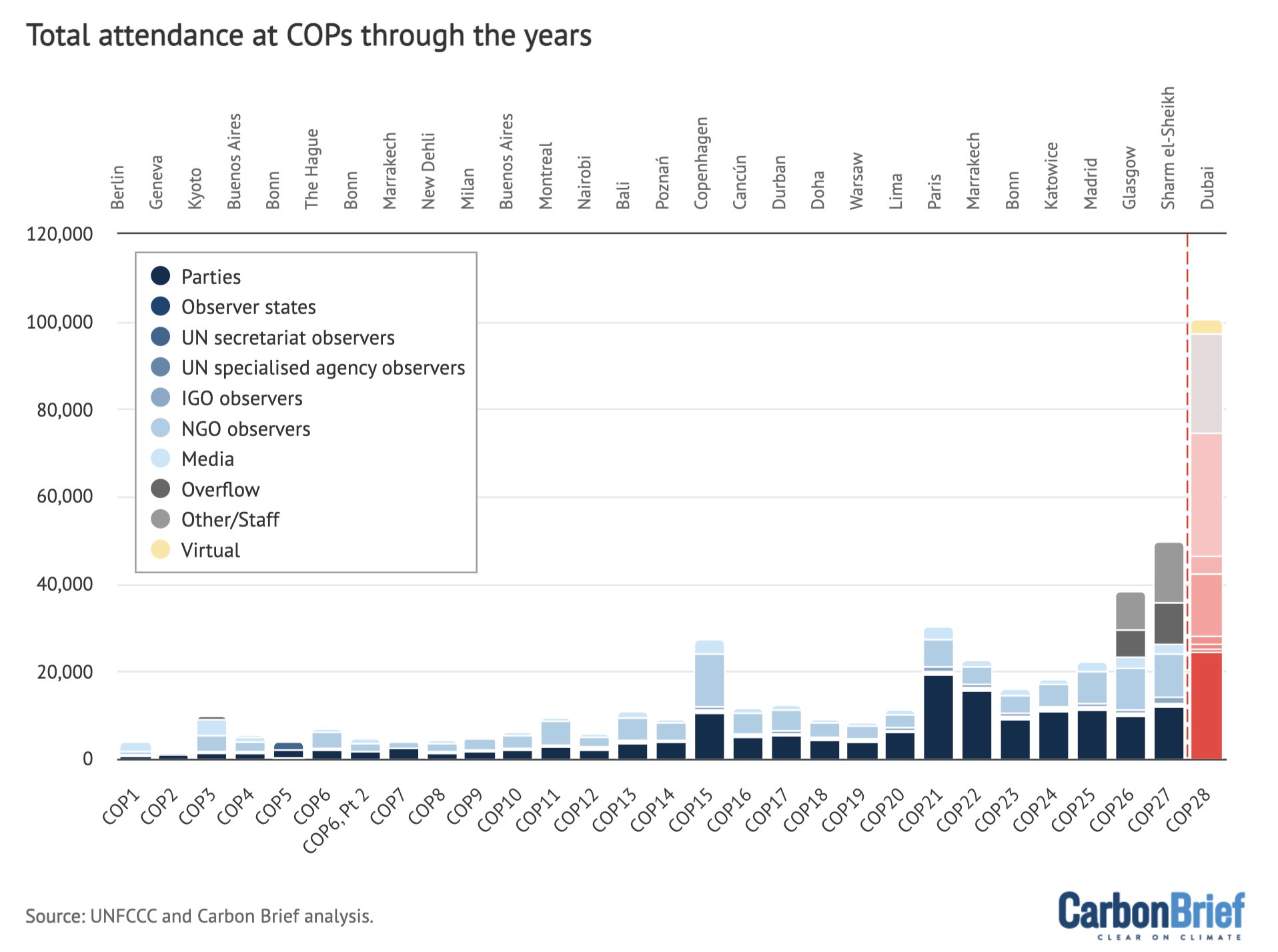
This is astonishing. Over 100,000 people are attending (and almost all flying) to the latest annual climate change conference. The numbers attending used to be 5,000 or so which was reasonable for a conference with 150+ countries represented, but now you have 100,000 people going.
You could justify the greenhouse gas emissions from those attending when it was a modest number, but with 100,000 attending the conference itself will cause more CO2 to be emitted than almost any other single event this year.
They estimate every hour of passenger flying emits 250 kgs of CO2 equivalent. Let’s assume the average flight is 12 hours each way.
250 x 24 x 100,000 = 600 million kgs of CO2 or 600,000 tonnes. That is around half the annual emissions of NZ Steel.
Liam Hehir writes:
Ponder the fact that there won’t be a story like this and wonder about why that is. It is genuinely weird, right?
Te Pāti Māori’s Crossed Guns Post Incites Online Controversy AUCKLAND – Te Pāti Māori has become embroiled in an online controversy following a social media post featuring an image of crossed guns.
The contentious post comes as the party gears up for the Nationwide Action Day, set to coincide with the opening of New Zealand’s 54th Parliament. The image, which was posted in the backdrop of the party’s call to resist the election of a National government, has received significant criticism from various corners of social media.
Critics argue that the use of such provocative and violent symbolism could potentially be misconstrued as a call for violence rather than peaceful protest. Social media platforms, including on X (formerly known as Twitter) and Facebook, have been flooded with comments voicing concerns about the meaning and implications of the graphic.
Some users worried that the use of firearms in the image were not consistent with a call to peaceful protest and could incite violence. Despite the ongoing controversy, Te Pāti Māori has yet to release an official statement addressing the concerns raised about the image. The debate continues to rage online, casting a shadow over the party’s preparations for the upcoming Nationwide Action Day.
If any other organisation or party had done posters for a protest march which included firearms on them, the media would have melted down and would have written stories condemning it, with comments from gun safety groups, radicalisation experts etc.
But once again the media have a double standard where TPM can say or do anything without criticism. They can call getting rid of 400 bureaucrats, “deliberate genocide” and they can use firearms on posters for a protest march.
I give credit to Labour’s Peeni Henare for calling them out on their extremism. But it is a reminder of how extreme a left Government would have been if they won in 2023. Instead they are threatening three years of protest because the parties that won the election are actually going to implement the policies they got elected on.
Radio NZ reports:
The principal of Te Kāpehu Whetu in Whangārei. Raewyn Tipene. said the school – which included a primary school and a secondary school – moved to the state system when charter contracts were cancelled. She said it involved a lot more bureaucracy.
“We came back to mainstream and it was horrendous. Largely it’s a different environment working in the public sector,” she said.
“It’s bureaucratic, the bureaucracy [is] amazing. The thing about partnership schools… it is one of the first times I have experienced what freedom felt like. You were given resources, you were told, ‘Here’s what you need to achieve, how you do that’s your business,’ and we overachieved.”
Tipene said the school’s enrolments and performance had dropped since it became a state school.
“Coming back to mainstream is just a nightmare, that’s probably the nicest way of putting it. An example of that would be that I get emails constantly about little bits and pieces of nothingness. Largely I ignore them because I think they’re just keeping people busy and are of no relevance to what we’re doing.”
She said an example was that the school had been talking to the ministry for five years about suitable buildings, and only recently received two buildings that were late by 12 months.
What a stark difference. My hope is that many existing state schools convert to be charter schools also and free themselves.
Radio NZ reports:
The new government has axed the $16 billion pumped hydro scheme at Lake Onslow, which had been championed by its Labour predecessors.
Energy Minister Simeon Brown said it was a wasteful project, and scrapping it was part of the new government’s plan for its first 100 days.
“This hugely wasteful project was pouring money down the drain at a time when we need to be reining in spending and focussing on rebuilding the economy and improving the lives of New Zealanders,” Brown said in a statement.
Excellent. A scheme that would have cost every household $8,000 is not what we need.
I was extremely fortunate to be in Wellington to Listen to Lord Hannan talk about the Magna Carta, equality, the Treaty and identity politics and more. It was a brilliant speech that should be seen by as many people as possible.
It will well be worth taking 30 minutes out of your day to watch it.
Stuff reports:
The cost to rebrand more than a dozen government departments, which primarily use te reo Māori names, could be “millions”, according to marketing experts.
It doesn’t need to cost anything. All people want is both the English and Te Reo names in publicity and releases so people understand what the entity is. There is no need for new logos, just a directive to include both names.
I also note that when departments decided to make their te reo name their primary name, that presumably cost money also – but did media cover that cost?
It was indeed an amazing exchange.