Who said this?

Create your own user feedback survey

Guest Post: Matthews should apologise and abstain

A guest post by Mike Knell:

Councillor Matthews should apologise for her unfounded and misleading comment about pokie players urinating on seats at a recent Wellington City Council meeting. She should also note a conflict of interest due to her one-sided, biased and misleading comments and abstain from voting at the gambling policy review to be held later this year.

Councillor Matthews’ comments and actions at this meeting, including taking selfies with Problem Gambling Foundation representatives before joining the table, are questionable behaviours from a duly elected public official.

Councillors take an oath of duty to come to the table with an open mind. Clearly, this and other misleading comments and actions illustrate a compromised and misinformed councillor pushing her own political agenda.

If councillors cannot act professionally, present information based on evidence and avoid their own personal opinions where common sense should prevail, then they should be held to public account.

Rebecca Matthews and a group of politically motivated councillors are demonizing the Class 4 fundraising model in an orchestrated manner to push their own agendas and deliberately mislead the public.

The question all ratepayers should be asking is: are these councillors really representing the local community’s voice?

Around 11,000 organisations benefit annually from the Class 4 fundraising model nationally. Many grant recipients we speak to say they certainly cannot do without the support, nor do they need or want councillors to speak on their behalf when in reality all they are doing is chasing a political career.

Wellington City’s current Class 4 gambling policy is, all in all, a fit-for-purpose approach. The existing policy achieves many outcomes and objectives of the Gambling Act. This should be applauded, not conveniently ignored.

There is no evidence that sinking lid policies have reduced the problem gambling rate in the past 15 years, which has remained static at around 0.5% of the adult population. The gambling sector pays a problem gambling levy of around $18 million per annum. On top of this, millions of dollars are invested by Class 4 societies on harm minimisation initiatives and technologies that are proven to be effective at controlling the problem.

It is naïve and misguided to believe that people are going to stop gambling because there are no longer pokie machines. As evidenced by COVID-19 responses, they will simply gamble online and on other products which do not return anywhere near the same, if any, economic benefit to their community.

Wellington City Council needs to take a balanced and factual approach to the harm and benefits from Class 4 gambling. Wellington city enjoyed the benefits from Class 4 gambling to the tune of more than $60 million over 2017 and 2018.

No one has yet come up with a sensible and practical plan B that would at least equal the contributions to the community and local economy from Class 4 gambling.

Adding tens of millions of dollars to the annual rating scheme to replace Class 4 funding will not likely be a favoured nor realistic solution for Wellington ratepayers.

We can’t stop generalisation and we shouldn’t try; what we should do is to avoid generalising incorrectly.

Mike Knell is the CE of the NZ Community Trust and the Acting Chair of the Gaming Machine Assn of NZ

The Greens top demands

The Herald reports:

He wouldn’t say what the Greens’ bottom lines in those talks were, but said a “wealth tax” was a “top priority”.

Which Labour has not ruled out. They have used weasel words to downplay it, but if it was ruled out then Ardern would use the same language as she used for Capital Gains Tax – that it will never happen while she is Prime Minister.

He would also be pushing for co-leader Marama Davidson to be a minister and suggested a Green MP hold the agriculture portfolio.

Good God. A Minister of Agriculture that hates farmers. It would be like appointing making Francis 7 from Logan’s Run the Minister for Senior Citizens.

General Debate 11 September 2020

Labour’s renewable promise just hot air

NewstalkZB reports:

Labour is promising to bring forward the Government’s 100 per cent renewable electricity generation target by five years if they are re-elected.

But to get to this ambitious target, the next government will need to spend $4 billion on an energy generation plan at the bottom of the South Island.

The Labour-led Government’s policy during this term in power was to have all of New Zealand’s electricity renewable by 2035.

But, speaking to reporters in Taupō this afternoon, Labour leader Jacinda Ardern said her party would bring that forward to 2030.

This should be filed in the same folder as Kiwibuild and Auckland Light Rail.

Under National, the share of renewable electricity did increase significantly – from 65.4% to 81.9%. That’s an increase of 16.5%. Since 2017 it has increased only a further 0.5% in two years.

As always Labour ig good on rhetoric, and bad on delivery.

Do you know the big increase since 2017? It has been coal.

In 2008 coal used for electricity was 4,515 GWh. By 2017 it had dropped to 1,133. That’s a 75% drop.

What has happened under two years of Jacinda? An 87% increase from 1,133 to 2,118.

Cigarette sales plunging

The Herald reports:

Cigarette sales are plunging faster than any time before as smokers turn to alternatives like vaping – with 410 million fewer smokes sold annually than just two years ago.

Dr Murray Laugesen, a trustee of the End Smoking NZ charity, analysed tobacco company returns that are published by the Ministry of Health and found a remarkable drop in sales.

About 2132 million cigarettes were sold last year – 193 million fewer than 2018, and following a 217 million drop the previous year.

The rate of decline from 2017 to 2019 has been about 8 per cent annually – roughly three times the rate across the first six years of the Government’s Smokefree 2025 project, started in 2011.

The trend is driven by factors including cost (a 25-pack of cigarettes was $16.39 in 2011 and is now about $41.89) and alternative products like vaping e-cigarettes

If the rate of decline has been three times greater in the last two years, that is obviously due to the greater prevalance of vaping.

“Although electronic cigarettes and heat not burn products are not perfect – the best thing is to not use any of these products at all – actually, if we were to convert our smoking epidemic into a situation of people using reduced-harm products, that would actually be a much better situation.”

Of course. Perfect is the enemy of good. Better that no one is addicted to nicotine, but if they are then vaping is 95% less harmful than smoking.

The Belarus Crisis

A good piece by Geoffrey Miller on how NZ needs to do more to condemn what is happening in Belarus with the rigged election.

There is a non trivial chance that the current regime may fall, as the protests have attracted widespread support. But there is also a non trivial chance the Government may set the armed forces on its own citizens.

This is why international pressure is critical, to try and ensure the protests don’t end up with more bloodshed.

The case for a temporary cut to GST

The Taxpayers’ Union has an excellent paper making the case that the best response to the Covid-19 economic crisis would be cutting GST from 15% to 10% temporarily. Far better than the masses of wasteful spending by the Government.

Some key points:

  • Would increase consumer spending
  • Would bring forward major purchases
  • A one off cost of $7.4 billion, if done for a year
  • Would give the average household an extra $4,700 disposable income
  • Would lead to an extra $12.9 billion of spending

Parties of both the right and left should support this. GST is a regressive tax so a temporary cut in GST would help low income households the most.

Not a bad idea

ACT announced:

“ACT would end the climate hypocrisy in Wellington by slashing taxpayer-funded flights to Parliament by 25 percent,” says ACT Leader David Seymour.

“Politicians spend a lot of time talking about climate change. MPs can take one simple action to help the planet and the taxpayer.

“Instead of preaching about the planet, politicians should lead by example when it comes to addressing climate change by committing to individual action that will have real, measurable benefits.

“Parliament has talked about putting solar panels on the roof and turning the Beehive green, but these changes would make little difference when MPs fly en masse into Wellington 30 times a year.

“Almost no other group of New Zealanders has an unlimited air travel budget. Ironically, it’s often the politicians who talk about climate change the most who report the biggest air travel expenses each quarter.

“Parliamentarians could take one simple action to help the climate and save the taxpayer significant money.

“ACT proposes to change the parliamentary calendar so that MPs sit for four days a week for 23 weeks a year, instead of three days a week for 30 weeks. “This would reduce the number of flights taken by MPs, and carbon emissions, by around 25 percent.

I like this proposal.

General Debate 10 September 2020

Guest Post: Time to change the fear narrative

A guest post by Emily Broadmore:

Throughout my twenties in parliament I learnt the importance of science-based decision making. This wasn’t just due to the logic of founding policy in evidence, but from a saleability perspective: we needed to convince the public about why we were making a decision and have a platform on which to defend ourselves if it was a total flop.

But evidence alone doesn’t sell a policy. As a communicator I am keenly aware of the power of emotive language – we pull at the heart strings, we carefully craft a call to action, we play on emotions to get the desired reaction. And there is no greater emotion than fear.

Thanks to the approach taken in New Zealand our healthcare system hasn’t been inundated with Covid-19 cases. Much of this success is due to the effective communication that bought the team of five million on board. However, alongside the shift in messaging – from flattening the curve to stamping it out – a culture of fear has bred throughout New Zealand.

This has manifested itself in the oddest ways, which over the past few months I have observed at first amusement and more recently exasperation. Neighbours not only practiced social distancing but also avoided eye contact, children share birthday cake at preschool yet morning tea is deemed a Covid-19 risk. This is as absurd as the popularity of book, toy and baking swaps that went on over Level 4, which also defied logic.

Despite the Ministry of Health lifting the Lockdown rules in line with New Zealand’s risk level, the messaging to the public has led to an acceptance of rules for rules sake. We are living in a community where rules based on fear, not science, are considered enough and questioning the logic of these rules is seen as rebellion.

The result is marginalising those in the community who respect evidence-based decision making. This is the status quo, and I do not think it is kind. Nor does it align with the can-do and curious nature that New Zealanders are known for.

Scholarly articles abound on how fear appeals have been used in relation to Covid-19. Now that a culture of fear prevails in the community it will be difficult to unwind. There is evidence that fear has a maximum value – that is, once a moderate amount of fear has been received there is no further benefit to adding more. The media could abate fear by showing perspective in the stories they choose to publish. Educate us about the latest science, don’t just whip us into a fear frenzy.

Cases of Covid-19 on the border are to be expected and will be business as usual for the distant future as we ease the borders and begin to live a new normal. Moving forward we can’t continue to be wrapped in cotton wool, isolated from the world in Covid free New Zealand. This isn’t the Nuclear Free movement. Cases in quarantine facilities shouldn’t be breaking news, flashing across the screen in a red banner. The word elimination was taken out of context from the start.

It’s time to change the messaging. And this isn’t just up to the Government – we also need a strong Opposition who isn’t afraid to challenge the status quo. The 2020 election will be a platform on which all parties can demonstrate how they plan to reopen New Zealand’s borders and unwind the culture of fear.

Sir Peter Gluckman, Rt Hon Helen Clark and Rob Fyfe asked in their July report – At what point will New Zealand accept less than absolute elimination? As they said – such a goal is likely unrealistic over a long term. Whichever government we have post-election will need to adopt new public health messaging: the type that encourages the public to face up to their fears and accept the new reality of this post-Covid-19 world.

Emily Broadmore is a Director of Heft Communications in Wellington, and previously worked in Parliament supporting MP’s and Ministers during the John Key-led National government.government.

Some good changes to Standing Orders

The next Parliament will have some changes to its Standing Orders, and as with previous reviews they are generally positive. Significant changes include:

  • A new petitions committee chaired by a presiding officer that will consider petitions and can refer them to specialist committees, or direct to Ministers for a response or even an Ombudsman
  • Transfer seven hours of debate time from the (generally pointless) Budget debate to other non-legislative business. This still leaves eight hours for the Budget debate which is more than enough.
  • Ability for select committees to have members participate remotely
  • More questioning of Ministers during committee stages of Bills by revoking the four call limit
  • Automatic introduction of a members’ bill that has 61 non-executive MPs in favour of it. This means non controversial members’ bills can bypass the ballot
  • Reduce 90 minute dinner breaks on Tuesday and Wednesday to 60 minutes so house can rise at 5 pm Thursday instead of 6 pm (very useful for flight catching)
  • Allow extended sittings on Friday morning for set topic debates or non Government business
  • Require select committees to include minority reports as of right
  • Allow questions and answers on ministerial statements

One of the more significant revisions. People often think Parliament is all about question time, but in reality a huge amount is done outside that which is constructive and useful towards improving laws and Government performance.

Under Labour everyone who earns up to $300,000 a year will pay more tax in NZ than Australia

Labour have just announced a new tax rate of 39% on incomes over $180,000. This is in contrast to Australia that has legislated to cut taxes.

Of course the 39% new tax rate is just the beginning. If they have a Labour/Green Government then they could strike a deal to implement part of the Greens’ tax agenda also.

But even with just what Labour is promising, this will see every New Zealander who earns up to and including $300,000 a year paying more income tax in New Zealand than they would in Australia.

IncomeNZAustExtra tax NZ
 $    10,000 $      1,050 $             –   $          1,050
 $    20,000 $      2,520 $          342 $          2,178
 $    30,000 $      4,270 $      2,242 $          2,028
 $    40,000 $      6,020 $      4,142 $          1,878
 $    50,000 $      8,020 $      6,592 $          1,428
 $    60,000 $    11,020 $      9,592 $          1,428
 $    70,000 $    14,020 $    12,592 $          1,428
 $    80,000 $    17,320 $    15,592 $          1,728
 $    90,000 $    20,620 $    18,592 $          2,028
 $  100,000 $    23,920 $    21,592 $          2,328
 $  110,000 $    27,220 $    24,592 $          2,628
 $  120,000 $    30,520 $    27,592 $          2,928
 $  130,000 $    33,820 $    30,592 $          3,228
 $  140,000 $    37,120 $    33,592 $          3,528
 $  150,000 $    40,420 $    36,592 $          3,828
 $  160,000 $    43,720 $    39,592 $          4,128
 $  170,000 $    47,020 $    42,592 $          4,428
 $  180,000 $    50,320 $    45,592 $          4,728
 $  190,000 $    54,220 $    48,592 $          5,628
 $  200,000 $    58,120 $    51,592 $          6,528
 $  210,000 $    62,020 $    56,092 $          5,928
 $  220,000 $    65,920 $    60,592 $          5,328
 $  230,000 $    69,820 $    65,092 $          4,728
 $  240,000 $    73,720 $    69,592 $          4,128
 $  250,000 $    77,620 $    74,092 $          3,528
 $  260,000 $    81,520 $    78,592 $          2,928
 $  270,000 $    85,420 $    83,092 $          2,328
 $  280,000 $    89,320 $    87,592 $          1,728
 $  290,000 $    93,220 $    92,092 $          1,128
 $  300,000 $    97,120 $    96,592 $             528
 $  310,000 $  101,020 $  101,092 $             (72)

A person earning $40,000 a year pays 45% more income tax in NZ than Australia. On $70,000 you are paying 11% more here than Australia and on $200,000 you are paying 13% more here than Australia.

The amount of revenue this will bring in is trivial compared to the amount of extra spending and debt Labour is incurring. So beyond doubt, if re-elected, they’ll then say they need to increases tax even more.

National on the other hand says it is unfair that inflation pushes you into a higher tax bracket even when your disposable income remains constant, so National will inflation adjust tax brackets to stop inflation pushing up your tax bill every year.

Guest Post: Housing

A guest post from a reader:

The country has painted itself into a bit of a corner.  Not everyone is able to own a house, so many have to rent a place to live. A lot of rental houses are older ones that have fallen off the bottom of being places where owners want to live.  I am not saying they are all cold and mouldy dumps … just like not all tenants are feral.  It is what  it is.

House prices are set by supply/demand and the cost/feasibility  of borrowing.  So lower deposits and mortgage interest rates mean higher house prices.  Add to that the ability to rat your tax-subsidised  Kiwisaver pension fund plus  various grants and you get relentless upward price pressure at the first home level.  Rents on the other hand are sort of tied to capital values and (of course) also influenced by what tenants can afford.  On the face of it as prices have inflated way above incomes this has created problems for both renters (rent hard to afford) and landlords (rent not generating enough return).

The sad fact is that if you are renting a house and want to buy one just like it for about the same as what you are paying in rent, you need a deposit of 40-50%.  Do the math and don’t forget rates, maintenance and insurance.  So a high LVR lets you get into paying a whole lot more per week, but at some point – looking at 10 years income to buy –  it eventually becomes sort of impossible.  It has never been easy to buy a first house, but it is only getting harder.  The “how many years income” thing just goes up and up.

As prices outpace rent growth, the rate of investment return on residential housing drops off.   This leaves a potential investor with little or no income and hanging out for the eventual capital gain. The show may be run at a cash loss for a while as the 40-50% deposit also applies if you want to buy a cash-neutral rental.  Ring-fencing the loss just makes life harder.  The corner we have been painted in to is that – generally – building houses to for income makes no sense.

None of the first-home buyer incentives lead to the building of more houses – they kick the can down the road and pour a bit more petrol on the bidding fire.  This is particularly true at the bottom end of the market – so-called “affordable” homes.   The RMA and high land prices do not help.  When Kiwibuild was announced there was a lot of noise about how prefabricated homes were going to take off and dent the price/availability problem.  There would have to be thousands of such homes under construction to have this effect.  This has not happened. 

So there are not a lot of new private sector low end houses being built, and rental houses make no sense as an income proposition. The $ profit is too low to interest many developers – why would you build a low price house on high price land?

And yet – if you drive around the country, every small or large town has significant collections of reasonably solid State houses largely built in the late 1930’s to the mid 1950’s. The bulk of them have since moved into private ownership.  One sort of wonders how it was all managed – Kiwibuild was an unsuccessful attempt to sort of replicate it.  National’s previous “Special Housing Areas” solution had been a bit of a fizzer.  

The corner just keeps getting smaller.  Unfortunately the State is the only player with the scale to do anything about it.  

Discovery buys Mediaworks TV arm

Newshub reports:

New Zealand’s largest independent commercial broadcaster MediaWorks and the global leader of real-life entertainment Discovery Inc have reached a binding agreement on the sale of MediaWorks’ free-to-air TV business.

The transaction is subject to a number of pre-completion approvals and is expected to be completed by the end of the year.

The MediaWorks TV acquisition will be Discovery’s most significant free-to-air investment in the New Zealand market to date. It includes entertainment channels Three and Bravo, streaming service ThreeNow, and multi-platform news and current affairs service Newshub, as well as the further channels Three+1, Bravo+1, The Edge TV and The Breeze TV.

Discovery will continue the existing strong partnership with NBCUniversal for the Bravo channel joint venture.

In the New Zealand market, Discovery currently operates a portfolio of six pay-TV channels including Discovery Channel, TLC, Animal Planet, Food Network, Living and Discovery Turbo and two free-to-air channels HGTV and Choice TV.

This is a great outcome. Tv3 and Newshub get an owner that is a media company, not an investment company. Discover boosts it presence here, and TV3 and Newshub get to continue.

I’ve noticed this year that Newshub has broken a huge number of exclusive stories, especially around Covid-19. We are well served by their presence.

General Debate 09 September 2020

Did James Shaw actually fund a housing development?

Stuff reports:

It’s been revealed the Taranaki Green School at the centre of a political funding row has aspirations to create an ‘eco-village’ at its Ōakura site including 20 houses.

This is news to the Green Party co-leader James Shaw, who says he knew nothing about it before granting the school nearly $12 million.

This would be funny, if it were not our money.

The school was planning to expand anyway, to 500 students. The $40,000 they charge overseas students would have funded the school expansion.

But James came along and gave them $12 million for nothing, to fund the school expansion.

This frees up $12 million from the owners, that they can use for their housing development.

The Green School also declined an interview.

In a statement, it said it had always been open about plans for the eco-village and they were not required as part of the Shovel Ready funding application.

“The plans refer to an eco-village housing area that has been in the public domain since the inception of Green School and shared openly with anyone interested in the project. It is a matter of public record.”

But there is no public record of the eco-village. It is not mentioned on the Green School website, in council documents or in previous media coverage about the school.

The school later clarified that the village has been mentioned in verbal briefings to people who have expressed an interest.

It said the development was in its early stages and would help relieve demands on rental property in Taranaki.

“There is a mix of housing available for school parents and the open market whereby they will be available for anyone looking to move into the area.

“These sustainable homes, of which there will be approximately 20, will be physically located on the other side of the road and away from the Green School campus.”

Mentioning something in a verbal briefing is not making it public.

So we’ve really given $12 million to property developers. Well done NZ Green Party.

Guest Post: Victoria is now a police state

A guest post by a reader:

The city of Melbourne has already endured one of the longest and harshest lockdowns anywhere in the world. And the lockdown has just been extended, with little hope that this will be over anytime soon. 

The Victorian Police is behaving like a hostile occupying force, with the gentle bedside manner of Imperial Stormtroopers and the sense of humour of the Stasi. Peaceful protest is illegal. The Police recently arrested a pregnant woman in her home and charged her with incitement. She now faces up to 15 years in jail for the heinous crime of promoting a peaceful protest on Facebook. Others have been forcibly masked before being wrestled to the ground and handcuffed for the crime of being out of their homes for a non-permitted reason. 

The Police has unlimited power. They can enter your home without a warrant, and they will do so without any hesitation. If you’re not quick enough opening the door, they will break it down for you. 

How could this happen in a civilised country? Why is there nobody stopping the madness? Here are some hints.    

For many years, governments have promoted the view that any means are justified to if lives are saved. How often have we heard politicians or officials say that a particularly onerous law is worth imposing if it only saves a single life. The Victorian government strategy with COVID-19 has been consistent with this: Exaggerate the risks and spread fear to justify imposing a state of emergency that gives you unlimited power. Then label any dissenter as selfish, irrational and willing to risk others’ lives. Use labels and emotive language to describe anybody who disagrees. Use force to intimidate people into compliance. Extend the state of emergency from time to time because lives are at stake. 

Civil liberties have long been treated as expendable. Protections against unreasonable search were merely an inconvenient nuisance in the way of the Police’s desire to go on fishing expeditions rather than doing the hard work. Civil liberties were easily abandoned when the Police and their sniffer dogs wanted to carry out the vital task of harassing an entire audience just in case a few teenagers could smoke a joint at an open-air concert. Now, when we really need our civil liberties, neither politicians nor the Police have any intention of upholding them. The precedent that the end justifies the means was set a long time ago. This is a slippery slope, and we are well on our way sliding to the bottom.

Finally, there is an arrogant and inappropriate culture within the Police. The Police behaves like a master, not a servant of the public. They are overtly political. They kneel in front of Black Lives Matter activists, but brutally suppress any dissent against the lockdown. They are tough on victimless crime, but soft on violent crime. They will blindly enforce the law to the hilt – as long as they like the law. 

Think this could never happen in New Zealand? You’re only slightly behind us. And don’t worry, you will catch up. 

The author is a New Zealander who has worked in Melbourne since 2012.

Revised: THE COSTS AND BENEFITS OF A COVID-19 LOCKDOWN

Martin Lally has revised his paper on the costs and benefits of a Covid-19 lockdown.

The key numbers are:

  • Eradication strategy may have saved 1,000 lives
  • The estimated number of QALY (quality adjusted life years) is 2,445
  • GDP loss is $87 billion
  • GDP loss due to lock downs rather than mitigation is $22b
  • GDP loss per QALY is $8.5 million
  • Normally a QALY is valued at $45,000
  • The cost of suppression rather than mitigation is 190 times the pre-Covid value for a QALY

This is why we need a Royal Commission into our Covid-19 response. We need the best experts to evaluate if our response was the best one available, so next time we are acting on a better information base.

Welfare numbers increasing before Covid-19

If Labour hikes taxes, Australia will gain

Luke Malpass writes:

The Labour Party is expected to release its tax policy within the next week or so. There are increasing murmurs that this could include an income tax hike for higher earners. There have been many around Labour who have always thought the cutting of the top rate to 33 per cent by John Key and Bill English was anti-progressive policy that exacerbated inequality, and should have been repealed.

But hiking the top tax rate would be a big mistake. First, in order to make it politically palatable, it would have to apply to relatively few people, which would mean it would not bring in much money.

Second, Labour has done a good job of appealing to aspirational New Zealand and those who want to get ahead. Ardern nixed a capital gains tax on this basis. NZ First wouldn’t support it and, even if it had, it would have killed Labour politically.

The other problem is a more long-term one. While current Labour MPs are very proud of Michael Cullen’s fiscal management, he unambiguously failed on one big metric under his stewardship: there was a steady and growing exodus of Kiwis to Australia that shot up to nearly 40,000 a year.

One of the things that helped change that equation during the Key years was a Kiwi economy performing better, with an overall lower tax burden. Should Labour propose to jack up the top rate again, most Kiwis will be left with salaries that are an average of 25 per cent less, and taxes that are the same or higher.

Australia already has tax cuts legislated for both 2022 and 2024. The 2024 cuts, which are admittedly a while away, will see all Australians taxed a maximum of 30 cents in the dollar up to $200,000.

If we increase taxes while Australia cuts them, then I have no doubt we will lose people to Australia. Once the Australian tax cuts are implemented, NZers will be paying more tax on all incomes up to $250,000. Here’s a table of the differences:

IncomeNZAustExtra tax NZ
 $    10,000 $    1,050 $           –   $          1,050
 $    20,000 $    2,520 $        342 $          2,178
 $    30,000 $    4,270 $    2,242 $          2,028
 $    40,000 $    6,020 $    4,142 $          1,878
 $    50,000 $    8,020 $    6,592 $          1,428
 $    60,000 $  11,020 $    9,592 $          1,428
 $    70,000 $  14,020 $  12,592 $          1,428
 $    80,000 $  17,320 $  15,592 $          1,728
 $    90,000 $  20,620 $  18,592 $          2,028
 $  100,000 $  23,920 $  21,592 $          2,328
 $  110,000 $  27,220 $  24,592 $          2,628
 $  120,000 $  30,520 $  27,592 $          2,928
 $  130,000 $  33,820 $  30,592 $          3,228
 $  140,000 $  37,120 $  33,592 $          3,528
 $  150,000 $  40,420 $  36,592 $          3,828
 $  160,000 $  43,720 $  39,592 $          4,128
 $  170,000 $  47,020 $  42,592 $          4,428
 $  180,000 $  50,320 $  45,592 $          4,728
 $  190,000 $  53,620 $  48,592 $          5,028
 $  200,000 $  56,920 $  51,592 $          5,328
 $  210,000 $  60,220 $  56,092 $          4,128
 $  220,000 $  63,520 $  60,592 $          2,928
 $  230,000 $  66,820 $  65,092 $          1,728
 $  240,000 $  70,120 $  69,592 $             528
 $  250,000 $  73,420 $  74,092 $           (672)

So someone on $160,000 a year will be paying $4,000 a year more income tax in NZ than Australia. And Jacinda and Grant want to increase that gap even more.

Yet Jacinda and Grant want to increase taxes, while Australia cuts them.

Also the median FT wage in NZ is around $60,000 and in Australia almost $80,000. So this means the median FT worker in NZ will be taking home $49,000 and in Australia around $64,500.

General Debate 08 September 2020

Labour’s answer to a recession is more costs of employers!

Newshub reports:

Labour is luring voters with the tantalising prospect of another day off making Matariki an official public holiday, but the party may not get it across the line. …

“The issue, of course, is that it’s another public holiday that employers have to pay for,” National Party leader Judith Collins said on Monday.

ACT leader David Seymour said Ardern is “in la la land”. 

“Small businesses don’t need another day off. They need this Government to take the next three years off. It just means another additional cost for businesses.”

The economy is in recession, borders may stay closed for years and Labour’s solution is to increase costs further on employers.

I’m all in favour of Matariki replacing an existing holiday such as Queen’s Birthday or Labour Day, but imposing an extra public holiday on employers is just going to punish them.

Many people don’t realise that the cost to some businesses of a public holiday isn’t just the costs of paying staff for not working, but the foregone revenue.

I used to work for a small advertising and design agency. It had around a dozen staff and the owners sometimes took home less in pay than the receptionist.

Say you have eight creative staff who normally do six chargeable hours a day at $100 an hour. That extra day’s leave means you lose around $5,000 in revenue. That would often be the entire profit for the month gone.

This policy just reminds me that almost no Labour Minister has worked in the private sector, let alone for a small business.

An interesting Topham Guerin interview

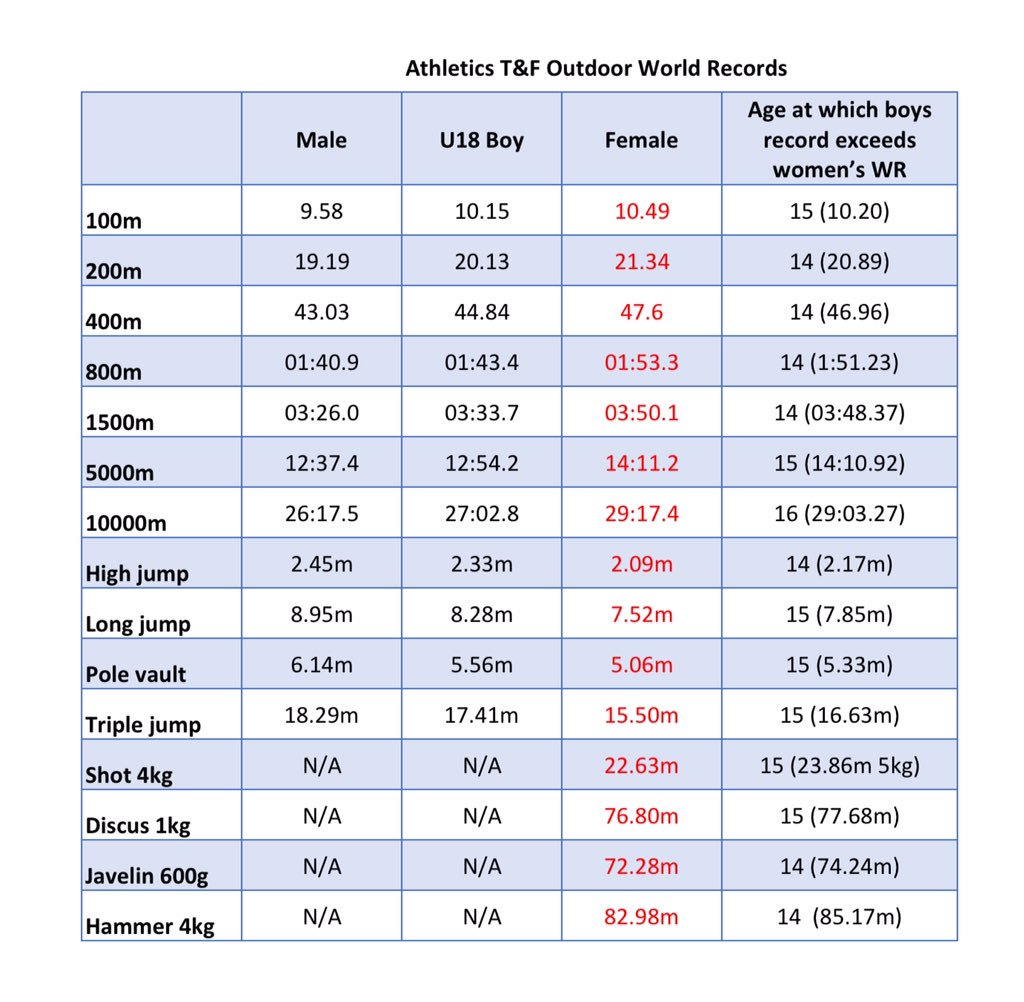
Schoolboys can beat women’s world records

I saw this on Twitter and thought it was very powerful. If you want to illustrate the huge difference biological sex makes in athletics, this shows it.

Basically top 14 to 16 year old boys can run faster or jump higher than any women in history. This is why we have different divisions for men and women.