General Debate 14 April 2021

A good bill submitted by Labour’s Louisa Wall.
It will change the law to explicitly clarify that journalists can protect their sources against government requests.
The definition used of journalist is:
a person who in the normal course of that person’s work may be given information by an informant in the expectation that the information may be published in a news medium
That would include myself as Kiwiblog is a news medium. I regularly receive information from members of the public, so it will be great to have clarified that I can protect those sources.
Green MP Julie Anne Genter is right to point out WCC has been woeful at providing safe (ie not Island Bay) cycleways over the last decade.
But as I point out the Council has been dominated by Labour and Greens for the last decade. In fact for six of those years the Mayor was from the Green Party.
So this just shows once again they are great as talking and crap at delivering.
Newsroom reports on something so farcical it should be made into a TV series:
Moreover, the Ministry said the final plan didn’t just take into account DHB expectations but also the nationwide, overarching “vaccination rollout plan“. That sounds great! Except the chart the Ministry linked to poses two problems.
First, it shows we are much farther behind than the chart Verrall pointed to. While Verrall’s chart (let’s call it Mythical Plan Chart A) said we were only expecting to vaccinate around 31,000 people last week, the “vaccination rollout plan” (hereafter known as Mythical Plan Chart B) has us vaccinating more than twice that many people every week by the start of April.
So Mythical Plan Chart A and Chart B contradict each other.
That leads into the second problem with Mythical Plan Chart B: It appears to be completely made up. When Bishop asked Covid-19 Response Minister Chris Hipkins for the data underlying the chart, so that the Opposition and media can better hold the Government’s rollout to account against its own aspirational targets, he said there were no numbers behind it. Instead, he said that Mythical Plan Chart B “is intended to be illustrative and approximate”.
So, our vaccination rollout is based on DHB expectations of how many people they’ll vaccinate, layered on top of a chart that appears to be little more than nice-looking lines drawn on a sheet of paper.
That is our vaccination plan – some nice-looking lines.
The Ministry of Health won’t give out daily vaccine data, ministers and officials can’t say what percentage of the frontline border workforce meant to be vaccinated by early March has actually been immunised and now an unvaccinated border worker has tested positive for Covid-19 and no one has any clue why.
Making it up on the fly has failed us – it’s time for the Government to give us a plan.
The Government seems weary of giving us any firm numbers, probably because they invariably fail to deliver on them.
A commenter suggested the Powerline blog for good coverage of the Chauvin trial. The blog is run by conservative lawyers in Minnesota.
Most media coverage has focused strongly on the prosecution case, while this blog details that the defence has done a good job in areas with reasonable doubt. I hope Chauvin does face punishment for his actions, but whether or not they rise to murder or even manslaughter beyond reasonable doubt is an open question.
Stuff reports:
The Māori Party has been referred to the police by the Electoral Commission after failing to declare almost $330,000 in donations to the Commission.
Any donations of over $30,000 received within a 12-month period have to declared to the Commission within 10 working days.
But three large donations to the Māori Party from 2020 were not declared until March and April 2021, well outside of that period.
Those donations were a cumulative $158,000 from John Tamihere, $120,000 from Aotearoa Te Kahu, and $49,000 from the National Urban Māori Authority.
There’s two issues here. The first is timeliness. The law states large donations must be declared within 10 working days. This allows the public prior to voting to know who is a major donor of a party. Not disclosing until months after an election almost $330,000 of donations is a serious breach and those responsible should be fined reasonably heavily.
The donation from John Tamihere is not controversial. Often party leaders donate to their parties.
The National Urban Maori Authority is a collective of local Maori authorities. Those who fund NUMA may be surprised that it in turn is funding a political party.
The real mystery is AOTEAROA TE KAHU LIMITED PARTNERSHIP. Go to the register of limited partnerships and you find they act on behalf of AOTEAROA TE KAHU GP LIMITED.
Their shareholder is ATK NOMINEES LIMITED. And their shareholder is MORRISON KENT LIMITED. It is fair to assume Morrison Kent are not the actual shareholders but are acting for someone.
So this leaves the question who actually controls and funds Aotearoa Te Kahu and made the decision to donate $120,000 to the Maori Party?
Tess McClure writes in The Guardian:
Next month will mark two years since Arden’s Labour government introduced its first “wellbeing budget”, which, rather than bowing to economic metrics such as GDP, used a much broader range of outcomes, including human health, safety and flourishing, to assess the success of policies. The move was greeted with international fanfare, and in the UK, Labour’s leadership has said it is examining similar plans.
But has the approach worked? By many measures, New Zealanders’ wellbeing is still faltering. Suicide rates have barely flickered, housing is increasingly unaffordable, progress to reduce greenhouse gas emissions is slow, and data released in recent weeks shows wait times for young people trying to access mental health care have increased since Labour’s election.
Child poverty rates also barely moved.
“It was marketing as opposed to substance,” says Arthur Grimes, former chief economist at the Reserve Bank of New Zealand, and now a professor of wellbeing and public policy at Victoria University School of Government. “But it came at a time when a number of other governments were so clearly not prioritising people’s wellbeing – stood in such sharp contrast to Britain and the US in particular – that it sort of looked like something novel and new and grand.”
Contrary to popular reporting, Grimes says New Zealand’s wellbeing budget was by no means the first in the world. He points to frameworks such as Bhutan’s Happiness Index, or the Welsh Wellbeing of Future Generations Act. More broadly, he says the words wellbeing and welfare are in essence identical in meaning – and while “wellbeing” might be a fresher arrival on the scene, welfare has long been core to the way many governments choose priorities and form legislation.
Every Budget is about wellbeing. The media fell for a slogan. And the so called living standards framework was started in 2011 by Treasury under Bill English.
A guest post by Bryan Leland:
The primary reason for high electricity prices at the moment is that nobody is responsible for ensuring that we have a reliable and economic supply. Not the Electricity Authority, not the generators, not Transpower. Not anyone.
According to the academic economists who run the market, market forces should ensure that we have a low cost, adequate and reliable supply even in a dry year. If they understood power systems they would realise that the market lacks the inducements needed to ensure that this happens.
The reality is that we have an electricity market that is not fit for purpose. An efficient market would provide a reliable supply with every new increment of generation chosen because it provides a reliable supply and minimises the long term cost of electricity to everyone.
Right now spot prices are between three and 10 times normal because the lake levels are low and we don’t have enough gas or coal-fired generating capacity. If it doesn’t rain heavily, the situation will get worse.
The existing market makes new generation investment very risky. It discourages investment in power stations that are a good long-term investment and rewards generators with prices well above the cost of generation when they have failed to provide sufficient generating capacity.
To illustrate this, in their retirement speeches, two CEOs of generating companies said that the way to make a profit in this market is to keep the system on the edge of a shortage. It follows that when a dry year comes along there is a risk of high prices and, possibly, blackouts.
During shortages the generators jack up the prices because this is the only way they can hope to affect demand. It doesn’t work for the simple reason that most consumers are on contract prices so they don’t see the price rise. The high prices severely damages many industries who buy on the spot market and cannot afford to cut back production, or like dairy companies, have no alternative but to keep on processing. Others, like the paper mill at Whakatane, simply shut up shop and put people out of work. According to the Major Electricity Users group “If the prices continue on the pathway they are on… there will be a number of major industrial operations in the country that simply won’t be in business anymore.” “We’re looking at the loss of thousands of jobs…”
In the “bad old days” the electricity industry gave early warnings to consumers about the risk of shortages so that everyone could do their bit towards reducing demand. As most people are public spirited, this worked well without any need to increase prices.
In our brave new world the government has decreed that it will respond to shortages and high prices by shutting down industries and sacrificing jobs before asking consumers to reduce consumption. So your lights stay on, but you lose your job and struggle to pay the electricity bill.
At the moment the storage lakes that should be close to full are at their lowest level in 20 years, we have a serious shortage of gas and, thanks to the ban on exploration, this will get worse. The coal-fired station at Huntly is now running flat out and it seems that the “last ditch” oil fired gas turbines at Whirinaki are being called on.
If we had a properly coordinated system steps would have been taken to ensure that sufficient energy was held in reserve in the lakes, in gas storage and in the coal stockpile to get us through. Right now the country desperately needs unusually heavy rain quite soon. NIWA is predicting average or low rainfall. If it doesn’t rain the high prices will continue. These will hurt poor people most and more industries will shut down putting more people out of work.
Assuming that nothing is done – as seems to be likely – the future outlook is that the drive to shut down fossil fuel generation and build more windfarms will exacerbate the problem of extreme price fluctuations. When the wind is blowing, prices will crash and when it stops blowing, prices will skyrocket and rotating blackouts may be needed. Prices will continue to increase.
A recent government policy is to encourage industry to shut down coal-fired boilers and turn to electric heat. Given the shortage situation, the electricity can only come from burning more coal at Huntly and for every tonne of coal industry saves Huntly will need to burn 2 1/2 tons of coal to provide the necessary electricity. And the latest is to subsidise electric cars that will also increase coal consumption at Huntly. Madness.
If this is allowed to happen, industry and commerce will have no alternative but to buy diesel generators and New Zealand will be in a third world the same situation. In Nigeria 30% of the electricity is generated by emergency diesels even though, like us, they have ample gas resources.
To get out of this mess in the short term we need to:
In the longer term, we need to:
Bryan Leyland MSc, DistFEngNZ, FIMechE, FIEE(rtd) is a Power Systems engineer with 60 years of experience in the industry in New Zealand and overseas.
Stuff reported:
Wellington Mayor Andy Foster has been accused of “delay tactics” and seeking “political cover” after he suggested a proposal to give iwi voting rights on council committees should be taken to the public.
A representative from each of Wellington’s two iwi will be given voting rights on all but one city council committee from July, after councillors voted 8-6 in favour of the proposal on Thursday.
Of course the public should be consulted. It is a major constitutional issue. Giving non-elected members votes on every Council committee is not a minor issue. Regardless of your view on it, it is arrogant to refuse to consult ratepayers on it.
Councillor Fleur Fitzsimons accused Foster of putting forward a “process delay amendment”, and ignoring the council’s treaty obligations.
She said she was not opposed to seeking public feedback because she was “too scared”, but because she was “too embarrassed”.
Can Cr Fitzsimons clearly state the clause of the Treaty that requires Iwi to have voting rights on council committees?
Councillor Jenny Condie agreed the proposal did not require formal public feedback, because it was “rectifying an injustice”.
She told Foster he was “waiting for potentially racist feedback to provide you with some political cover”.
While Cr Condie thinks you are a racist if you oppose non elected members having voting rights on council committees. Once again the term is used to denote anyone who disagrees with someone on an issue, rather than accept people can have different views in good faith.
Rebecca Matthews said seats on the council had traditionally been a “white privilege”.
WCC already has two Maori Councillors – all elected to the Council by the racist public they seem to despise.
UPDATE:

In a now deleted tweet, one Labour Councillor smears her fellow Councillors as racist because they didn’t vote to give unelected persons votes on Council committees. This shows how many on the left operate. They form a political preference on an issue, and then smear anyone who disagrees with them on the issue as racist.
Newshub reports:
Health authorities have made a sudden change to a policy about high-risk border workers after Newshub asked questions about the Ministry of Health’s testing processes.
COVID-19 Response Minister Chris Hipkins revealed to Newshub on Friday he intends to make reporting to the Government’s testing register mandatory for all border employees amid revelations it wasn’t known how many of them had been swabbed.
“All relevant employers have had a specific duty to keep records of testing since last year,” Hipkins said.
“However, last month, to make the system clearer and easier to administer, I signalled my intention to make reporting to the register mandatory for all relevant employers at the border.
Staggering that after a year of Covid-19, this had not already happened.
The Government is literally unable to tell us (or know itself) which frontline workers have or have not been tested.
Stuff reports:
The Government is set to spend far less than it promised on mental health initiatives in its 2019 Budget.
A flagship new frontline mental health service intended to keep mild and moderate patients away from hospitals had only seen $67.4 million by March – less than half the $145.3m it was due to cost by July. …
National’s mental health spokesman, Matt Doocey, who uncovered the funding situation using a written parliamentary question, said the Government was good at making announcements but bad at actually delivering on them.
This cuts to the heart of it.
Announcing funding decisions is easy. Any semi-competent person can do it.
Riding your agencies hard to make sure they deliver is difficult. It requires cunning, tenacity and experience.
Hollywood Reporter reports:
Helen Mirren is set to portray Israel’s only female prime minister Golda Meir in an upcoming biopic set during the Yom Kippur War.
Golda, from BAFTA-winning producer Michael Kuhn (Florence Foster Jenkins, The Duchess) and being directed by Oscar winner Guy Nattiv, will focus on the 1973 conflict, when Egypt, Syria, and Jordan launched a surprise attack on Israel to reclaim territory lost during the Six-Day War in 1967, and the decisions made by Meir amid infighting from her all-male cabinet. Nicholas Martin (Florence Foster Jenkins) wrote the screenplay and also produces.
An inspired choice. Mirren is perfect to play Meir.
Golda Meir is one of my political heroes. She was one of 24 signatories of the Israeli Declaration of Independence, and was issued Israel’s first passport as Ambassador to the USSR. As Minister of Housing she saw 230,000 houses and apartments built. She ordered Mossad to kill the terrorists who slaughtered the Israeli athletes at the Munich Olympics. She also presided over the winning of the 1973 Yom Kippur War which saw 10 Arab countries supported by Cuba and the USSR attack Israel without warning on their holiest day. The war lasted 19 days and saw Egypt and Syria lose 2,100 square kms of territory.
A guest post by David Garrett:
Last year marked the 80th anniversary of the end of the Battle of Britain. In the northern summer of 1940, pilots from Britain, all parts of the Commonwealth, a few Americans, and a bunch of very pissed off Poles and Czechs took to the skies over southern England to battle the Luftwaffe, which was tasked with establishing air superiority so Operation Sealion, the planned invasion of Britain, could proceed.
The story is well known: against odds of four to one, and with the assistance of radar, fighters which were at least the equal if not in some respects superior to the Germans’ – and brilliant tactical decisions by New Zealander Air Vice Marshal Keith Park, who controlled the fighter group defending London and the south of England – the Luftwaffe failed, and Operation Sealion never took place. “The few”, as Churchill memorably called them, had prevailed, and England lived to fight on until eventually joined by the Americans. The RAF lost 544 pilots in the Battle of Britain.
By September 1940, the Battle of Britain had been fought and won – but Bomber Command’s war was just beginning, and was to last until literally the last week of the war, with an attack on Hitler’s housing complex at Berchtesgaden (unfortunately Adolf wasn’t home). While the achievement of “the few” was magnificent and should indeed never be forgotten, it is sobering to note that Bomber Command lost more aircrew in one raid – 670 in a disastrous raid on Nuremberg which went horribly wrong – than in the entire Battle of Britain. In all, over 55,000 airmen in Bomber Command lost their lives, including 1800 odd New Zealanders.
Night after night, for almost five years, young men from throughout the Commonwealth climbed into bombers and flew eight or nine hours to and from targets in Germany. The comparison between a nine hour trip in a modern jet aircraft and those trips eighty years ago is so massive as to be almost incomprehensible. Aside from being in mortal peril from the time they crossed the French coast on the way out to the time they returned to their bases – some daring German night fighters even shot down bombers on their final approach to their bases in southern England – the aircraft themselves bore little resemblance to the plane that flies you to Bali, with a hot meal and free drinks.
For a start, the aircraft were unpressurized, which meant the crew needed to be on oxygen from 10,000 feet – they often bombed from as high as 25,000 feet – and temperatures dropped as low as minus 40C. In the early part of the war – before the magnificent Lancaster became available in significant numbers in early 1942 – the bombers at Bomber Command’s disposal were woefully inadequate: far too slow; under gunned, and mechanically unreliable. As many were lost as a result of mechanical failure or pilot error as were shot down by “flak” – anti- aircraft fire – or by night fighters.
In the first two years of the bomber war pilots were told they had a 30% chance of completing their 30 mission “tour” which gained them a break from operations, some leave, and a spell as instructors. In fact the odds were much worse than that – until mid 1944 they only had a 1:6 chance of survival, much longer odds than they were led to believe.
Again it is not well known that all members of Bomber Command were volunteers – and the percentage of men who “funked it” and refused to continue was tiny, about 1.5% over the course of the war. Some – perhaps most – of that determination to continue can be put down to raw courage, and the invincibility of youth; the average age of a Lancaster bomber crew was 21, meaning there were a good number of 19 year olds. But even the invincibility of youth must have been sorely challenged by seeing a crewmate have his head blown off, or to watch the remains of a rear gunner being hosed out of his turret – often the most effective means of removing him.
It must be acknowledged however that at least some of the tiny refusal to fly rate was down to the draconian treatment of those who were labeled “LMF” – Lacking Moral Fibre. Such poor bastards who just could not continue were stripped of their rank insignia and their wings in front of the whole station, and shipped off elsewhere to fulfil menial tasks such as cleaning the toilets. For some men, that disgrace must literally have been seen as a fate worse than death.
But back to the nightly “operations”. Bomber Command was led by Sir Arthur “Bomber” Harris, an irascible but extremely capable and determined man who commanded the respect of his subordinates, and after the war, when what Bomber Command had done to German cities became unfashionable, was stoutly defended if not revered by the men he had commanded. Harris attended few reunions after the war – he was understandably deeply embittered by his shabby treatment after the battle was over – but whenever he did attend, he was apparently “cheered to the echo” by the attendees.
Harris had a single fixed idea which stayed with him until the very end: that if it was done properly and for long enough, obliterating German cities and the people as well as the military targets within them, could by itself win the war without the need for a land invasion. Even Harris’s stoutest defenders now recognize that he was wrong, although it is interesting that in the immediate post war period, many former German military leaders thought Harris was right: If there had been a few more Hamburgs or Dresdens they say, Germany may have been forced to capitulate months or years before May 1945.
Post war analysis shows pretty conclusively that Harris was wrong to dismiss attacks on synthetic oil plants – by 1944 70% of Germany’s fuel was produced by such plants – as “panacea targets” which for him were simply annoyances diverting him from his real task of flattening German cities. But to state the obvious, tanks and planes cannot run if they don’t have fuel. Luftwaffe leader Adolf Galland – one of the few who stood up to Goering and Hitler – noted post war that in the latter stages, they still had plenty of planes and pilots, but almost no fuel with which to fly them. That of course was why the allies could achieve the air superiority prior to and after D Day which the Luftwaffe had failed to achieve four years earlier.
Immediately post war Harris began to be regarded as something of an embarrassment by his superiors – including his former friend and staunch supporter Winston Churchill – and within a few short years, he was regarded as a pariah. When a statue to him was finally erected in 1992, red paint was thrown over it by pacifists, and he was being labeled a war criminal, not least because of the bombing of Dresden which Churchill had promoted.
So, was the massive loss of life – many thousands more German lives were lost in one raid on Hamburg than in the entire blitz on London – and the almost complete destruction of 70% of German cities, worth it? It seems that the Germans – who were in the best position to know – thought so.
General Oberst Georg Lindeman declared unequivocally that “the reason Germany lost the war was allied air power”. General Major Kolb said that the Allied day and night bombing “forced Germany on the defensive from the middle of 1940”. Field Marshal Albert Kesselring told his captors that “allied air power was the greatest single reason for the German defeat” A tank manufacturer, Oscar Henschel, said he was able to produce only 42 Tiger tanks per month in the latter stages of the war instead of 120. He said that ‘If the bombers had kept up their attacks on my plants for two or three successive days, they would have been put out of commission for months”
(from “Tail-end Charlies”, Nicholl and Rennell, Viking, 2004).
The bomber war created other less obvious strategic advantages for the allies: the chief of them being the number of lethal German 88mm guns which had to be diverted from their primary role as tank busters to highly effective anti-aircraft guns protecting German cities. Jack Watson, a verteran of 72 bombing operations over Germany opined that:
“If the bombing campaign hadn’t been carried out D Day would have been a complete fiasco , because the stacks of 88 mm guns that were around the cities, especially Berlin, would all have been on the Atlantic wall killing our troops as they came ashore”.
It is estimated that 75% of the dual purpose 88mm guns had to be diverted to air defence. Had they been available to protect Berlin from the Russians – instead of boys and old men armed with the hand held German panzerfaust anti-tank weapon – the war would arguably have gone on for months longer.
Finally, it is important to note what a game changer the jet powered Messerschmitt 262 was – and more importantly could have been – had the plants manufacturing them and the oil plants producing their fuel had not been relentlessly bombed in the closing stages of the war.
There are numerous reports of allied airmen being stunned by attacks by aircraft flying at close to twice the speed of the long range fighters then protecting them on their raids deep in the shrinking Reich. After the war, Goering, the head of the Luftwaffe, told his interrogators that, given four or five months more, Germany would have had not only enough operational jet fighters to prevent defeat, but to win the war. But in March 1945, there just weren’t enough jets to make a difference – and there never would be, as 24 hour bombing by Bomber Command and the American Eight Air Force continued to smash the factories making them, and the oil plants necessary to power them.
So, was the bomber war – and the massive loss of life on both sides worth it? I say a resounding Yes, despite all the post war hand wringing about “area bombing”, and the creation of deadly firestorms in Hamburg and Dresden. Perhaps the position is best summed up by one old crewman who wrote of his “disgust and dismay” at reading in the newspapers:
“ groveling and sanctimonious apologia for… bombing German targets. By all means let us forgive but not forget. It was very sad to see so little mention of the mighty effort of Bomber Command in winning the war. The great exploits and victories were relegated to fifth rate skirmishes and wasted efforts directed by misguided warlords. Let the critics…the agitators and the detractors visit any military cemetery in Europe and see the profusion of headstones marked ‘Bomber Command’ ”
(Nichol and Rennell, op cit. p.405.
But was the bombing of Dresden a legitimate operation occurring as it did very late in the war, or was it tantamount to a war crime? I summarize that debate in part II.
Every MP who is not a member of the Executive can (and should) have a bill in the Members’ Ballot. There should be 92 bills in there but there are only 51. So which parties are lagging?
Basically three out of four backbench Labour MPs haven’t been able to come up with a law change they think is worth pursuing.
Prince Philip, the Duke of Edinburgh, has died aged 99. He was the longest serving regal consort in British history. They were married for 73 years.
His life has been a life of service. He will be missed.
The March 2021 Roy Morgan poll is out.
Party Vote
Seats
Direction
What should be very concerning to National is there was an 8% drop in those saying NZ is heading in the right direction, yet National also dropped 6% in the poll.
Shouldn’t over-react to one (or even two polls) but National definitely needs to make sure those voters who are losing confidence in the Government, see National as a credible alternative.
Newshub reports:
A Hamilton landlord says she has no choice but to ask a terminally ill woman and four Work and Income beneficiary families to vacate their homes following a Government crackdown on property investors.
Natasha Goodwin made the difficult decision to give tenants of her five rental properties their 90 days’ notice last month after calculating the Government’s recently announced housing changes would soon cost her tens of thousands of dollars extra a year.
Among those forced out of their homes is Anne Johnson, a woman whose rare respiratory condition is likely to end her life within the next few months – but Goodwin says she’s only breaking even, and the changes have left her with no choice.
The median house price in Hamilton is $730,000. The median rent is $440 a week or $23,000 a year or 3.1% of the median house price. But you also have costs. Typical costs might be:
So total costs of $9,000 means net income is $14,000 or 1.9% of the house price. So if you have a mortgage of 3% on 75% of the value that is a cost of $16,000 a year so you are not even breaking even.
What the Government has now done is say you have to pay tax on the $14,000 so you get a tax bill of $5,000 on the property despite the rental income not covering the costs of the property and mortgage.
Among Goodwin’s tenants is Anne Johnson, who likely has just months to live.
The 67-year-old has Churg-Strauss disorder, a rare autoimmune disease with no cure, and hypersensitivity vasculitis – the combined effects of which will ultimately end her life.
“It’s very rare and people don’t usually last more than two years,” her son Marc Bishop told Newshub. “Mum is fortunate enough to be living on borrowed time as she was diagnosed a bit over two years ago.”
Johnson has been given three months to vacate her Melville house, which she has been living in for the last year and is conveniently located within walking distance of Hamilton Hospital, where she regularly goes for treatment. …
Bishop doesn’t have any hard feelings toward Goodwin; he describes her as a “lovely young woman” and understands her rationale for selling up.
His anger is instead reserved for Grant Robertson, who he says has been spouting “verbal diarrhea” about the benefits the housing changes will bring.
A good description.
She initially bought three Hamilton units to house herself, her sister and her mother so they could all live close together, but it got to the point her mother needed something slightly bigger, so she bought her a two-bedroom unit.
She then bought another home so she could remain in close proximity to her mum, followed by a two-storey place to look after her when she was later diagnosed with cancer.
“I just thought, ‘it’s not really worth selling – I might as well rent them out if they’re going to break even’,” she remembers.
This is the case for many landlords. They break even at best.
“I don’t make anything off keeping these rentals, I break even. Especially for one of the places I’ve got – three units in Hamilton – the maintenance on it just costs a bloody fortune and it’s really not worth keeping.
“I figured if I was breaking even and housing someone then I was doing a good deed, but it’s come to the point where it’s not worth keeping these houses. It’s so stressful.”
Goodwin believes the changes should never have been made. She says if they weren’t, her tenants would be able to remain in their homes.
“I’m making five families homeless… they’re all WINZ tenants. The majority are probably going to struggle to find places as they’ve got bad credit,” she said.
And Labour wonders why the priority waiting list for homes keeps increasing.
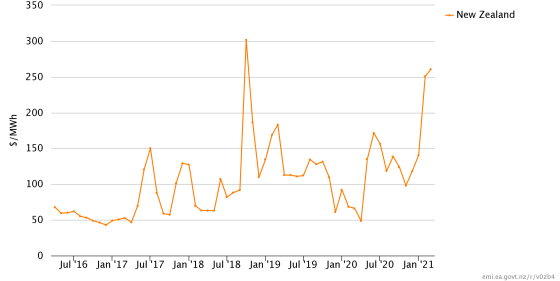
This graph is from the wholesale electricity market site. It shows what the average wholesale price has been for the last five years, by month. So it smooths out the spikes that last for a day or two.
As you can see most of 2016 and 2016 it was around $50/MWh. This is around a third of the retail price. Sometimes would spike higher to over $100.
Since mid 2018 it has consistently been over $100 except for a few months in early 2020. And in 2021 it has increased month on month to hit $250. Some daily spikes have been at $500.
So wholesale prices in 2021 are well above retail prices. So guess what that means? It is totally inevitable retail prices will soon increase, and potentially quite massively.
And this will be as a consequence of government policy. MBIE explicitly warned the Government this may happen. The Government will try and find someone else to blame such as electricity retailers or generators. Or maybe even landlords if they can make that stick. But we will know better.
The Herald reports:
A former Instagram glamour model threatened to blow up a plane from Melbourne to Auckland after demanding a glass of wine.
Hannah Lee Pierson, 31, was charged over the dramatic mid-flight disturbance on an Air New Zealand flight on November 7 last year. …
After the crew began serving food and beverage, Pierson requested a glass of wine.
But when crew told her that her ticket did not cover wine, and that she would need to buy one from the menu, she began abusing a member of the flight crew.
“I don’t give a f***, get me a f****** wine,” she yelled at the top of her voice, the summary of facts states.
She then stood up and yelled: “I’ll f****** get it myself, give me the f****** wine” and called the attendant a “b****”.
As Pierson tried to leave her seat, crew managed to divert her into a vacant row of seats and hold her there.
Pierson then grabbed a crew member’s arm in a tight grip, squeezing hard.
She began making movements with her head that caused other staff members to believe she was going to head-butt the crew member, the summary says.
Pierson continuously tried to get out of her seat, with crew especially concerned, given that she was near an emergency exit.
Several times, she then yelled: “Get me a f****** wine or I’ll blow up the plane”.
Crew handcuffed her, then strapped her to the chair using spare seatbelts.
Her tirade continued with “total disregard for the other passengers in the vicinity that included young children”.
About 90 minutes before arriving at Auckland Airport, she fell asleep.
But when she woke up on landing, she continued her verbal abuse.
After pleading guilty today, her lawyer said she intended to apply for a discharge without conviction, saying a conviction would have travel consequences.
Her behaviour should have consequences. She should not be travelling. If I had my way I’d give her 30 days in prison. Her behaviour was despicable and being drunk is no excuse. Very few people would act like she does, even if pissed.
You would generally regard having only achieved 23% of your target to be a miserable failure. But compared to most other Government failures, this almost seems like success. I mean Kiwibuild is still at under 1%.